
Top Stories
Researchers Uncover Link Between Prime Numbers and Black Holes

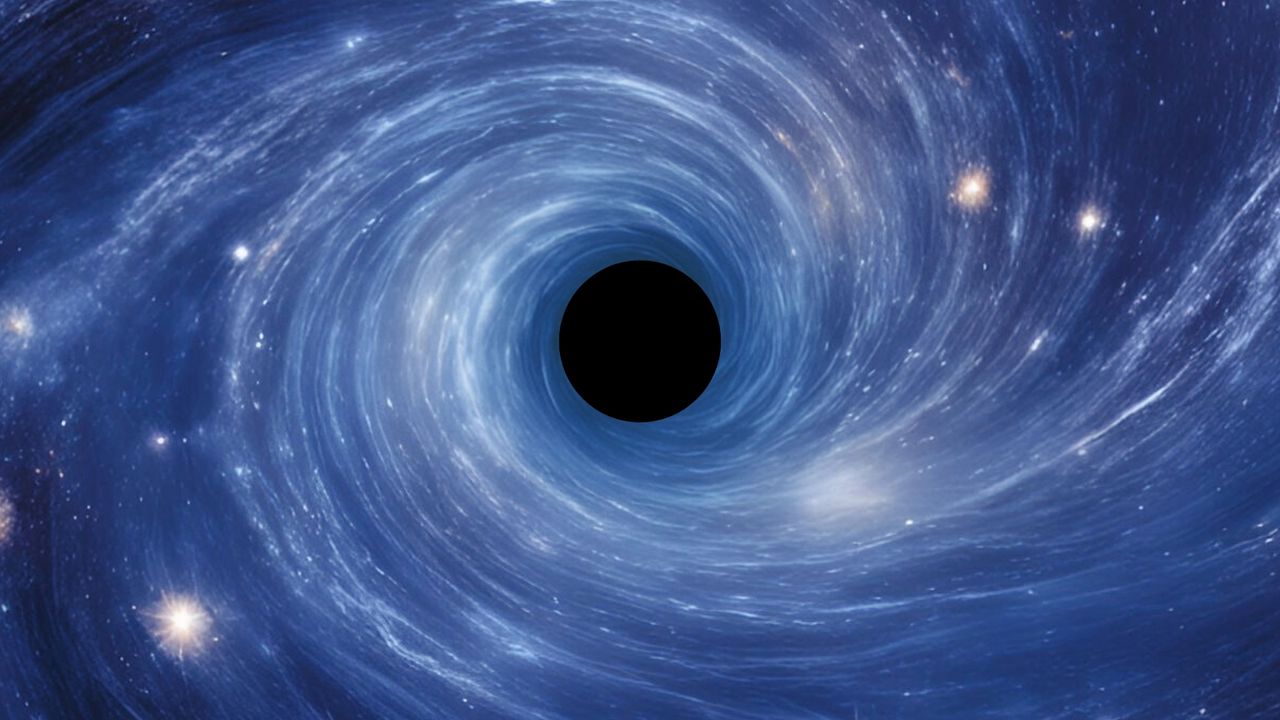
Scientists have discovered a surprising connection between prime numbers and black holes, suggesting that the fundamental truths of mathematics may play a role in understanding some of the universe’s deepest mysteries. Over the past year, researchers have explored how formulas based on prime numbers can describe certain features of black holes, potentially reshaping aspects of theoretical physics.
Mathematicians regard prime numbers as the “fundamental particles” of mathematics. These numbers cannot be broken down into smaller natural numbers, meaning they can only be divided by themselves and one. Recent investigations indicate that these mathematical constructs could offer fresh insights into the nature of black holes, regions of intense gravitational pull where classical physics breaks down.
Link Between Chaos and Prime Numbers
Black holes contain singularities, points where gravity is thought to become infinite. In the 1960s, physicists discovered a chaotic environment surrounding these singularities. Remarkably, this chaos appears to share characteristics with a similar kind of chaos identified in prime numbers. Eric Perlmutter from the Institute of Theoretical Physics at Saclay noted that many high-energy physicists may not fully understand the implications of number theory in this context.
The foundational conjecture relating to prime numbers is the Riemann hypothesis, proposed by German mathematician Bernhard Riemann in 1859. This hypothesis includes a formula that estimates the number of prime numbers less than a given value and the zeta function, which adjusts this estimate based on its zeros. The Riemann hypothesis is so pivotal that a correct proof can earn a prize of $1 million from the Clay Mathematics Institute.
In the late 1980s, physicists began to consider whether physical systems could be described using prime numbers. Bernard Julia from the École Normale Supérieure proposed a hypothetical particle, termed “primons,” with energy levels corresponding to the logarithms of prime numbers. Although initially dismissed as merely a thought experiment, the concept of primons has gained traction in light of recent discoveries.
Emerging Theories and Discoveries
In 2025, physicists Yan Fyodorov, Ghaith Hiary, and Jon Keating observed that fluctuations in the zeros of the zeta function produce fractal chaos, a phenomenon also observed near black hole singularities. This connection was further explored by Sean Hartnoll from the University of Cambridge and graduate student Ming Yang, who identified a “conformal” symmetry in the chaos close to singularities. Hartnoll described this symmetry as akin to the artwork of Dutch artist M. C. Escher, where structures repeat at different scales.
The researchers proposed that this scaling symmetry indicates a quantum system near the singularity, organizing into a “conformal primon gas cloud.” By expanding their analysis to a hypothetical five-dimensional universe, the team discovered that the dynamics of singularities necessitate the use of “complex” prime numbers, known as Gaussian primes, which include imaginary components.
Hartnoll expressed intrigue about the potential implications of prime number randomness near singularities, suggesting that these connections could extend to higher-dimensional theories of gravity. He stated, “We don’t know yet whether the appearance of prime number randomness close to a singularity has a deeper meaning.”
In a subsequent 2025 preprint, Perlmutter introduced a new framework involving the zeta zeros, broadening the approach to include not just integers but all real numbers. This adjustment could unlock more powerful techniques for understanding quantum gravity, according to physicist Jon Keating from the University of Oxford, who emphasized the value of adopting broader perspectives in tackling longstanding scientific challenges.
Perlmutter remains cautiously optimistic about the potential of these prime physics discoveries to accelerate breakthroughs in understanding black holes within the context of quantum gravity. He remarked, “The kinds of things we’re trying to understand, black holes in quantum gravity, are surely governed by some beautiful structures. Number theory seems to be a natural language.”
As research continues, the intersection of mathematics and physics may lead to profound insights into the workings of the universe, proving that even the most abstract concepts can have real-world significance.

Urgent Swatting Incident Ties Up Emergency Resources in Alabama

Urgent Tax Alert: Claim Your Deductions Before April 15!

Scientists Investigate Cosmic Defects: Where Are They Now?

Spring Bocce Leagues Open Registration in Rapid City

CALV Offers Essential Communication Class for Real Estate Pros

Samsung Galaxy Watch 9 Set for Larger 435mAh Battery Upgrade

Healthy Choice Wellness Reports Earnings, Stock Sees Uptick

Prince Harry Claims to Be ‘Antidote to Andrew’ Amid Royal Crisis

Pet Owners Weigh Kibble Against Fresh Dog Food Options

ALMA Discovers Companion Orbiting Giant Star π 1 Gruis

U.S. Visa Rescheduling Hits H‐1B Applicants as New Vetting Rules Take Effect

University of Hawaiʻi Joins $25.6M AI Project for Disaster Monitoring

F-22 Raptor vs. Su-57 Felon: A 2025 Fighter Jet Comparison

Recent Divorce Judgments from Iberia Parish Court Records

Urgent: Flight Cancellations Loom at Texas Airports Amid Shutdown

Ohio State Study Uncovers Brain Connectivity and Function Links

Frank Dunn, Esteemed Builder and Community Leader, Passes Away at 89

Appian Recognizes 2025 Partner Award Winners for Enterprise Innovation
-
 Science9 months ago
ALMA Discovers Companion Orbiting Giant Star π 1 Gruis
-
 Politics7 months ago
U.S. Visa Rescheduling Hits H‐1B Applicants as New Vetting Rules Take Effect
-
Science10 months ago
University of Hawaiʻi Joins $25.6M AI Project for Disaster Monitoring
-
 World10 months ago
F-22 Raptor vs. Su-57 Felon: A 2025 Fighter Jet Comparison
-
 Politics9 months ago
Recent Divorce Judgments from Iberia Parish Court Records
-
 Top Stories10 months ago
Urgent: Flight Cancellations Loom at Texas Airports Amid Shutdown
-
 Science10 months ago
Ohio State Study Uncovers Brain Connectivity and Function Links
-
 Lifestyle10 months ago
Frank Dunn, Esteemed Builder and Community Leader, Passes Away at 89
-
 Business9 months ago
Appian Recognizes 2025 Partner Award Winners for Enterprise Innovation
-

 World10 months ago
Prince Andrew Faces Fallout from Scandals and Allegations
-

 Entertainment8 months ago
Malachi Barton Tops Google Searches as Disney’s Rising Star of 2025
-

 Top Stories9 months ago
Republican Matt Van Epps Wins Tennessee Special Election