
Science
Researchers Unveil Method to Use Gravitational Waves to Probe Dark Matter

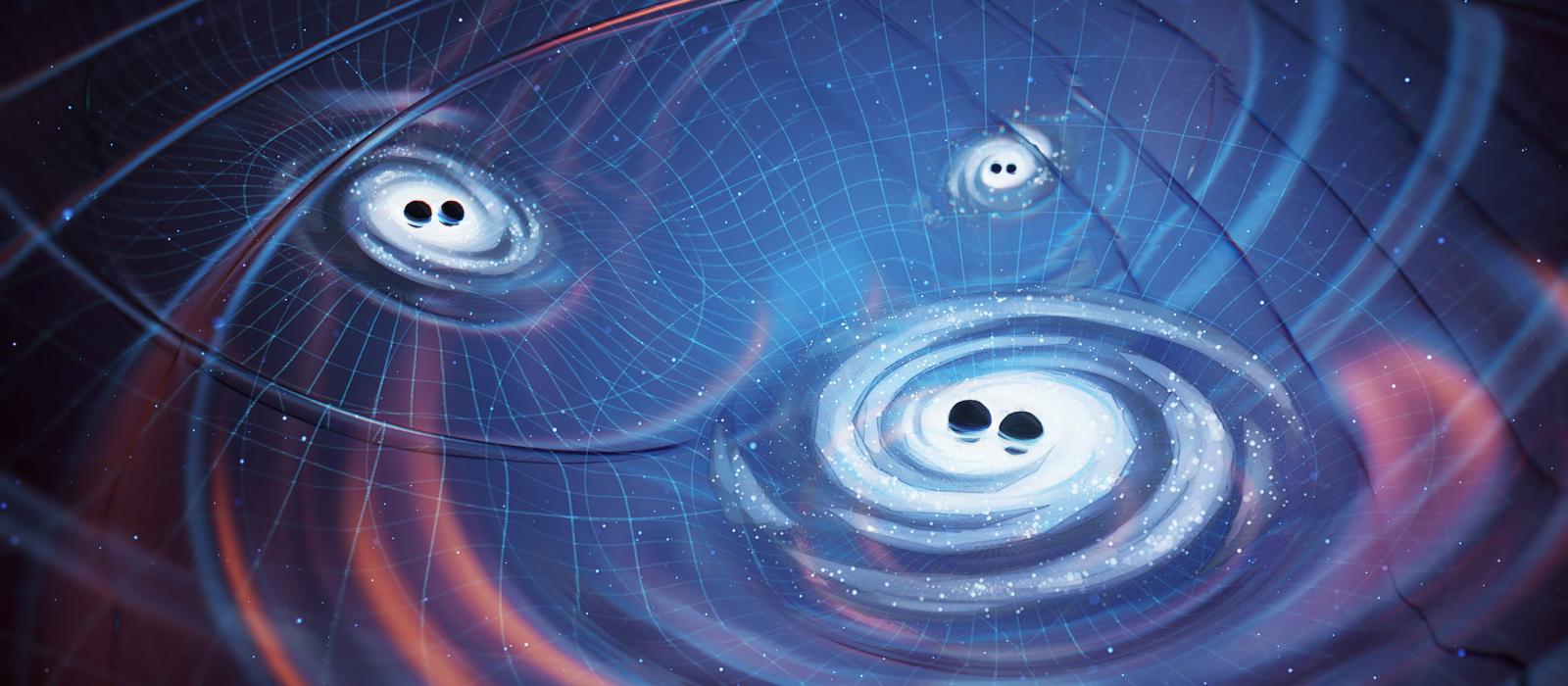
A groundbreaking study from the University of Amsterdam (UvA) proposes a novel method for using gravitational waves (GWs) to investigate the elusive nature of dark matter. This research, led by physicists Rodrigo Vicente, Theophanes K. Karydas, and Gianfranco Bertone, has the potential to enhance our understanding of one of the universe’s most enduring mysteries.
The discovery of GWs in 2015 confirmed a key prediction of Albert Einstein‘s Theory of General Relativity, marking a significant advance in astronomy. These waves occur when massive objects such as black holes or neutron stars merge, generating ripples in spacetime that can be detected across vast distances.
New Insights into Dark Matter
The research published in the journal Physical Review Letters outlines an innovative approach to modeling how dark matter interacts with GWs generated by black hole mergers. By employing next-generation instruments, scientists aim to detect the influence of dark matter, a component believed to constitute approximately 65% of the universe’s mass.
Previously, studies focused on simplified models of how black holes influence their environments. In contrast, this new research utilizes a comprehensive relativistic framework, which accounts for various cosmic conditions affecting the gravitational waves produced by extreme mass-ratio inspirals (EMRIs). These are scenarios where smaller black holes or neutron stars spiral into larger black holes, leading to significant gravitational wave emissions.
The team’s findings emphasize that dense concentrations of dark matter could form around massive black holes, creating “spikes” or “mounds” that would imprint unique signatures on gravitational wave signals. This advancement could provide astronomers with a powerful tool for mapping dark matter’s distribution throughout the universe.
Future Observations with LISA
In the coming decade, the European Space Agency (ESA) plans to launch the Laser Interferometer Space Antenna (LISA), a pioneering space observatory designed to study gravitational waves. The LISA mission, which will consist of three spacecraft configured to measure spacetime ripples using six lasers, is expected to detect over 10,000 gravitational wave signals during its operational period.
The implications of this research extend beyond theoretical exploration. It is poised to enhance our understanding of the universe’s composition and the nature of dark matter. Alongside existing detectors such as the Laser Interferometer Gravitational Wave Observatory (LIGO), the Virgo Collaboration, and the Kamioka Gravitational-wave Detector (KAGRA), LISA is set to significantly expand the horizons of gravitational wave astronomy.
As scientists continue to unravel the complexities of dark matter, this study marks a pivotal step forward, promising to shed light on the unseen elements that shape our universe. The ongoing efforts at UvA reflect a growing commitment to harnessing gravitational waves as a means to explore fundamental questions about the cosmos.

Urgent Swatting Incident Ties Up Emergency Resources in Alabama

Urgent Tax Alert: Claim Your Deductions Before April 15!

Scientists Investigate Cosmic Defects: Where Are They Now?

Spring Bocce Leagues Open Registration in Rapid City

CALV Offers Essential Communication Class for Real Estate Pros

Samsung Galaxy Watch 9 Set for Larger 435mAh Battery Upgrade

Healthy Choice Wellness Reports Earnings, Stock Sees Uptick

Prince Harry Claims to Be ‘Antidote to Andrew’ Amid Royal Crisis

Pet Owners Weigh Kibble Against Fresh Dog Food Options

ALMA Discovers Companion Orbiting Giant Star π 1 Gruis

U.S. Visa Rescheduling Hits H‐1B Applicants as New Vetting Rules Take Effect

University of Hawaiʻi Joins $25.6M AI Project for Disaster Monitoring

F-22 Raptor vs. Su-57 Felon: A 2025 Fighter Jet Comparison

Recent Divorce Judgments from Iberia Parish Court Records

Ohio State Study Uncovers Brain Connectivity and Function Links

Urgent: Flight Cancellations Loom at Texas Airports Amid Shutdown

Frank Dunn, Esteemed Builder and Community Leader, Passes Away at 89

Appian Recognizes 2025 Partner Award Winners for Enterprise Innovation
-
 Science10 months ago
ALMA Discovers Companion Orbiting Giant Star π 1 Gruis
-
 Politics8 months ago
U.S. Visa Rescheduling Hits H‐1B Applicants as New Vetting Rules Take Effect
-
Science10 months ago
University of Hawaiʻi Joins $25.6M AI Project for Disaster Monitoring
-
 World10 months ago
F-22 Raptor vs. Su-57 Felon: A 2025 Fighter Jet Comparison
-
 Politics9 months ago
Recent Divorce Judgments from Iberia Parish Court Records
-
 Science10 months ago
Ohio State Study Uncovers Brain Connectivity and Function Links
-
 Top Stories10 months ago
Urgent: Flight Cancellations Loom at Texas Airports Amid Shutdown
-
 Lifestyle10 months ago
Frank Dunn, Esteemed Builder and Community Leader, Passes Away at 89
-
 Business10 months ago
Appian Recognizes 2025 Partner Award Winners for Enterprise Innovation
-

 World10 months ago
Prince Andrew Faces Fallout from Scandals and Allegations
-

 Entertainment8 months ago
Malachi Barton Tops Google Searches as Disney’s Rising Star of 2025
-

 Top Stories9 months ago
Republican Matt Van Epps Wins Tennessee Special Election