
Science
KIST Unveils Innovative Eco-Friendly Technology for Palladium Recovery

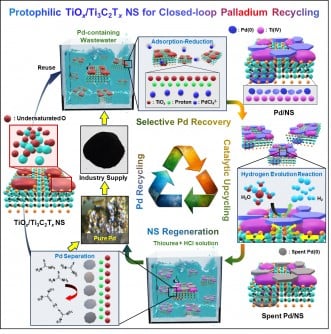
A research team at the Korea Institute of Science and Technology (KIST) has developed an eco-friendly technology for recovering palladium, a crucial metal used in various industries, including electronics and hydrogen fuel cells. This innovation addresses the growing concern over the unstable supply of palladium, as production is largely concentrated in a limited number of countries.
Palladium is highly valued for its catalytic properties, especially in small quantities. However, the traditional recovery processes are often inefficient and environmentally harmful. The KIST team, led by Dr. Jae-Woo Choi and Dr. Jin Young Kim, has created a recovery method utilizing titanium-based maxene material known as ‘TiOx/Ti3C2Tx’ nanosheets. This technology allows for the recovery of 99.9% pure palladium within just 30 minutes and operates effectively in weakly acidic environments.
The existing technologies primarily function in strongly acidic conditions, which makes them less suitable for the types of wastewater generated in most industrial settings. The new process does not require toxic chemicals or external power sources, reducing energy consumption and carbon emissions by up to 80% compared to conventional methods that rely on strong acids.
Revolutionary Features and Applications
The KIST-developed technology demonstrates remarkable adsorption performance at 1,983 mg/g and retains approximately 90% efficiency after over ten reuse cycles. This durability confirms the stability and reusability of the maxene material, making it a valuable asset in the recycling of palladium. Notably, the palladium recovered can be repurposed as a catalyst for hydrogen production, contributing to a circular resource ecosystem.
This breakthrough is particularly significant given South Korea’s annual generation of substantial amounts of electronic waste and spent catalysts, which currently often go unrecovered. The KIST team aims to refine this technology further, envisioning real-time treatment of palladium-containing wastewater in industrial contexts.
Dr. Jae-Woo Choi emphasized the importance of this innovation, stating, “This research represents a technological turning point that can contribute to the self-sufficiency of Korea’s resource circulation system.” He noted that it could significantly reduce dependence on imported precious metals.
Future Prospects and Broader Impact
KIST researchers are also exploring the potential to expand this technology to recover other precious metals, including platinum, gold, and silver. This expansion could enhance South Korea’s capabilities in precious metal recovery, fostering economic independence in this critical sector.
Dr. Jin Young Kim highlighted the versatility of the recovered palladium, noting its potential applications beyond recycling, specifically as an electrochemical electrode catalyst in hydrogen production. “We verified the potential for it to be utilized not as a ‘discarded metal,’ but as a circular resource supporting clean energy production,” he added.
The research, conducted under KIST’s Institutional Program and the Solar Panel Recycling Technology Development Project, received support from the Ministry of Science and ICT and the Ministry of Climate, Energy, and Environment. The findings were published in the prestigious journal Advanced Functional Materials, underscoring the significance of this work in advancing sustainable technology.
KIST, established in 1966 as Korea’s first government-funded research institute, continues to pursue innovative solutions to national and global challenges. With this groundbreaking technology, they are poised to make a substantial impact in the field of resource recovery and sustainability. For more information, visit KIST’s official website at https://www.kist.re.kr/eng/index.do.

Urgent Swatting Incident Ties Up Emergency Resources in Alabama

Urgent Tax Alert: Claim Your Deductions Before April 15!

Scientists Investigate Cosmic Defects: Where Are They Now?

Spring Bocce Leagues Open Registration in Rapid City

CALV Offers Essential Communication Class for Real Estate Pros

Samsung Galaxy Watch 9 Set for Larger 435mAh Battery Upgrade

Healthy Choice Wellness Reports Earnings, Stock Sees Uptick

Prince Harry Claims to Be ‘Antidote to Andrew’ Amid Royal Crisis

Pet Owners Weigh Kibble Against Fresh Dog Food Options

ALMA Discovers Companion Orbiting Giant Star π 1 Gruis

U.S. Visa Rescheduling Hits H‐1B Applicants as New Vetting Rules Take Effect

University of Hawaiʻi Joins $25.6M AI Project for Disaster Monitoring

F-22 Raptor vs. Su-57 Felon: A 2025 Fighter Jet Comparison

Recent Divorce Judgments from Iberia Parish Court Records

Urgent: Flight Cancellations Loom at Texas Airports Amid Shutdown

Ohio State Study Uncovers Brain Connectivity and Function Links

Frank Dunn, Esteemed Builder and Community Leader, Passes Away at 89

Appian Recognizes 2025 Partner Award Winners for Enterprise Innovation
-
 Science9 months ago
ALMA Discovers Companion Orbiting Giant Star π 1 Gruis
-
 Politics8 months ago
U.S. Visa Rescheduling Hits H‐1B Applicants as New Vetting Rules Take Effect
-
Science10 months ago
University of Hawaiʻi Joins $25.6M AI Project for Disaster Monitoring
-
 World10 months ago
F-22 Raptor vs. Su-57 Felon: A 2025 Fighter Jet Comparison
-
 Politics9 months ago
Recent Divorce Judgments from Iberia Parish Court Records
-
 Top Stories10 months ago
Urgent: Flight Cancellations Loom at Texas Airports Amid Shutdown
-
 Science10 months ago
Ohio State Study Uncovers Brain Connectivity and Function Links
-
 Lifestyle10 months ago
Frank Dunn, Esteemed Builder and Community Leader, Passes Away at 89
-
 Business10 months ago
Appian Recognizes 2025 Partner Award Winners for Enterprise Innovation
-

 World10 months ago
Prince Andrew Faces Fallout from Scandals and Allegations
-

 Entertainment8 months ago
Malachi Barton Tops Google Searches as Disney’s Rising Star of 2025
-

 Top Stories9 months ago
Republican Matt Van Epps Wins Tennessee Special Election