
Science
Innovative Kirigami Technique Enhances Solar Sail Navigation

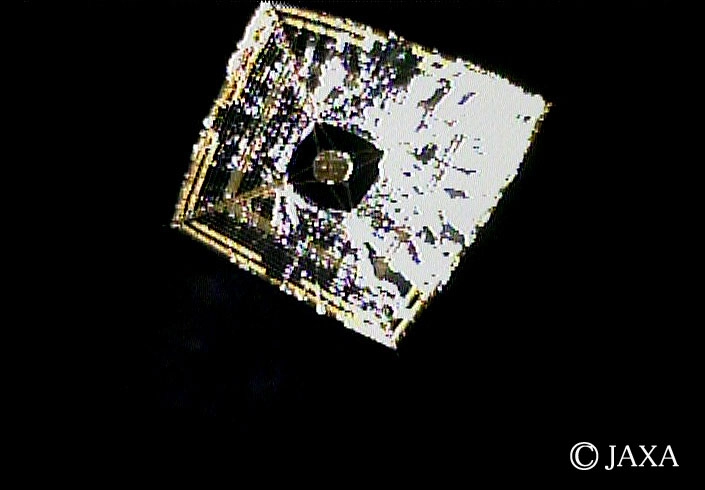
Researchers at the University of Pennsylvania have developed a groundbreaking technique to enhance the maneuverability of solar sails, a technology promising to revolutionize space propulsion. The new method, detailed in a pre-print paper by Gulzhan Aldan and Igor Bargatin, employs a technique known as kirigami, an ancient Japanese art of paper cutting, to enable solar sails to change direction without relying on traditional propellant.
Solar sails utilize sunlight for propulsion, offering significant advantages over conventional methods, primarily by eliminating the need for propellant. However, a major challenge has been their ability to turn effectively. In traditional sailing, a captain adjusts the sail’s angle to catch the wind differently, aided by a rudder. In contrast, solar sails lack this rudder mechanism, complicating their navigation in space.
The study introduces kirigami as a solution. By making deliberate cuts in the sail material, the design allows the sail to “buckle” and change shape when pulled, creating a three-dimensional surface. This transformation enables individual segments of the sail to tilt relative to incoming sunlight, functioning like numerous tiny mirrors. As light reflects off these segments, the sail is propelled in the opposite direction, thanks to the principle of conservation of momentum.
Traditional methods to control solar sails have included reaction wheels, which require propellant, and tip vanes, small mirrors that can break down easily. More sophisticated options, such as Reflectivity Control Devices (RCDs), can switch between reflective and absorptive states but consume power even when inactive. The kirigami approach, in contrast, primarily relies on electrical power for servo motors, which are known for their efficiency and only draw power during operation.
To validate their method, Aldan and Bargatin conducted simulations using COMSOL, a widely used physics simulation software. They performed a series of ray tracing experiments to measure the forces acting on the sail under various angles and conditions. Although the force was measured at a modest 1 nN per Watt of sunlight, the cumulative effect is sufficient to turn a solar sail and its payload over time.
In a practical test, the researchers cut a sail film and placed it in a test chamber where they illuminated it with a laser. By stretching the film while observing the laser’s movement across the chamber wall, the results closely matched the projected angles for each strain level.
This innovative technique could significantly reduce the energy and cost associated with turning solar sails. Nevertheless, the field remains competitive, with various other technologies vying for similar advancements. The absence of numerous experimental missions to test these technologies leaves uncertainty about when kirigami sails will be operational in space.
Ultimately, once deployed, these advanced solar sails are expected to present a stunning visual in the cosmos, marking a significant step forward in solar sailing technology.
For deeper insights, refer to the study by Aldan and Bargatin titled “Low-Power Solar Sail Control using In-Plane Forces from Tunable Buckling of Kirigami Films.”

Urgent Swatting Incident Ties Up Emergency Resources in Alabama

Urgent Tax Alert: Claim Your Deductions Before April 15!

Scientists Investigate Cosmic Defects: Where Are They Now?

Spring Bocce Leagues Open Registration in Rapid City

CALV Offers Essential Communication Class for Real Estate Pros

Samsung Galaxy Watch 9 Set for Larger 435mAh Battery Upgrade

Healthy Choice Wellness Reports Earnings, Stock Sees Uptick

Prince Harry Claims to Be ‘Antidote to Andrew’ Amid Royal Crisis

Pet Owners Weigh Kibble Against Fresh Dog Food Options

ALMA Discovers Companion Orbiting Giant Star π 1 Gruis

U.S. Visa Rescheduling Hits H‐1B Applicants as New Vetting Rules Take Effect

University of Hawaiʻi Joins $25.6M AI Project for Disaster Monitoring

F-22 Raptor vs. Su-57 Felon: A 2025 Fighter Jet Comparison

Recent Divorce Judgments from Iberia Parish Court Records

Ohio State Study Uncovers Brain Connectivity and Function Links

Prince Andrew Faces Fallout from Scandals and Allegations

Urgent: Flight Cancellations Loom at Texas Airports Amid Shutdown

Frank Dunn, Esteemed Builder and Community Leader, Passes Away at 89
-
 Science8 months ago
ALMA Discovers Companion Orbiting Giant Star π 1 Gruis
-
 Politics6 months ago
U.S. Visa Rescheduling Hits H‐1B Applicants as New Vetting Rules Take Effect
-
Science8 months ago
University of Hawaiʻi Joins $25.6M AI Project for Disaster Monitoring
-
 World8 months ago
F-22 Raptor vs. Su-57 Felon: A 2025 Fighter Jet Comparison
-
 Politics8 months ago
Recent Divorce Judgments from Iberia Parish Court Records
-
 Science9 months ago
Ohio State Study Uncovers Brain Connectivity and Function Links
-
 World8 months ago
Prince Andrew Faces Fallout from Scandals and Allegations
-
 Top Stories8 months ago
Urgent: Flight Cancellations Loom at Texas Airports Amid Shutdown
-
 Lifestyle8 months ago
Frank Dunn, Esteemed Builder and Community Leader, Passes Away at 89
-

 Business8 months ago
Appian Recognizes 2025 Partner Award Winners for Enterprise Innovation
-

 Entertainment6 months ago
Malachi Barton Tops Google Searches as Disney’s Rising Star of 2025
-
 Science9 months ago
Innovator Captures Light at 2 Billion Frames Per Second