
Science
Astronomers Uncover Evidence of Early “Monster Stars” in Universe

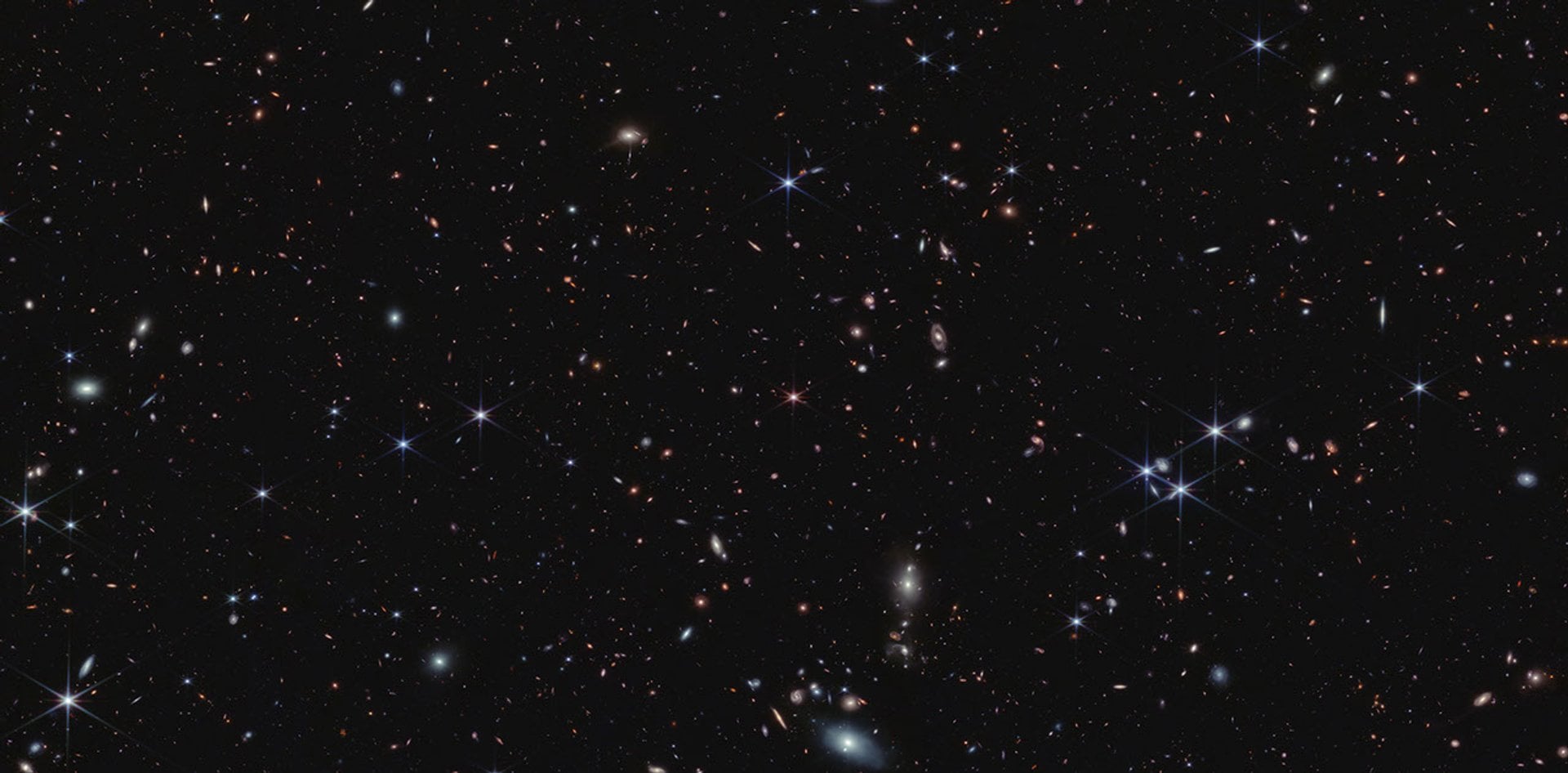
A team of astronomers has made a significant breakthrough in understanding the early universe by providing the first compelling evidence of “monster stars”—massive celestial bodies weighing between 1,000 and 10,000 solar masses. Utilizing the advanced capabilities of the James Webb Space Telescope (JWST), the researchers are challenging existing models of black hole formation and shedding light on the birth of supermassive black holes (SMBHs) shortly after the Big Bang.
New Insights into Cosmic Evolution
For over two decades, scientists have been perplexed by how SMBHs, which can weigh millions to billions of solar masses, could form less than a billion years after the Big Bang. Existing cosmological models suggest that the timescale was insufficient for typical black hole formation processes. However, recent observations indicate that these massive black holes might have originated from collapsing clouds of cosmic gas, a phenomenon referred to as direct collapse black holes (DCBHs). The alternative theory proposes that early stars, known as Population III stars, were responsible for producing these black holes.
Leading the research is Devesh Nandal, a Postdoctoral Fellow with the Swiss National Science Foundation at the University of Virginia and the Institute for Theory and Computation (ITC) at the Harvard & Smithsonian Center for Astrophysics. He collaborated with an international team that included Daniel Whalen, a Senior Lecturer in Cosmology at the University of Portsmouth, along with astrophysicist Muhammad A. Latif from United Arab Emirates University and researcher Alexander Heger from the School of Physics and Astronomy at Monash University.
Discovering GS 3073
The team focused their investigation on the galaxy GS 3073, initially identified in 2022 by Latif, Whalen, and their colleagues from various institutions including the University of Edinburgh and the University of Exeter. They discovered an unusual nitrogen-to-oxygen ratio of 0.46 in GS 3073, a ratio that could not be accounted for by any known type of star or stellar explosion.
This led the researchers to hypothesize that the first stars in the universe formed from turbulent cold gas flows a few hundred million years after the Big Bang. They also noted the presence of an actively feeding black hole at the center of GS 3073, which could potentially be a remnant of one of these massive stars. This discovery aligns with the detection of multiple quasars existing less than one billion years after the Big Bang, suggesting that SMBHs were already playing a significant role in the cosmic landscape.
“To test this theory, we modeled how stars of 1,000 to 10,000 solar masses would evolve and what chemicals they would produce,” stated Nandal in a press release from the University of Portsmouth.
The team’s modeling revealed a mechanism accounting for the observed nitrogen-to-oxygen ratio, beginning with the fusion of helium to create carbon. This carbon then combines with hydrogen to form nitrogen, which is distributed throughout the star and eventually released into space. This process continues as long as helium is fused in the core, enriching the surrounding gas cloud and ultimately leading to the observed nitrogen excess.
Importantly, the researchers found that these monster stars do not explode as supernovae at the end of their life cycles, but rather collapse directly into massive black holes, serving as the seeds for the SMBHs recognized today. They also established that the nitrogen signature is unique to stars within this specific mass range, providing further evidence for their existence.
The implications of these findings extend beyond individual stars, offering fresh insights into the universe during the period known as the Cosmic Dark Ages, a time frame between 380,000 and 1 billion years after the Big Bang. This era had remained elusive for astronomers due to the faintness of light from this period, making it challenging for conventional instruments to observe.
As the JWST continues its observations, the researchers anticipate discovering more galaxies exhibiting similar nitrogen excesses, which would facilitate further investigation into the potential existence of these monster stars. According to Whalen, this research opens up new pathways to understanding the early universe and the formation of its most massive structures.
These groundbreaking findings not only advance our knowledge of black hole formation but also enhance our understanding of the evolution of the universe itself during its formative years.

Urgent Swatting Incident Ties Up Emergency Resources in Alabama

Urgent Tax Alert: Claim Your Deductions Before April 15!

Scientists Investigate Cosmic Defects: Where Are They Now?

Spring Bocce Leagues Open Registration in Rapid City

CALV Offers Essential Communication Class for Real Estate Pros

Samsung Galaxy Watch 9 Set for Larger 435mAh Battery Upgrade

Healthy Choice Wellness Reports Earnings, Stock Sees Uptick

Prince Harry Claims to Be ‘Antidote to Andrew’ Amid Royal Crisis

Pet Owners Weigh Kibble Against Fresh Dog Food Options

ALMA Discovers Companion Orbiting Giant Star π 1 Gruis

U.S. Visa Rescheduling Hits H‐1B Applicants as New Vetting Rules Take Effect

University of Hawaiʻi Joins $25.6M AI Project for Disaster Monitoring

F-22 Raptor vs. Su-57 Felon: A 2025 Fighter Jet Comparison

Recent Divorce Judgments from Iberia Parish Court Records

Urgent: Flight Cancellations Loom at Texas Airports Amid Shutdown

Ohio State Study Uncovers Brain Connectivity and Function Links

Frank Dunn, Esteemed Builder and Community Leader, Passes Away at 89

Appian Recognizes 2025 Partner Award Winners for Enterprise Innovation
-
 Science10 months ago
ALMA Discovers Companion Orbiting Giant Star π 1 Gruis
-
 Politics8 months ago
U.S. Visa Rescheduling Hits H‐1B Applicants as New Vetting Rules Take Effect
-
Science10 months ago
University of Hawaiʻi Joins $25.6M AI Project for Disaster Monitoring
-
 World10 months ago
F-22 Raptor vs. Su-57 Felon: A 2025 Fighter Jet Comparison
-
 Politics9 months ago
Recent Divorce Judgments from Iberia Parish Court Records
-
 Top Stories10 months ago
Urgent: Flight Cancellations Loom at Texas Airports Amid Shutdown
-
 Science10 months ago
Ohio State Study Uncovers Brain Connectivity and Function Links
-
 Lifestyle10 months ago
Frank Dunn, Esteemed Builder and Community Leader, Passes Away at 89
-
 Business10 months ago
Appian Recognizes 2025 Partner Award Winners for Enterprise Innovation
-

 World10 months ago
Prince Andrew Faces Fallout from Scandals and Allegations
-

 Entertainment8 months ago
Malachi Barton Tops Google Searches as Disney’s Rising Star of 2025
-

 Top Stories9 months ago
Republican Matt Van Epps Wins Tennessee Special Election