
Science
Astronomers Discover Nickel Vapor in Interstellar Comet 3I/ATLAS

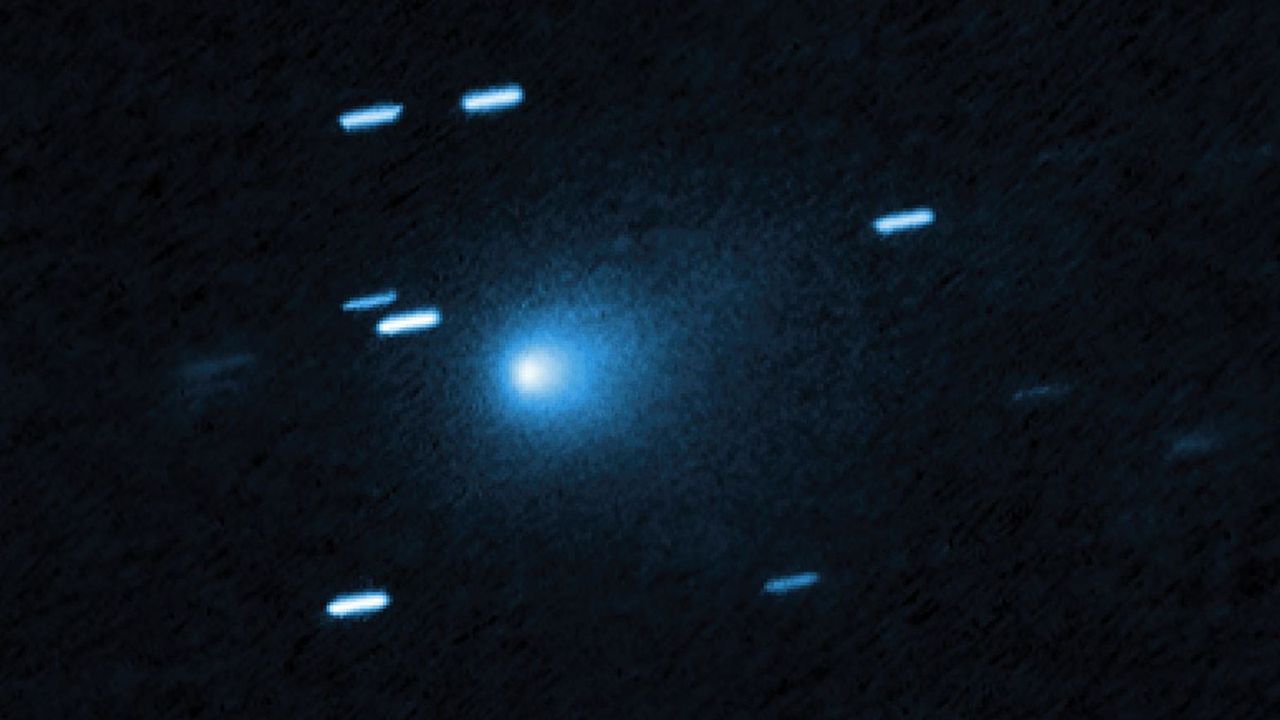
A team of astronomers has made a groundbreaking discovery involving the interstellar comet 3I/ATLAS, detecting glowing nickel vapor in its atmosphere at an astonishing distance from the sun. This finding challenges previous assumptions about the behavior of metals in cold space environments, offering insights into the chemistry of materials from beyond our solar system.
On July 1, 2025, the Asteroid Terrestrial-impact Last Alert System (ATLAS) identified 3I/ATLAS, marking it as only the third confirmed interstellar object. Unlike its predecessors, ‘Oumuamua and comet Borisov, this comet was observed early in its trajectory through the solar system, allowing astronomers a unique opportunity to study its chemical processes as it approaches the sun.
Unprecedented Observations
The international research team, including Ph.D. student Rohan Rahatgaonkar from the Instituto de Astrofísica-Pontificia Universidad Católica de Chile and Darryl Z. Seligman, an Assistant Professor of Physics and Astronomy at Michigan State University, utilized the Very Large Telescope (VLT) in Chile to observe the comet in real time. Their findings suggest that 3I/ATLAS formed billions of years ago, potentially predating our own solar system.
Initial observations revealed a fascinating sequence of chemical activation as 3I/ATLAS neared the sun. The first significant detection of nickel vapor occurred on July 20, 2025, when spectrographs recorded spectral lines at a distance of 3.88 astronomical units (AU) from the sun. This distance is nearly four times that of Earth, indicating that nickel can exist in gaseous form much further from the sun than previously thought.
As the comet continued its approach, the researchers noted a marked increase in the amount of nickel vapor. By mid-August, when the comet was about 3.07 AU from the sun, the team detected cyanogen (CN) gas, a common molecular emission found in solar system comets.
Unraveling Chemical Mysteries
One of the most intriguing aspects of this discovery is the detection of nickel without any corresponding evidence of iron, which raises questions about the processes leading to nickel’s release. The team’s findings suggest that nickel may not be sublimating directly from solid metal but could instead be released from specific molecules that break apart under solar radiation.
Potential carriers of nickel could include compounds involving carbon monoxide or other organic materials. These molecules may decompose at lower temperatures, allowing nickel atoms to escape into the comet’s atmosphere.
Further observations from the James Webb Space Telescope (JWST) complement these findings, revealing that the coma surrounding 3I/ATLAS contains a higher ratio of carbon dioxide to water than typically seen in solar system comets. This complex mixture of materials suggests a rich and varied chemical environment.
As 3I/ATLAS moves towards perihelion, its closest approach to the sun on October 29, 2025, the research team continues to gather essential data, offering valuable insights into the chemistry of interstellar materials. These observations may reveal whether the building blocks of planetary systems are consistent across the galaxy or if they exhibit significant variation due to different stellar environments.
The ongoing study of 3I/ATLAS showcases the beauty of scientific inquiry, as researchers remain open to unexpected findings that can challenge existing theories. As the comet approaches perihelion, astronomers anticipate further increases in activity and possibly the emergence of new chemical species.
The international collaboration, which includes scientists from Chile, Belgium, the UK, Canada, New Zealand, the US, and Italy, aims to unlock more secrets from this cosmic traveler before it exits the solar system, carrying with it ancient materials from a distant star system.

Urgent Swatting Incident Ties Up Emergency Resources in Alabama

Urgent Tax Alert: Claim Your Deductions Before April 15!

Scientists Investigate Cosmic Defects: Where Are They Now?

Spring Bocce Leagues Open Registration in Rapid City

CALV Offers Essential Communication Class for Real Estate Pros

Samsung Galaxy Watch 9 Set for Larger 435mAh Battery Upgrade

Healthy Choice Wellness Reports Earnings, Stock Sees Uptick

Prince Harry Claims to Be ‘Antidote to Andrew’ Amid Royal Crisis

Pet Owners Weigh Kibble Against Fresh Dog Food Options

ALMA Discovers Companion Orbiting Giant Star π 1 Gruis

U.S. Visa Rescheduling Hits H‐1B Applicants as New Vetting Rules Take Effect

University of Hawaiʻi Joins $25.6M AI Project for Disaster Monitoring

F-22 Raptor vs. Su-57 Felon: A 2025 Fighter Jet Comparison

Recent Divorce Judgments from Iberia Parish Court Records

Urgent: Flight Cancellations Loom at Texas Airports Amid Shutdown

Ohio State Study Uncovers Brain Connectivity and Function Links

Frank Dunn, Esteemed Builder and Community Leader, Passes Away at 89

Appian Recognizes 2025 Partner Award Winners for Enterprise Innovation
-
 Science9 months ago
ALMA Discovers Companion Orbiting Giant Star π 1 Gruis
-
 Politics7 months ago
U.S. Visa Rescheduling Hits H‐1B Applicants as New Vetting Rules Take Effect
-
Science10 months ago
University of Hawaiʻi Joins $25.6M AI Project for Disaster Monitoring
-
 World10 months ago
F-22 Raptor vs. Su-57 Felon: A 2025 Fighter Jet Comparison
-
 Politics9 months ago
Recent Divorce Judgments from Iberia Parish Court Records
-
 Top Stories10 months ago
Urgent: Flight Cancellations Loom at Texas Airports Amid Shutdown
-
 Science10 months ago
Ohio State Study Uncovers Brain Connectivity and Function Links
-
 Lifestyle10 months ago
Frank Dunn, Esteemed Builder and Community Leader, Passes Away at 89
-
 Business9 months ago
Appian Recognizes 2025 Partner Award Winners for Enterprise Innovation
-

 World10 months ago
Prince Andrew Faces Fallout from Scandals and Allegations
-

 Entertainment8 months ago
Malachi Barton Tops Google Searches as Disney’s Rising Star of 2025
-

 Top Stories9 months ago
Republican Matt Van Epps Wins Tennessee Special Election