
Science
Ancient Arrow Points Reveal Craft Production in Prehistoric Argentina

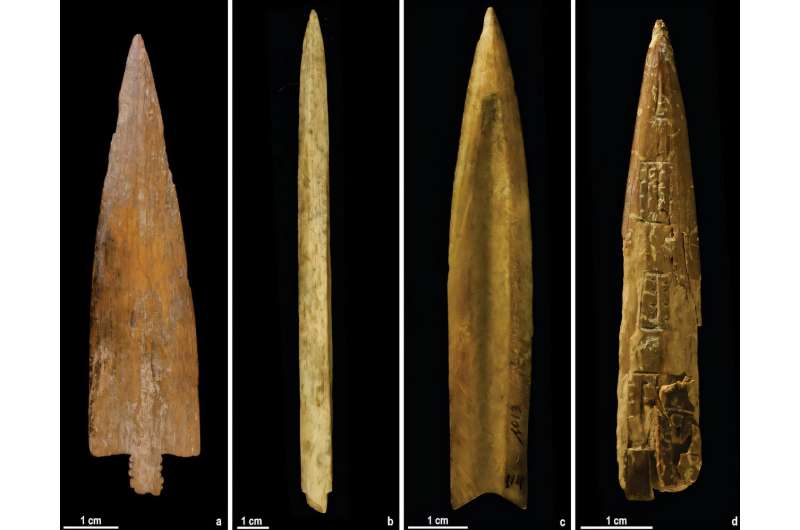
Research has unveiled significant insights into prehistoric craft production in Argentina’s Sierras de Córdoba. A study led by Dr. Matías Medina and his colleagues, Sebastián Pastor and Gisela Sario, focuses on the manufacturing techniques of bone arrow points from the Late Prehispanic Period, approximately 1220 to 330 cal BP. This research, recently published in the International Journal of Osteoarchaeology, sheds light on the sophisticated methods employed by ancient communities in this region, highlighting their organized approach to tool-making and daily life.
Understanding the Archaeological Context
For many years, the study of bone tools from the Late Prehispanic Period in Argentina was limited. The communities then practiced mixed economies, integrating hunting, gathering, and farming, which allowed for mobility and seasonal habitation. Despite the importance of bone tools in their material culture, archaeological evidence remained sparse and often overlooked.
Dr. Medina noted, “Publications dealing specifically with bone technology were, for decades, scarce, especially in South America.” Most findings were derived from site reports that offered little more than basic descriptions of worked bone assemblages. This lack of detailed analysis hindered a comprehensive understanding of these tools and their production techniques.
The recent study fills this void by focusing on 117 bone artifacts sourced from the Museo Arqueológico Numba Charava. These artifacts were collected throughout the 20th century from various sites in the southern Punilla Valley, though many lacked precise provenance. The analysis revealed that the primary material used for crafting arrow points was bone from the guanaco, a species hunted for its meat, while bones from other animals, such as pampas deer, were less common.
Manufacturing Techniques and Social Implications
The research detailed the intricate process of creating bone arrow points. Bones were typically sourced from the metapodia, the long bones of the hand and feet. The initial step involved splitting the bones lengthwise to create workable blanks, which were then flattened through grinding on abrasive stones. The final shaping into arrowheads included scraping and whittling, with some points featuring barbs and decorative elements.
Dr. Medina emphasized the rarity of decorative points, stating, “Only three bone arrow points with incised decoration on the blade were reported in the archaeological literature.” These decorations, consisting mainly of lines and small triangles, are reminiscent of styles found on other artifacts from the region, suggesting a cultural connection among the makers.
The findings indicate that these bone arrow points were likely used primarily for warfare rather than hunting. The presence of decorative elements may have served as expressions of social identity, leaving a mark of cultural affiliation on enemies during conflict.
This research not only highlights the technological sophistication of the communities in the southern Punilla Valley but also points to the transmission of knowledge within families, suggesting that tool-making skills were likely passed down through generations. This reinforces the idea that the nuclear family was the fundamental social unit responsible for food and tool production during this period.
Dr. Medina called for further comparative studies with neighboring regions, particularly the Low Paraná and Uruguay River floodplains, which are over 500 kilometers away. He stated, “A new technological comparison that accounts for stone availability and subsistence organization will offer insights into the implications of various technological alternatives.”
The study signifies a critical advancement in understanding prehistoric craft production and lays the groundwork for future research aimed at uncovering the complexities of societal organization in ancient Argentina. As the field of archaeology continues to evolve, this work serves as a catalyst for deeper exploration into the lives of those who shaped the history of the Sierras de Córdoba.

Urgent Swatting Incident Ties Up Emergency Resources in Alabama

Urgent Tax Alert: Claim Your Deductions Before April 15!

Scientists Investigate Cosmic Defects: Where Are They Now?

Spring Bocce Leagues Open Registration in Rapid City

CALV Offers Essential Communication Class for Real Estate Pros

Samsung Galaxy Watch 9 Set for Larger 435mAh Battery Upgrade

Healthy Choice Wellness Reports Earnings, Stock Sees Uptick

Prince Harry Claims to Be ‘Antidote to Andrew’ Amid Royal Crisis

Pet Owners Weigh Kibble Against Fresh Dog Food Options

ALMA Discovers Companion Orbiting Giant Star π 1 Gruis

U.S. Visa Rescheduling Hits H‐1B Applicants as New Vetting Rules Take Effect

University of Hawaiʻi Joins $25.6M AI Project for Disaster Monitoring

F-22 Raptor vs. Su-57 Felon: A 2025 Fighter Jet Comparison

Recent Divorce Judgments from Iberia Parish Court Records

Ohio State Study Uncovers Brain Connectivity and Function Links

Prince Andrew Faces Fallout from Scandals and Allegations

Urgent: Flight Cancellations Loom at Texas Airports Amid Shutdown

Frank Dunn, Esteemed Builder and Community Leader, Passes Away at 89
-
 Science8 months ago
ALMA Discovers Companion Orbiting Giant Star π 1 Gruis
-
 Politics6 months ago
U.S. Visa Rescheduling Hits H‐1B Applicants as New Vetting Rules Take Effect
-
Science8 months ago
University of Hawaiʻi Joins $25.6M AI Project for Disaster Monitoring
-
 World8 months ago
F-22 Raptor vs. Su-57 Felon: A 2025 Fighter Jet Comparison
-
 Politics8 months ago
Recent Divorce Judgments from Iberia Parish Court Records
-
 Science9 months ago
Ohio State Study Uncovers Brain Connectivity and Function Links
-
 World8 months ago
Prince Andrew Faces Fallout from Scandals and Allegations
-
 Top Stories8 months ago
Urgent: Flight Cancellations Loom at Texas Airports Amid Shutdown
-
 Lifestyle8 months ago
Frank Dunn, Esteemed Builder and Community Leader, Passes Away at 89
-

 Business8 months ago
Appian Recognizes 2025 Partner Award Winners for Enterprise Innovation
-

 Entertainment6 months ago
Malachi Barton Tops Google Searches as Disney’s Rising Star of 2025
-

 Science9 months ago
Innovator Captures Light at 2 Billion Frames Per Second