
Entertainment
“Stranger Things Explores Wormholes: Science Meets Pop Culture”

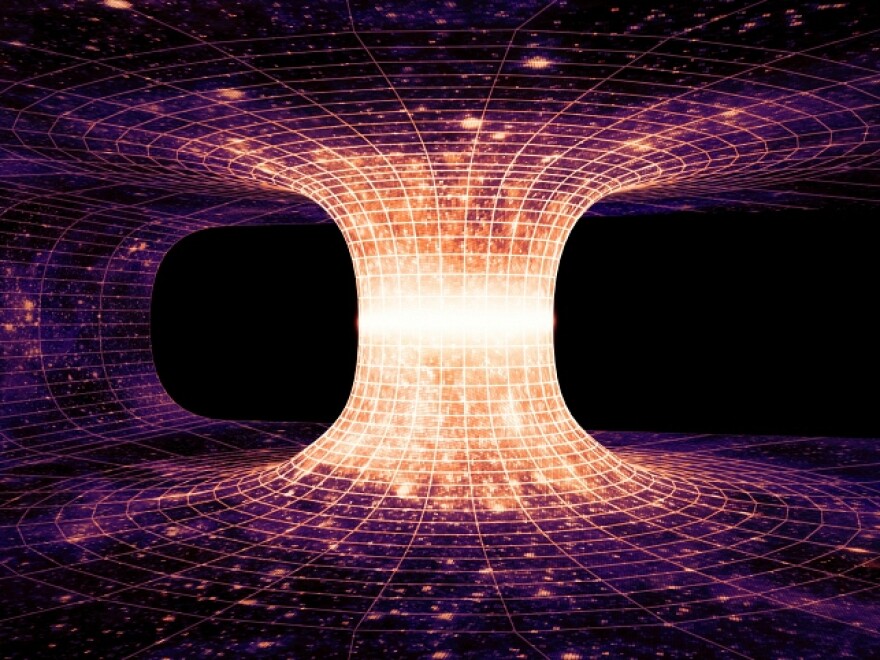
The fifth season of *Stranger Things* brings the concept of wormholes to life, sparking interest in both science and popular culture. During a classroom scene, science teacher Scott Clarke, portrayed by Randy Havens, engages his students by asking them about the significance of wormholes. His standout student, Erica, played by Priah Ferguson, eagerly responds, explaining that wormholes allow matter to traverse galaxies or dimensions without the need to cross the intervening space.
Set in the fictional town of Hawkins, Indiana, the series is a nostalgic homage to the 1980s, evoking the spirit of classic John Hughes films while intertwining it with a narrative steeped in science fiction. The origins of the wormhole concept can be traced back to the groundbreaking work of Albert Einstein. Wormholes have become a familiar trope in Hollywood, appearing in works by renowned authors and filmmakers such as Carl Sagan, *Star Trek*, and the 2014 film *Interstellar*. In the classroom scene, Clarke marvels at the possibilities, stating, “Just think of all the places mankind could go: another galaxy, another time even.”
The theoretical framework for wormholes stems from Einstein’s General Theory of Relativity, which posits that the universe is an intertwined fabric of space and time. In 1935, Einstein and physicist Nathan Rosen proposed a mathematical model suggesting that the spacetime continuum could form a tunnel connecting two distant points, termed an Einstein-Rosen bridge. This concept evolved into what is commonly known today as a wormhole. Theoretical physicist Sean Carroll, from Johns Hopkins University, emphasizes the intriguing nature of wormholes, describing them as “a hugely interesting and helpful toy model for physicists.”
While wormholes remain a theoretical construct, Carroll notes that they serve as a valuable tool for exploring scientific questions. He states, “If you travel faster than the speed of light, then there’s really no difference between traveling to the future and traveling to the past.” Despite their potential, significant challenges hinder the existence of traversable wormholes.
The intersection of hard science and pop culture has fostered a unique relationship between physics and Hollywood, particularly concerning wormholes. The term “wormhole” was popularized by physicist John Archibald Wheeler in 1957, and further public interest surged when Sagan featured them in his novel *Contact*. Carroll remarks, “The pop-culture need for a way to get across space very, very quickly has actually been a big reason why physicists talk about wormholes all the time these days.”
In 1988, physicists Kip Thorne and Michael Morris published research that examined the conditions necessary for wormholes to exist, concluding that they would require exotic forms of matter to remain open, thus making them unlikely to be traversable. Hollywood, however, continues to embrace wormholes as a narrative device. Carroll has consulted on various projects, including the 2011 film *Thor*, where a wormhole was proposed as a means for the character to travel between worlds. Interestingly, the term “Einstein-Rosen bridge” is used in the film, with a character explaining its function as a wormhole to another.
In 2022, a paper published in the journal *Nature* stirred controversy by claiming to have created a holographic wormhole using Google’s quantum computer chip, Sycamore. Critics, including mathematician Peter Woit of Columbia University, argued that the characterization of the findings could mislead the public into believing in the existence of real wormholes. Woit described the publicity campaign surrounding the research as “scientifically dubious” yet “incredibly effective.”
The impact of *Stranger Things* has extended beyond entertainment, with educators like Carsten Welsch from the University of Liverpool utilizing the series to engage students in scientific discussions. Welsch acknowledges the challenges of teaching physics, particularly to teenagers, and finds that *Stranger Things* resonates more than traditional references like *Star Wars*. He appreciates the show’s integration of scientific principles, noting that its depiction of the Upside Down serves as a near-perfect analogy for antimatter research.
The Upside Down, a parallel dimension in the series, mirrors our physical world, which Welsch describes as analogous to the relationship between particles and their antiparticles. He expresses gratitude to the creators of *Stranger Things* for incorporating scientific concepts, stating that such representations can spark curiosity and inquiry among students.
As the series unfolds, the characters demonstrate the importance of knowledge and scientific inquiry. In a pivotal moment, character Dustin, played by Gaten Matarazzo, identifies a real wormhole, highlighting the potential consequences of neglecting scientific understanding. While wormholes may not yet offer a gateway to other dimensions, Welsch hopes that the fascination they inspire can help cultivate the next generation of scientific leaders.

Urgent Swatting Incident Ties Up Emergency Resources in Alabama

Urgent Tax Alert: Claim Your Deductions Before April 15!

Scientists Investigate Cosmic Defects: Where Are They Now?

Spring Bocce Leagues Open Registration in Rapid City

CALV Offers Essential Communication Class for Real Estate Pros

Samsung Galaxy Watch 9 Set for Larger 435mAh Battery Upgrade

Healthy Choice Wellness Reports Earnings, Stock Sees Uptick

Prince Harry Claims to Be ‘Antidote to Andrew’ Amid Royal Crisis

Pet Owners Weigh Kibble Against Fresh Dog Food Options

ALMA Discovers Companion Orbiting Giant Star π 1 Gruis

U.S. Visa Rescheduling Hits H‐1B Applicants as New Vetting Rules Take Effect

University of Hawaiʻi Joins $25.6M AI Project for Disaster Monitoring

F-22 Raptor vs. Su-57 Felon: A 2025 Fighter Jet Comparison

Recent Divorce Judgments from Iberia Parish Court Records

Ohio State Study Uncovers Brain Connectivity and Function Links

Prince Andrew Faces Fallout from Scandals and Allegations

Urgent: Flight Cancellations Loom at Texas Airports Amid Shutdown

Frank Dunn, Esteemed Builder and Community Leader, Passes Away at 89
-
 Science8 months ago
ALMA Discovers Companion Orbiting Giant Star π 1 Gruis
-
 Politics6 months ago
U.S. Visa Rescheduling Hits H‐1B Applicants as New Vetting Rules Take Effect
-
Science8 months ago
University of Hawaiʻi Joins $25.6M AI Project for Disaster Monitoring
-
 World8 months ago
F-22 Raptor vs. Su-57 Felon: A 2025 Fighter Jet Comparison
-
 Politics8 months ago
Recent Divorce Judgments from Iberia Parish Court Records
-
 Science8 months ago
Ohio State Study Uncovers Brain Connectivity and Function Links
-
 World8 months ago
Prince Andrew Faces Fallout from Scandals and Allegations
-
 Top Stories8 months ago
Urgent: Flight Cancellations Loom at Texas Airports Amid Shutdown
-
 Lifestyle8 months ago
Frank Dunn, Esteemed Builder and Community Leader, Passes Away at 89
-

 Business8 months ago
Appian Recognizes 2025 Partner Award Winners for Enterprise Innovation
-

 Entertainment6 months ago
Malachi Barton Tops Google Searches as Disney’s Rising Star of 2025
-

 Science9 months ago
Innovator Captures Light at 2 Billion Frames Per Second