
Science
Researchers Unveil Carbon-Free Heating Tech for Steel Production

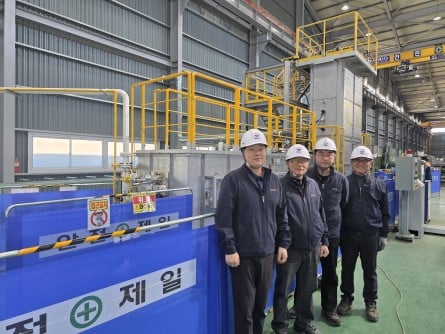
Researchers at the Korea Institute of Energy Research (KIER), led by Dr. Hookyung Lee, have introduced a groundbreaking electrified heat treatment technology. This innovative system replaces fossil fuels with electricity in the metal heat treatment process, particularly in the production of galvanized steel strips used in automobiles and household appliances. The technology aims to support decarbonization efforts across energy-intensive industries, aligning with national greenhouse gas reduction targets for 2035.
The South Korean government has intensified initiatives to decarbonize industrial processes, including the push for electrification. As a result, industries such as steel are facing increasing pressure to adopt new technologies. Notably, the industrial sector aims to achieve a 31% reduction in emissions from 2018 levels through various measures, including the electrification of processes and the production of low-carbon products.
Innovative Technology Tackles Emissions
The conventional process for producing galvanized steel strips involves a continuous galvanizing line (CGL), where steel plates are submerged in molten zinc. This process requires an annealing step, which typically uses fossil fuels like natural gas for heating. Consequently, the steel industry, along with zinc manufacturing, contributes to approximately 15% of South Korea’s total greenhouse gas emissions.
To combat these emissions, Dr. Lee’s team has developed a “carbon-free annealing system” that operates entirely on electricity. By substituting the traditional burners in annealing furnaces with electric heating elements, the technology has demonstrated remarkable results. Testing under conditions similar to commercial production revealed a reduction of carbon dioxide and nitrogen oxides in exhaust gases by more than 98%.
The new system maintains the refractory structure and conveying mechanisms of conventional furnaces while integrating electric elements positioned above and below the steel strip. This design facilitates rapid and uniform heating through high-temperature radiant heat, significantly minimizing heat loss to the furnace walls.
When the system was applied to anneal steel strips measuring 0.49 millimeters at a temperature of 750°C, the quality of the output matched that of traditional methods. The results confirm that significant reductions in carbon emissions can occur without compromising productivity or product quality.
Broader Implications for the Industry
The electric annealing furnace eliminates the need for fuel and air supply systems, which are essential for combustion-based systems. This shift potentially reduces capital investment costs and installation space by about 40%. Furthermore, when powered by renewable energy sources such as wind and solar, the technology could enable a truly carbon-free heat treatment process. This capability positions the technology as an effective response to global environmental regulations, including the Carbon Border Adjustment Mechanism (CBAM), which imposes additional carbon costs on imported goods.
Dr. Lee emphasized the significance of this development, stating, “This demonstration is the world’s first case to show that carbon-free heating can be achieved simply by replacing burners with electric heating elements.” He further indicated plans to enhance the technology into an AI-based design and operation system, which will automatically optimize heating element configurations based on various factors like steel strip width, thickness, and speed. This advancement aims to create an export-ready carbon-free heating solution, linking it to commercial-scale demonstrations with domestic steelmakers and international markets.
The findings of this research were published in September 2025 in the journal Applied Thermal Engineering, a respected publication in the field of energy and thermal engineering. The project received support from South Korea’s Ministry of Trade, Industry and Energy, with demonstrations conducted in collaboration with Samwoo Eco Co., Ltd..
This new electrification technology represents a significant step forward in reducing the environmental impact of the steel industry, showing that innovative approaches can lead to both sustainability and efficiency.

Urgent Swatting Incident Ties Up Emergency Resources in Alabama

Urgent Tax Alert: Claim Your Deductions Before April 15!

Scientists Investigate Cosmic Defects: Where Are They Now?

Spring Bocce Leagues Open Registration in Rapid City

CALV Offers Essential Communication Class for Real Estate Pros

Samsung Galaxy Watch 9 Set for Larger 435mAh Battery Upgrade

Healthy Choice Wellness Reports Earnings, Stock Sees Uptick

Prince Harry Claims to Be ‘Antidote to Andrew’ Amid Royal Crisis

Pet Owners Weigh Kibble Against Fresh Dog Food Options

ALMA Discovers Companion Orbiting Giant Star π 1 Gruis

U.S. Visa Rescheduling Hits H‐1B Applicants as New Vetting Rules Take Effect

University of Hawaiʻi Joins $25.6M AI Project for Disaster Monitoring

F-22 Raptor vs. Su-57 Felon: A 2025 Fighter Jet Comparison

Recent Divorce Judgments from Iberia Parish Court Records

Ohio State Study Uncovers Brain Connectivity and Function Links

Prince Andrew Faces Fallout from Scandals and Allegations

Urgent: Flight Cancellations Loom at Texas Airports Amid Shutdown

Frank Dunn, Esteemed Builder and Community Leader, Passes Away at 89
-
 Science8 months ago
ALMA Discovers Companion Orbiting Giant Star π 1 Gruis
-
 Politics6 months ago
U.S. Visa Rescheduling Hits H‐1B Applicants as New Vetting Rules Take Effect
-
Science8 months ago
University of Hawaiʻi Joins $25.6M AI Project for Disaster Monitoring
-
 World8 months ago
F-22 Raptor vs. Su-57 Felon: A 2025 Fighter Jet Comparison
-
 Politics8 months ago
Recent Divorce Judgments from Iberia Parish Court Records
-
 Science9 months ago
Ohio State Study Uncovers Brain Connectivity and Function Links
-
 World8 months ago
Prince Andrew Faces Fallout from Scandals and Allegations
-
 Top Stories8 months ago
Urgent: Flight Cancellations Loom at Texas Airports Amid Shutdown
-
 Lifestyle8 months ago
Frank Dunn, Esteemed Builder and Community Leader, Passes Away at 89
-

 Business8 months ago
Appian Recognizes 2025 Partner Award Winners for Enterprise Innovation
-

 Entertainment6 months ago
Malachi Barton Tops Google Searches as Disney’s Rising Star of 2025
-

 Science9 months ago
Innovator Captures Light at 2 Billion Frames Per Second