
Science
Cosmic Rays from Nearby Supernova Illuminate Earth-like Planet Origins

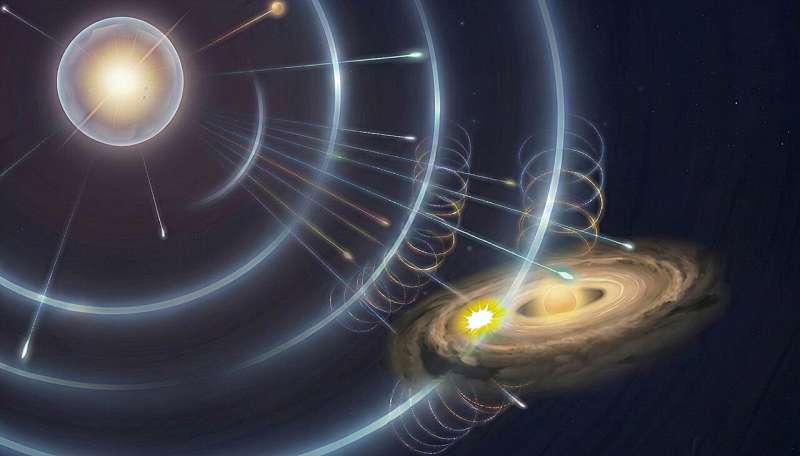
Recent research suggests that cosmic rays generated by nearby supernovae may play a crucial role in explaining the formation of Earth-like planets. This new perspective, put forth by a team led by astrophysicist Ryo Sawada from the Institute for Cosmic Ray Research at the University of Tokyo, challenges long-held beliefs regarding the conditions necessary for the creation of rocky planets such as Earth.
For years, scientists have posited that the early solar system was enriched with short-lived radioactive elements, particularly aluminum-26, through the explosion of a supernova. These elements contributed significantly to the heating of young planetesimals, leading to the loss of water and other volatile materials essential for the emergence of rocky planets. However, this theory hinged on a rare event—namely, the specific distance and timing of a supernova explosion that would allow the radioactive material to enrich the solar system without causing destruction.
In the study published in Science Advances on December 21, 2025, Sawada and his colleagues propose a more universal mechanism. They argue that rather than relying solely on direct material injection from a supernova, the young solar system may have been enveloped in a “cosmic-ray bath.” This scenario posits that the shock waves from supernovae create high-energy particles, known as cosmic rays, that can trigger nuclear reactions within the protosolar disk. These reactions naturally produce radioactive elements, including aluminum-26, at distances more typical of star clusters.
The team found that sufficient amounts of these radioactive elements could be generated at a distance of about one parsec from a supernova explosion. This distance is common within star clusters, suggesting that the conditions necessary for forming Earth-like planets could be more prevalent than previously thought. The findings indicate that instead of an extraordinary coincidence, the formation of the solar system may have resulted from existing in a stellar nursery alongside a massive star that later exploded.
This research has broader implications for the understanding of planetary formation and habitability. If cosmic-ray immersion is a common occurrence, then the conditions that shaped Earth could arise in many environments with sun-like stars. Conversely, if the birth of Earth depended solely on rare supernova encounters, then the existence of water-depleted rocky planets might be exceptional.
Sawada emphasizes the interconnected nature of astrophysical processes, noting that phenomena typically studied within high-energy astrophysics can have significant implications for planetary science. This study illustrates that sometimes the answers to complex questions lie not in adding complexity but in reevaluating what has been overlooked.
The research does not claim that supernovae guarantee the formation of every habitable planet, as many factors still influence planetary environments. Nonetheless, it provides a fresh perspective on the origins of Earth-like planets and highlights the importance of cosmic-ray interactions in shaping planetary systems.
This work underscores the need for continued exploration of how violent astrophysical events influence the evolution of planetary systems, offering valuable insights into the conditions that may foster life beyond Earth.

Urgent Swatting Incident Ties Up Emergency Resources in Alabama

Urgent Tax Alert: Claim Your Deductions Before April 15!

Scientists Investigate Cosmic Defects: Where Are They Now?

Spring Bocce Leagues Open Registration in Rapid City

CALV Offers Essential Communication Class for Real Estate Pros

Samsung Galaxy Watch 9 Set for Larger 435mAh Battery Upgrade

Healthy Choice Wellness Reports Earnings, Stock Sees Uptick

Prince Harry Claims to Be ‘Antidote to Andrew’ Amid Royal Crisis

Pet Owners Weigh Kibble Against Fresh Dog Food Options

ALMA Discovers Companion Orbiting Giant Star π 1 Gruis

U.S. Visa Rescheduling Hits H‐1B Applicants as New Vetting Rules Take Effect

University of Hawaiʻi Joins $25.6M AI Project for Disaster Monitoring

F-22 Raptor vs. Su-57 Felon: A 2025 Fighter Jet Comparison

Recent Divorce Judgments from Iberia Parish Court Records

Urgent: Flight Cancellations Loom at Texas Airports Amid Shutdown

Ohio State Study Uncovers Brain Connectivity and Function Links

Frank Dunn, Esteemed Builder and Community Leader, Passes Away at 89

Appian Recognizes 2025 Partner Award Winners for Enterprise Innovation
-
 Science9 months ago
ALMA Discovers Companion Orbiting Giant Star π 1 Gruis
-
 Politics8 months ago
U.S. Visa Rescheduling Hits H‐1B Applicants as New Vetting Rules Take Effect
-
Science10 months ago
University of Hawaiʻi Joins $25.6M AI Project for Disaster Monitoring
-
 World10 months ago
F-22 Raptor vs. Su-57 Felon: A 2025 Fighter Jet Comparison
-
 Politics9 months ago
Recent Divorce Judgments from Iberia Parish Court Records
-
 Top Stories10 months ago
Urgent: Flight Cancellations Loom at Texas Airports Amid Shutdown
-
 Science10 months ago
Ohio State Study Uncovers Brain Connectivity and Function Links
-
 Lifestyle10 months ago
Frank Dunn, Esteemed Builder and Community Leader, Passes Away at 89
-
 Business10 months ago
Appian Recognizes 2025 Partner Award Winners for Enterprise Innovation
-

 World10 months ago
Prince Andrew Faces Fallout from Scandals and Allegations
-

 Entertainment8 months ago
Malachi Barton Tops Google Searches as Disney’s Rising Star of 2025
-

 Top Stories9 months ago
Republican Matt Van Epps Wins Tennessee Special Election