
World
Iran Rejects Broader U.S. Talks as Trump Signals Military Boost

Iran has stated it is open to negotiating with the United States regarding its nuclear program, yet firmly excluded the possibility of broader discussions. This development arises amid heightened tensions as U.S. President Donald Trump hinted at the potential deployment of a second aircraft carrier to the Middle East. The diplomatic landscape is particularly sensitive, with Trump scheduled to meet with Israeli Prime Minister Benjamin Netanyahu later today.
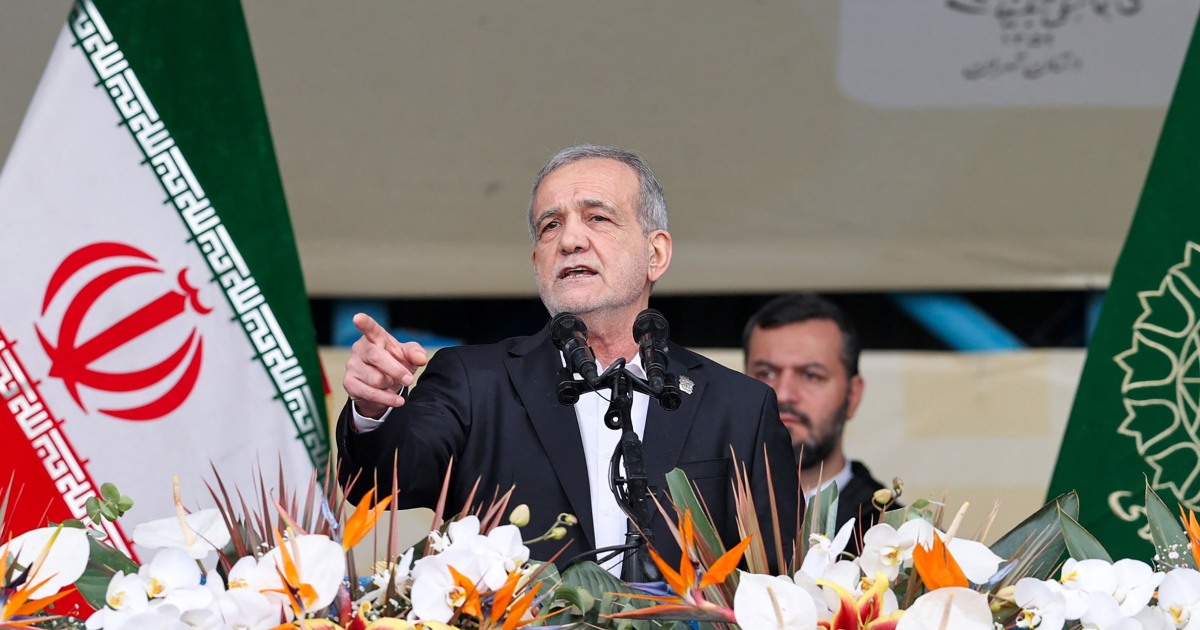
In a speech on February 10, 2024, during the 47th anniversary of the Islamic Revolution, Iranian President Masoud Pezeshkian asserted, “We are not seeking nuclear weapons and we are ready for any kind of verification.” His comments reflect a desire for dialogue, yet they also underscore Iran’s insistence on not discussing its ballistic missile capabilities, which Tehran considers a red line.
The backdrop of this dialogue is marked by significant unrest within Iran, where the death toll from recent protests has reportedly reached nearly 7,000, according to the U.S.-based Human Rights Activists News Agency. This figure contrasts with the Iranian government’s official count of 3,117 deaths reported last month. The Human Rights Activists News Agency claims to verify each death through a network of activists on the ground.
Trump’s administration has been ramping up military presence in the region, positioning forces capable of both supporting potential strikes and exerting pressure during negotiations. On February 9, Trump indicated that if discussions with Iran do not yield results, he may send a second carrier group to the Persian Gulf, joining the already deployed USS Abraham Lincoln. “We have an armada that is heading there, and another one might be going,” Trump stated in an interview with Axios. He emphasized that time is “running out” for Tehran to negotiate a “fair and equitable deal.”
Iranian officials have expressed their readiness for self-defense, elevating fears of a broader regional conflict. Foreign Minister Abbas Aragchi stated on Sunday that there was “no other option but to negotiate” with the United States, framing the urgency of the situation.
The upcoming discussions between Trump and Netanyahu will likely center not only on Iran’s nuclear ambitions but also its missile program and support for regional groups such as Hamas and Hezbollah. Netanyahu’s visit, originally scheduled for later in February, was expedited following a recent round of U.S.-Iran talks in Oman.
Trump described it as a “no-brainer” for any agreement to encompass Iran’s nuclear program, yet he expressed the need to include discussions on Iran’s substantial ballistic missile arsenal. Iranian officials have categorically rejected negotiations over their missile capabilities, which are among the largest in the Middle East. Ali Shamkhani, an advisor to Iran’s Supreme Leader Ayatollah Ali Khamenei, reiterated this position, stating that Iran’s missile capabilities are non-negotiable, as reported by the state-run news agency IRNA.
As tensions escalate, both sides face significant pressure to navigate the complex dynamics of diplomacy, military readiness, and internal unrest. The outcome of these discussions could have profound implications for regional stability and international relations.

Urgent Swatting Incident Ties Up Emergency Resources in Alabama

Urgent Tax Alert: Claim Your Deductions Before April 15!

Scientists Investigate Cosmic Defects: Where Are They Now?

Spring Bocce Leagues Open Registration in Rapid City

CALV Offers Essential Communication Class for Real Estate Pros

Samsung Galaxy Watch 9 Set for Larger 435mAh Battery Upgrade

Healthy Choice Wellness Reports Earnings, Stock Sees Uptick

Prince Harry Claims to Be ‘Antidote to Andrew’ Amid Royal Crisis

Pet Owners Weigh Kibble Against Fresh Dog Food Options

ALMA Discovers Companion Orbiting Giant Star π 1 Gruis

U.S. Visa Rescheduling Hits H‐1B Applicants as New Vetting Rules Take Effect

University of Hawaiʻi Joins $25.6M AI Project for Disaster Monitoring

F-22 Raptor vs. Su-57 Felon: A 2025 Fighter Jet Comparison

Recent Divorce Judgments from Iberia Parish Court Records

Ohio State Study Uncovers Brain Connectivity and Function Links

Urgent: Flight Cancellations Loom at Texas Airports Amid Shutdown

Frank Dunn, Esteemed Builder and Community Leader, Passes Away at 89

Prince Andrew Faces Fallout from Scandals and Allegations
-
 Science9 months ago
ALMA Discovers Companion Orbiting Giant Star π 1 Gruis
-
 Politics7 months ago
U.S. Visa Rescheduling Hits H‐1B Applicants as New Vetting Rules Take Effect
-
Science9 months ago
University of Hawaiʻi Joins $25.6M AI Project for Disaster Monitoring
-
 World9 months ago
F-22 Raptor vs. Su-57 Felon: A 2025 Fighter Jet Comparison
-
 Politics9 months ago
Recent Divorce Judgments from Iberia Parish Court Records
-
 Science9 months ago
Ohio State Study Uncovers Brain Connectivity and Function Links
-
 Top Stories9 months ago
Urgent: Flight Cancellations Loom at Texas Airports Amid Shutdown
-
 Lifestyle9 months ago
Frank Dunn, Esteemed Builder and Community Leader, Passes Away at 89
-
 World9 months ago
Prince Andrew Faces Fallout from Scandals and Allegations
-

 Business9 months ago
Appian Recognizes 2025 Partner Award Winners for Enterprise Innovation
-

 Entertainment7 months ago
Malachi Barton Tops Google Searches as Disney’s Rising Star of 2025
-

 Top Stories8 months ago
Republican Matt Van Epps Wins Tennessee Special Election