
World
Buddhist Monks Complete 2,300-Mile Peace Walk, Critique Trump’s Initiative

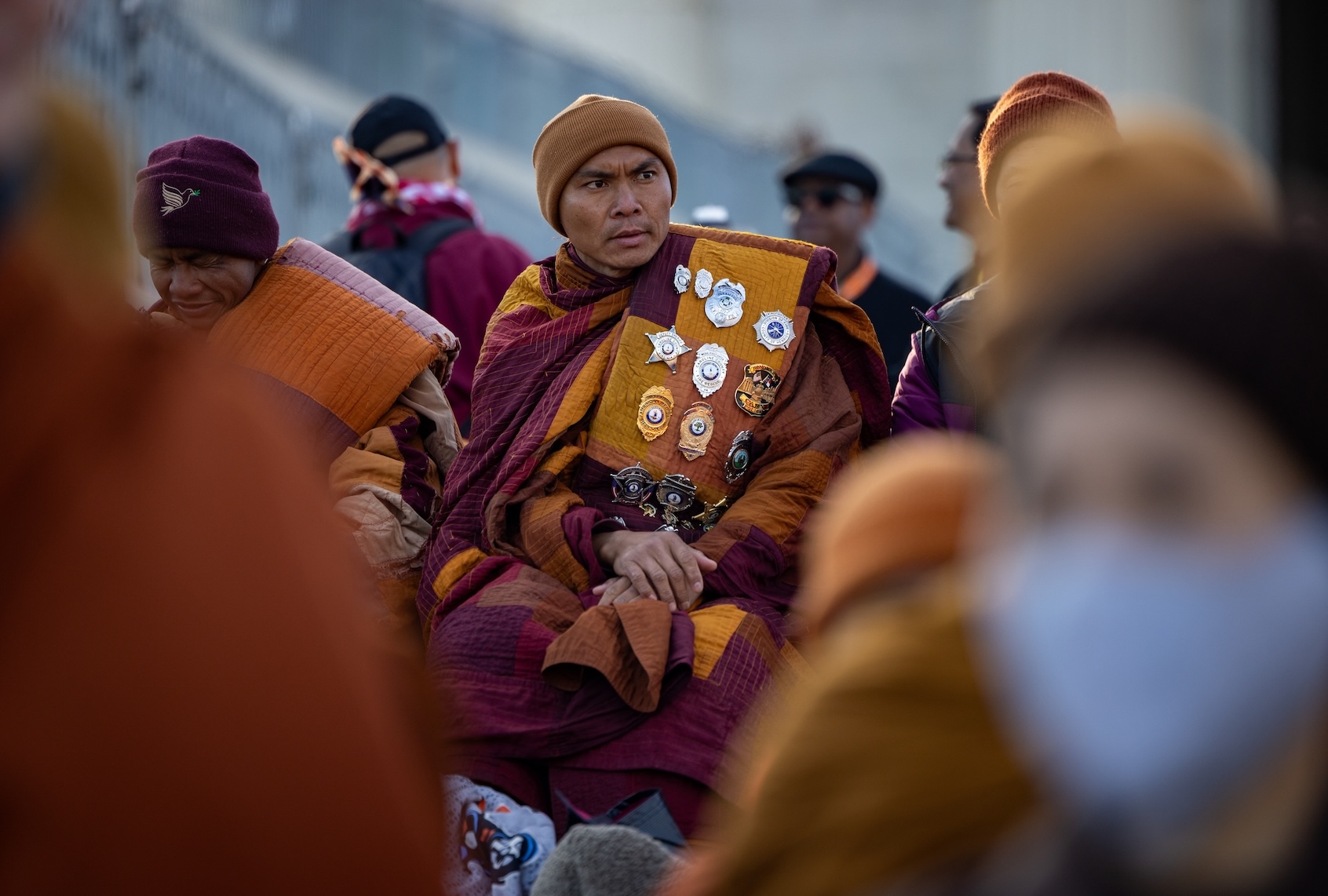
A group of 19 Buddhist monks has completed a significant 2,300-mile peace walk from Fort Worth, Texas, to Washington, D.C. This arduous journey, which spanned 108 days and crossed seven states, aimed to promote mindfulness and peace amid increasing global turmoil. Led by the Venerable Bhikkhu Paññākāra, the monks attracted considerable attention, drawing thousands of admirers along the way.
The pilgrimage concluded this week in Washington, where approximately 3,500 people gathered to hear the monks speak. Many attendees welcomed the monks with silence and reverence, a stark contrast to the noise of contemporary conflicts. “My hope is, when this walk ends, the people we met will continue practicing mindfulness and find peace,” Bhikkhu Paññākāra stated during the final leg of the journey. The monks faced challenges, including a tragic incident in Texas where two members were struck by a vehicle, resulting in the amputation of one monk’s leg.
Contrasting Ideals: Monks’ Peace Walk vs. Trump’s “Board of Peace”
While the monks’ peaceful mission captured hearts, a contrasting narrative unfolded in the political arena with the launch of former President Donald Trump‘s “Board of Peace.” Officially joined by the Israeli government this week, the initiative has been met with skepticism, particularly among many Western democracies that have opted not to participate.
The “Board of Peace” emerged during negotiations for a ceasefire in Gaza, following the violent conflicts that escalated after the October 7, 2023 attacks by Hamas. The ongoing situation in Gaza has drawn condemnation from various human rights organizations, including Amnesty International, which have described Israel’s response as disproportionate and harmful to civilians. Reports indicate that over 73,000 Palestinians and 2,000 Israelis have died since the conflict reignited, raising serious questions about the validity of Trump’s peace efforts.
Critics argue that Trump’s initiative represents a troubling redefinition of peace, characterized more by political maneuvering than genuine resolution. “Today’s ceremony marking the establishment of the so-called global ‘Board of Peace’ lays bare a brazen disregard for international law and human rights,” Amnesty International remarked earlier this year.
The Broader Implications of Trump’s Peace Agenda
The so-called peace board has attracted a mix of nations, including Kosovo, Egypt, Armenia, and Pakistan. However, the legitimacy of these countries, many of which lack democratic governance, raises further concerns about the initiative’s true intentions. Critics describe it as a low-rent version of the United Nations Security Council, with Trump positioned as its unelected head indefinitely.
Trump’s foreign policy claims have come under scrutiny, with assertions that he has “ended” multiple conflicts often seen as exaggerated. For instance, the brief war between Israel and Iran last year was labeled as a conflict he resolved, despite ongoing tensions in the region. The Pentagon’s recent positioning of U.S. military assets near Iran suggests that the situation remains volatile.
The implications of Trump’s initiatives extend beyond international conflicts. His administration has been criticized for fostering a more militarized approach to domestic security, with agencies like ICE and DHS adopting measures reminiscent of oppressive regimes. The increasing militarization of American policing has sparked public outcry, leading many to question the validity of peace when it is enforced through violence.
In contrast, the monks’ journey underscores an essential truth: peace resides within individuals and communities rather than at the hands of political figures. As Bhikkhu Paññākāra emphasized, “to unlock that box and free it” is crucial for fostering genuine peace.
While political grandstanding may dominate headlines, the heartfelt mission of the monks resonates deeply in a society yearning for tranquility. As they walked, barefoot and in single file, the monks not only promoted peace but challenged the definitions and practices of it in an increasingly chaotic world.
The stark differences between the monks’ mission and Trump’s political maneuvers highlight a broader conversation about the nature of peace, the role of leadership, and the necessity of grassroots movements in an era marked by conflict and division. As the world reflects on these contrasting paths, the call for inner peace and genuine reconciliation remains ever more urgent.

Urgent Swatting Incident Ties Up Emergency Resources in Alabama

Urgent Tax Alert: Claim Your Deductions Before April 15!

Scientists Investigate Cosmic Defects: Where Are They Now?

Spring Bocce Leagues Open Registration in Rapid City

CALV Offers Essential Communication Class for Real Estate Pros

Samsung Galaxy Watch 9 Set for Larger 435mAh Battery Upgrade

Healthy Choice Wellness Reports Earnings, Stock Sees Uptick

Prince Harry Claims to Be ‘Antidote to Andrew’ Amid Royal Crisis

Pet Owners Weigh Kibble Against Fresh Dog Food Options

ALMA Discovers Companion Orbiting Giant Star π 1 Gruis

U.S. Visa Rescheduling Hits H‐1B Applicants as New Vetting Rules Take Effect

University of Hawaiʻi Joins $25.6M AI Project for Disaster Monitoring

F-22 Raptor vs. Su-57 Felon: A 2025 Fighter Jet Comparison

Recent Divorce Judgments from Iberia Parish Court Records

Ohio State Study Uncovers Brain Connectivity and Function Links

Urgent: Flight Cancellations Loom at Texas Airports Amid Shutdown

Frank Dunn, Esteemed Builder and Community Leader, Passes Away at 89

Prince Andrew Faces Fallout from Scandals and Allegations
-
 Science9 months ago
ALMA Discovers Companion Orbiting Giant Star π 1 Gruis
-
 Politics7 months ago
U.S. Visa Rescheduling Hits H‐1B Applicants as New Vetting Rules Take Effect
-
Science9 months ago
University of Hawaiʻi Joins $25.6M AI Project for Disaster Monitoring
-
 World9 months ago
F-22 Raptor vs. Su-57 Felon: A 2025 Fighter Jet Comparison
-
 Politics9 months ago
Recent Divorce Judgments from Iberia Parish Court Records
-
 Science9 months ago
Ohio State Study Uncovers Brain Connectivity and Function Links
-
 Top Stories9 months ago
Urgent: Flight Cancellations Loom at Texas Airports Amid Shutdown
-
 Lifestyle9 months ago
Frank Dunn, Esteemed Builder and Community Leader, Passes Away at 89
-
 World9 months ago
Prince Andrew Faces Fallout from Scandals and Allegations
-

 Business9 months ago
Appian Recognizes 2025 Partner Award Winners for Enterprise Innovation
-

 Entertainment7 months ago
Malachi Barton Tops Google Searches as Disney’s Rising Star of 2025
-

 Top Stories8 months ago
Republican Matt Van Epps Wins Tennessee Special Election