
Science
Researchers Unveil ‘OCTOID,’ an Innovative Color-Changing Soft Robot

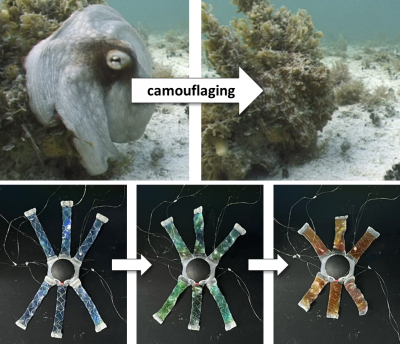
A research team led by Dr. Dae-Yoon Kim at the Korea Institute of Science and Technology (KIST) has introduced a groundbreaking soft robot named ‘OCTOID’. This innovative technology mimics the remarkable camouflage and movement capabilities of octopuses, enabling the robot to change both its color and shape dynamically.
The OCTOID robot stands out for its ability to respond to electrical stimulation. Unlike traditional soft robots that primarily bend or stretch, OCTOID can alter its appearance to blend into its environment while also moving and grasping objects effectively. This multifunctionality opens new avenues for robotics applications, particularly in environments where adaptability is crucial.
Technical Specifications and Functionality
The development of OCTOID represents a significant advancement in soft robotics. The robot comprises advanced composite materials that allow for its unique properties. When electrical currents are applied, specific parts of the robot can change color, mimicking the natural patterns found in cephalopods. This feature enhances its ability to camouflage, making it suitable for use in surveillance or exploration in diverse settings.
Moreover, OCTOID’s movement capabilities are designed to be fluid and responsive. It can navigate complex terrains and adjust its grasp on various objects, which could have implications in fields ranging from search and rescue operations to delicate assembly tasks in manufacturing.
Research conducted at KIST emphasizes the importance of interdisciplinary collaboration in bringing such innovations to life. Under the leadership of Sangrok Oh, KIST continues to focus on developing technologies that integrate seamlessly with human environments, enhancing both safety and efficiency.
Potential Applications and Future Developments
The implications of OCTOID extend beyond mere novelty. Experts believe that the technology could revolutionize industries like healthcare, where robots are increasingly being used for patient care and rehabilitation. By mimicking human-like movements and adapting to various scenarios, OCTOID could provide more effective support in therapeutic settings.
As research and development continue, the team at KIST plans to explore further enhancements to OCTOID’s capabilities. Future iterations may incorporate more sophisticated sensors for improved environmental interaction, paving the way for more autonomous operations.
In summary, OCTOID exemplifies the potential of soft robotics to transform how machines can interact with the world. With its ability to change color and shape, this innovative robot not only represents a step forward in technology but also highlights the intricate connections between biology and engineering.

Urgent Swatting Incident Ties Up Emergency Resources in Alabama

Urgent Tax Alert: Claim Your Deductions Before April 15!

Scientists Investigate Cosmic Defects: Where Are They Now?

Spring Bocce Leagues Open Registration in Rapid City

CALV Offers Essential Communication Class for Real Estate Pros

Samsung Galaxy Watch 9 Set for Larger 435mAh Battery Upgrade

Healthy Choice Wellness Reports Earnings, Stock Sees Uptick

Prince Harry Claims to Be ‘Antidote to Andrew’ Amid Royal Crisis

Pet Owners Weigh Kibble Against Fresh Dog Food Options

ALMA Discovers Companion Orbiting Giant Star π 1 Gruis

U.S. Visa Rescheduling Hits H‐1B Applicants as New Vetting Rules Take Effect

University of Hawaiʻi Joins $25.6M AI Project for Disaster Monitoring

F-22 Raptor vs. Su-57 Felon: A 2025 Fighter Jet Comparison

Recent Divorce Judgments from Iberia Parish Court Records

Ohio State Study Uncovers Brain Connectivity and Function Links

Prince Andrew Faces Fallout from Scandals and Allegations

Urgent: Flight Cancellations Loom at Texas Airports Amid Shutdown

Frank Dunn, Esteemed Builder and Community Leader, Passes Away at 89
-
 Science8 months ago
ALMA Discovers Companion Orbiting Giant Star π 1 Gruis
-
 Politics6 months ago
U.S. Visa Rescheduling Hits H‐1B Applicants as New Vetting Rules Take Effect
-
Science8 months ago
University of Hawaiʻi Joins $25.6M AI Project for Disaster Monitoring
-
 World8 months ago
F-22 Raptor vs. Su-57 Felon: A 2025 Fighter Jet Comparison
-
 Politics8 months ago
Recent Divorce Judgments from Iberia Parish Court Records
-
 Science9 months ago
Ohio State Study Uncovers Brain Connectivity and Function Links
-
 World8 months ago
Prince Andrew Faces Fallout from Scandals and Allegations
-
 Top Stories8 months ago
Urgent: Flight Cancellations Loom at Texas Airports Amid Shutdown
-
 Lifestyle8 months ago
Frank Dunn, Esteemed Builder and Community Leader, Passes Away at 89
-

 Business8 months ago
Appian Recognizes 2025 Partner Award Winners for Enterprise Innovation
-

 Entertainment6 months ago
Malachi Barton Tops Google Searches as Disney’s Rising Star of 2025
-

 Science9 months ago
Innovator Captures Light at 2 Billion Frames Per Second