
Science
Researchers Harness Indian Dance to Advance Robotic Hand Learning

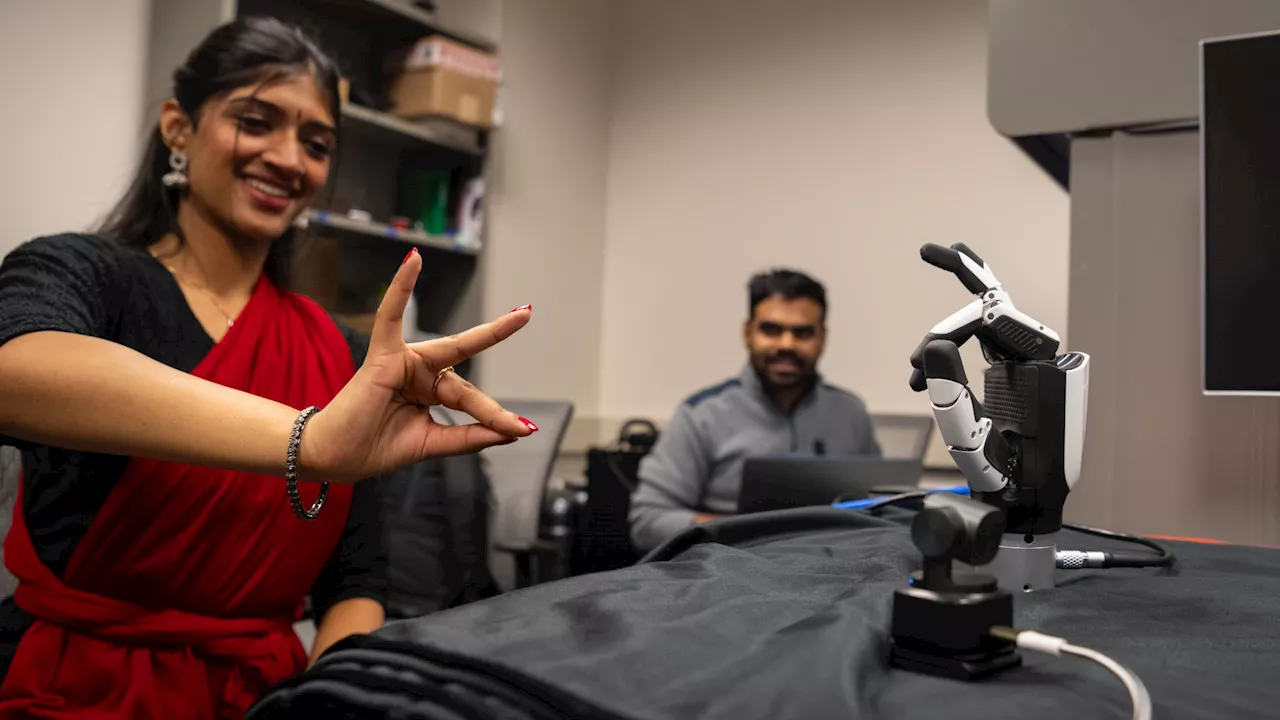
A recent study from the University of Maryland, Baltimore County (UMBC) has uncovered valuable insights into robotic hand movement learning by examining traditional Indian classical dance, specifically the hand gestures known as Bharatanatyam mudras. The research indicates that these ancient dance forms encode intricate movement patterns that could enhance how robotic systems learn to control hand motions and improve rehabilitation techniques for fine motor skills.
The study builds on the concept of kinematic synergies, which refer to coordinated patterns of joint movement that assist the brain in simplifying complex actions. These synergies function like an alphabet. By combining them, a diverse range of hand gestures can be created. Lead researcher Ramana Vinjamuri has dedicated over a decade to understanding the brain’s management of detailed hand control.
To begin, Vinjamuri’s team analyzed thirty natural hand grasps, ranging from holding small beads to lifting large bottles. They identified six key synergies that encompassed nearly all variations in these movements. Subsequently, they applied the same methodology to study thirty Bharatanatyam mudras, discovering a similar number of synergies but with significantly greater flexibility.
To evaluate the differences between the two sets of synergies, the researchers reconstructed fifteen letters of the American Sign Language (ASL) alphabet. The mudra-derived system outperformed the natural grasp alphabet, producing gestures with enhanced accuracy.
Vinjamuri’s interest in dance as a subject of study stemmed from observing older dancers. “We noticed dancers tend to age super gracefully: They remain flexible and agile because they have been training,” he explained. This observation prompted the team to explore whether these refined movements could provide a more advanced framework for robotic motion.
“Through dance, we are not just examining healthy movement but what Vinjamuri refers to as super healthy movement. These traditional gestures may offer what he describes as a superhuman alphabet,” he added. Initially, Vinjamuri sought a universal system to reconstruct all movements. However, after extensive research, he concluded that while a perfect system may not exist, the mudra-based alphabet presents superior dexterity and flexibility compared to the conventional grasp alphabet.
The implications of this study extend beyond robotics. The research team is now applying their findings to the development of robotic systems. Instead of programming robots to imitate specific gestures, they are teaching machines to amalgamate these fundamental movement alphabets to create new hand shapes. They are currently testing this approach on both a robotic hand and a humanoid robot, each requiring different translation methods from mathematical modeling to practical movement.
Additionally, the lab has developed a low-cost system that utilizes cameras and software for recording and analyzing gestures. Vinjamuri believes this technology could facilitate accessible physical therapy tools that help guide patients through rehabilitation exercises at home.
Curiosity remains a driving force behind this research. “Once I learned about synergies, I became eager to see if we could use them to enable a robotic hand to respond and perform like a human hand,” said Parthan Olikkal, a Ph.D. researcher involved in the project. “Integrating my work into the research efforts and observing the outcomes has been immensely gratifying.”
The study has been published in the journal Scientific Reports, showcasing a promising intersection of technology and traditional art forms that could redefine robotic learning and rehabilitation techniques.

Urgent Swatting Incident Ties Up Emergency Resources in Alabama

Urgent Tax Alert: Claim Your Deductions Before April 15!

Scientists Investigate Cosmic Defects: Where Are They Now?

Spring Bocce Leagues Open Registration in Rapid City

CALV Offers Essential Communication Class for Real Estate Pros

Samsung Galaxy Watch 9 Set for Larger 435mAh Battery Upgrade

Healthy Choice Wellness Reports Earnings, Stock Sees Uptick

Prince Harry Claims to Be ‘Antidote to Andrew’ Amid Royal Crisis

Pet Owners Weigh Kibble Against Fresh Dog Food Options

ALMA Discovers Companion Orbiting Giant Star π 1 Gruis

U.S. Visa Rescheduling Hits H‐1B Applicants as New Vetting Rules Take Effect

University of Hawaiʻi Joins $25.6M AI Project for Disaster Monitoring

F-22 Raptor vs. Su-57 Felon: A 2025 Fighter Jet Comparison

Recent Divorce Judgments from Iberia Parish Court Records

Ohio State Study Uncovers Brain Connectivity and Function Links

Prince Andrew Faces Fallout from Scandals and Allegations

Urgent: Flight Cancellations Loom at Texas Airports Amid Shutdown

Frank Dunn, Esteemed Builder and Community Leader, Passes Away at 89
-
 Science8 months ago
ALMA Discovers Companion Orbiting Giant Star π 1 Gruis
-
 Politics6 months ago
U.S. Visa Rescheduling Hits H‐1B Applicants as New Vetting Rules Take Effect
-
Science8 months ago
University of Hawaiʻi Joins $25.6M AI Project for Disaster Monitoring
-
 World8 months ago
F-22 Raptor vs. Su-57 Felon: A 2025 Fighter Jet Comparison
-
 Politics8 months ago
Recent Divorce Judgments from Iberia Parish Court Records
-
 Science9 months ago
Ohio State Study Uncovers Brain Connectivity and Function Links
-
 World8 months ago
Prince Andrew Faces Fallout from Scandals and Allegations
-
 Top Stories8 months ago
Urgent: Flight Cancellations Loom at Texas Airports Amid Shutdown
-
 Lifestyle8 months ago
Frank Dunn, Esteemed Builder and Community Leader, Passes Away at 89
-

 Business8 months ago
Appian Recognizes 2025 Partner Award Winners for Enterprise Innovation
-

 Entertainment6 months ago
Malachi Barton Tops Google Searches as Disney’s Rising Star of 2025
-

 Science9 months ago
Innovator Captures Light at 2 Billion Frames Per Second