
Science
Physics Student Pioneers Battery Research at The University of Tulsa

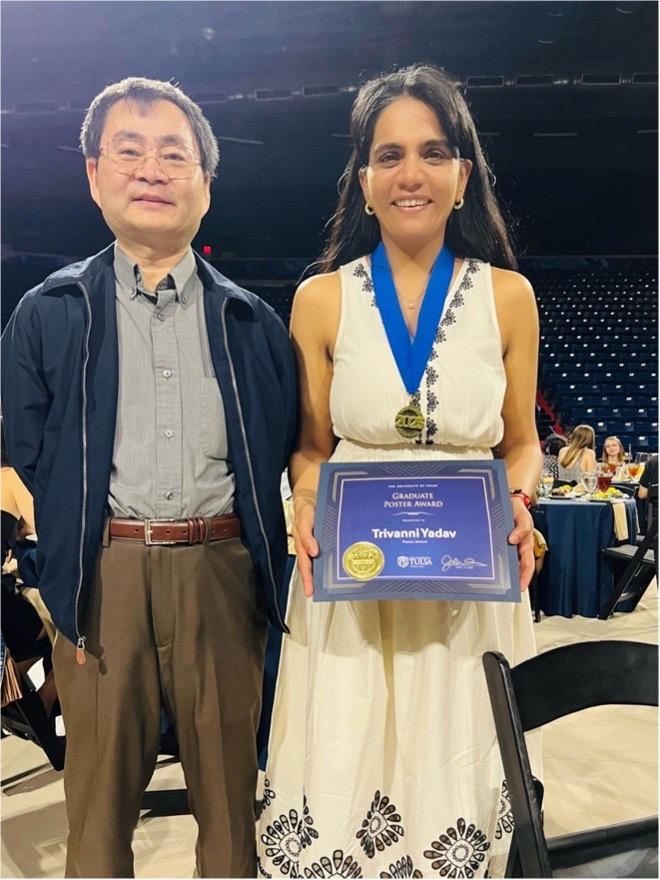
Trivanni Yadav, a doctoral candidate at The University of Tulsa (UTulsa), is making significant strides in battery research that could transform energy storage and safety. Originally from Delhi, India, Yadav found her academic home at UTulsa after completing her master’s degree at Central Michigan University. The university’s robust research opportunities within the Department of Physics & Engineering Physics resonated with her career aspirations, prompting her to apply for the program.
Yadav’s journey has been marked by notable achievements. She received a graduate assistantship and additional financial support, which has facilitated her academic progress. Through her time at UTulsa, she has published two peer-reviewed papers and has presented her research at significant conferences, including a presentation in Washington, D.C., in September 2025 and another scheduled for Denver in 2026.
Research Focus on Safer Battery Solutions
Yadav’s research primarily investigates the potential of Lithium Lanthanum Zirconium Oxide (LLZO) as a safer and more efficient alternative to traditional lithium-ion batteries. Conventional batteries, which rely on liquid electrolytes, present safety risks such as flammability and leakage. In contrast, LLZO is a solid electrolyte that exhibits non-flammable properties and remains stable under extreme conditions.
Utilizing first-principles quantum simulations, Yadav explores how atomic-scale defects within LLZO can enhance lithium ion mobility. “I aim to understand how certain defects can act as ‘express lanes’ that improve battery performance,” she explained. This research not only has implications for consumer electronics but also for space exploration, where radiation can create defects affecting battery functionality.
Yadav’s work is crucial for developing long-lasting smartphones and electric vehicles that can recharge in minutes, as well as creating more efficient energy storage systems.
Acknowledgement and Community Support
Her academic contributions have garnered recognition, including the Distinguished Graduate Research Poster Award, where she ranked first among 70 participants across various disciplines at UTulsa. Yadav also received the Iris M. Ovshinsky Travel Award from the American Physical Society’s Division of Materials Physics, a prestigious accolade awarded to only 21 students globally to support their attendance at the APS Global Physics Summit 2025.
Yadav credits her success to the mentorship of Sanwu Wang, Ph.D., the Ruth and William Kistler Jr. Endowed Chair in Physics & Engineering Physics, and Scott Holmstrom, Ph.D., dean of the Graduate School. Their guidance has been instrumental in her academic and personal development.
Beyond her research, Yadav has also embraced a teaching role at UTulsa, instructing General Physics I and creating supplemental learning materials that have benefited over 300 undergraduate students. “The entire Physics Department feels like a second family to me,” she remarked, acknowledging the supportive environment at the university.
Yadav encourages aspiring researchers to remain persistent and vocal about their work. “You have to show up and communicate your science,” she advised. “The journey can feel intimidating, but remember that you’ve earned your place. Stay strong and have faith in yourself.”
Through her groundbreaking research and commitment to community, Trivanni Yadav exemplifies the potential of emerging scientists to drive innovation and inspire future generations within the field of physics.

Urgent Swatting Incident Ties Up Emergency Resources in Alabama

Urgent Tax Alert: Claim Your Deductions Before April 15!

Scientists Investigate Cosmic Defects: Where Are They Now?

Spring Bocce Leagues Open Registration in Rapid City

CALV Offers Essential Communication Class for Real Estate Pros

Samsung Galaxy Watch 9 Set for Larger 435mAh Battery Upgrade

Healthy Choice Wellness Reports Earnings, Stock Sees Uptick

Prince Harry Claims to Be ‘Antidote to Andrew’ Amid Royal Crisis

Pet Owners Weigh Kibble Against Fresh Dog Food Options

ALMA Discovers Companion Orbiting Giant Star π 1 Gruis

U.S. Visa Rescheduling Hits H‐1B Applicants as New Vetting Rules Take Effect

University of Hawaiʻi Joins $25.6M AI Project for Disaster Monitoring

F-22 Raptor vs. Su-57 Felon: A 2025 Fighter Jet Comparison

Recent Divorce Judgments from Iberia Parish Court Records

Ohio State Study Uncovers Brain Connectivity and Function Links

Prince Andrew Faces Fallout from Scandals and Allegations

Urgent: Flight Cancellations Loom at Texas Airports Amid Shutdown

Frank Dunn, Esteemed Builder and Community Leader, Passes Away at 89
-
 Science8 months ago
ALMA Discovers Companion Orbiting Giant Star π 1 Gruis
-
 Politics6 months ago
U.S. Visa Rescheduling Hits H‐1B Applicants as New Vetting Rules Take Effect
-
Science8 months ago
University of Hawaiʻi Joins $25.6M AI Project for Disaster Monitoring
-
 World8 months ago
F-22 Raptor vs. Su-57 Felon: A 2025 Fighter Jet Comparison
-
 Politics8 months ago
Recent Divorce Judgments from Iberia Parish Court Records
-
 Science9 months ago
Ohio State Study Uncovers Brain Connectivity and Function Links
-
 World8 months ago
Prince Andrew Faces Fallout from Scandals and Allegations
-
 Top Stories8 months ago
Urgent: Flight Cancellations Loom at Texas Airports Amid Shutdown
-
 Lifestyle8 months ago
Frank Dunn, Esteemed Builder and Community Leader, Passes Away at 89
-

 Business8 months ago
Appian Recognizes 2025 Partner Award Winners for Enterprise Innovation
-

 Entertainment6 months ago
Malachi Barton Tops Google Searches as Disney’s Rising Star of 2025
-

 Science9 months ago
Innovator Captures Light at 2 Billion Frames Per Second