
Science
NASA’s Juno Mission Reveals Jupiter’s New Size and Shape

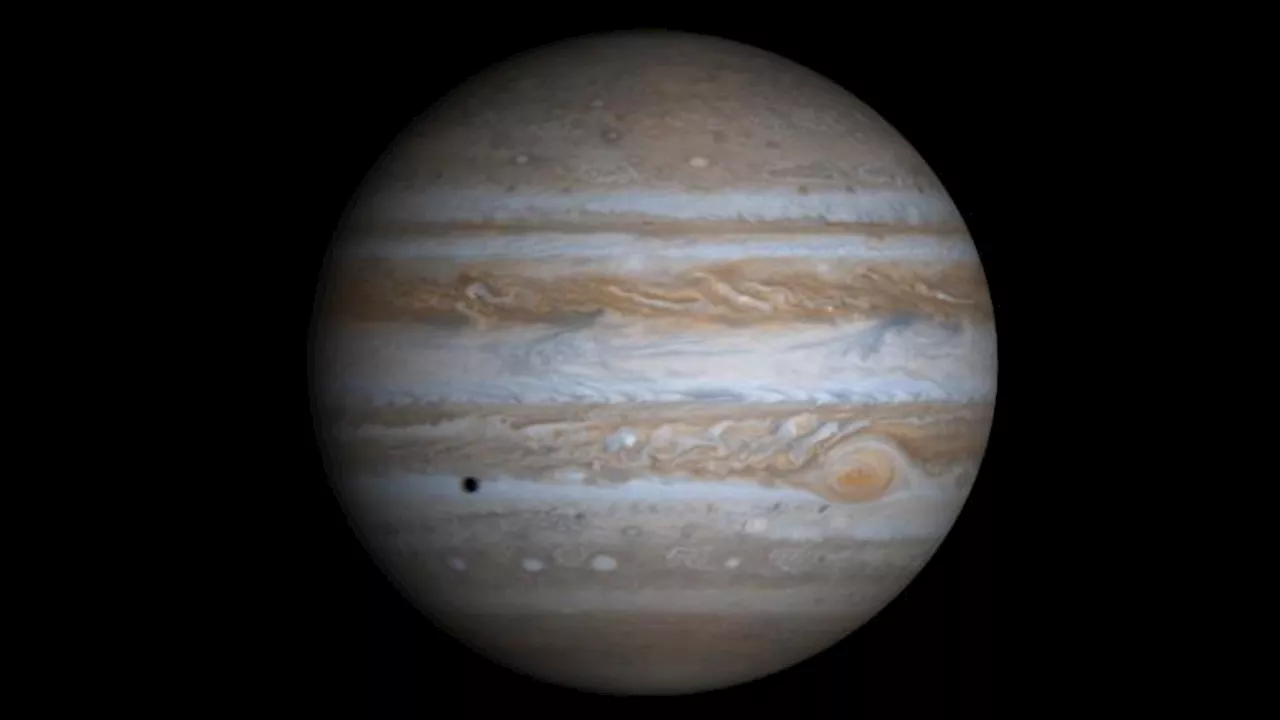
NASA’s Juno mission has unveiled significant new details about Jupiter, indicating that the gas giant is both smaller and flatter than previously known. Research based on Juno’s data shows that Jupiter’s equatorial radius is approximately 5 miles less than earlier estimates, while its polar diameter is about 15 miles smaller. This revelation prompts a re-evaluation of the planet’s characteristics and has implications for our understanding of gas giants in general.
The findings stem from Juno’s innovative technique known as radio occultation. This method measures how radio signals change as they travel through a planet’s atmosphere. During its multiple flybys of Jupiter, the spacecraft transmitted radio waves back to Earth while passing behind the planet. As these signals navigated through Jupiter’s dense atmosphere, they experienced bending and slowing, which helped scientists gather vital data regarding temperature, pressure, and atmospheric structure.
With this refined data, researchers determined that Jupiter’s equatorial radius is now estimated to be about 5 miles smaller than before, and the distance from pole to pole is approximately 15 miles less. This adjustment confirms that Jupiter is more noticeably flattened than earlier calculations suggested, primarily due to its rapid rotation. A complete rotation of the planet takes less than 10 hours, which contributes to its distinct shape.
Understanding Jupiter’s dimensions more accurately is crucial for scientists studying the planet’s immense gravitational field, energy transfer within its atmosphere, and the layers beneath its iconic cloud tops. As NASA’s Juno continues to gather data since its arrival at Jupiter in 2016, it has provided insights into the planet’s magnetic field, deep atmospheric jets, and enigmatic interior.
The implications of these findings extend beyond Jupiter itself. The planet serves as a reference point for studying other gas giants and distant exoplanets. Therefore, even minor adjustments to its known dimensions can enhance the interpretation of observations related to planets orbiting different stars.
In a recent commentary, AccuWeather’s Anna Azallion highlighted this as one of the top astronomy stories of 2026, noting the excitement surrounding ongoing space exploration and discoveries. As scientists continue to refine their understanding of Jupiter, textbooks may need to be updated to reflect these new insights.
Juno’s mission underscores how our comprehension of the solar system’s largest planet is evolving. While Jupiter itself remains unchanged, our perception and knowledge of it continue to deepen, revealing the complexities of its structure and behavior.

Urgent Swatting Incident Ties Up Emergency Resources in Alabama

Urgent Tax Alert: Claim Your Deductions Before April 15!

Scientists Investigate Cosmic Defects: Where Are They Now?

Spring Bocce Leagues Open Registration in Rapid City

CALV Offers Essential Communication Class for Real Estate Pros

Samsung Galaxy Watch 9 Set for Larger 435mAh Battery Upgrade

Healthy Choice Wellness Reports Earnings, Stock Sees Uptick

Prince Harry Claims to Be ‘Antidote to Andrew’ Amid Royal Crisis

Pet Owners Weigh Kibble Against Fresh Dog Food Options

ALMA Discovers Companion Orbiting Giant Star π 1 Gruis

U.S. Visa Rescheduling Hits H‐1B Applicants as New Vetting Rules Take Effect

University of Hawaiʻi Joins $25.6M AI Project for Disaster Monitoring

F-22 Raptor vs. Su-57 Felon: A 2025 Fighter Jet Comparison

Recent Divorce Judgments from Iberia Parish Court Records

Ohio State Study Uncovers Brain Connectivity and Function Links

Urgent: Flight Cancellations Loom at Texas Airports Amid Shutdown

Frank Dunn, Esteemed Builder and Community Leader, Passes Away at 89

Appian Recognizes 2025 Partner Award Winners for Enterprise Innovation
-
 Science9 months ago
ALMA Discovers Companion Orbiting Giant Star π 1 Gruis
-
 Politics7 months ago
U.S. Visa Rescheduling Hits H‐1B Applicants as New Vetting Rules Take Effect
-
Science10 months ago
University of Hawaiʻi Joins $25.6M AI Project for Disaster Monitoring
-
 World10 months ago
F-22 Raptor vs. Su-57 Felon: A 2025 Fighter Jet Comparison
-
 Politics9 months ago
Recent Divorce Judgments from Iberia Parish Court Records
-
 Science10 months ago
Ohio State Study Uncovers Brain Connectivity and Function Links
-
 Top Stories10 months ago
Urgent: Flight Cancellations Loom at Texas Airports Amid Shutdown
-
 Lifestyle10 months ago
Frank Dunn, Esteemed Builder and Community Leader, Passes Away at 89
-
 Business9 months ago
Appian Recognizes 2025 Partner Award Winners for Enterprise Innovation
-

 World10 months ago
Prince Andrew Faces Fallout from Scandals and Allegations
-

 Entertainment8 months ago
Malachi Barton Tops Google Searches as Disney’s Rising Star of 2025
-

 Top Stories9 months ago
Republican Matt Van Epps Wins Tennessee Special Election