
Science
Iron Age Surgeons Used Primitive Prosthetic to Save Woman’s Jaw

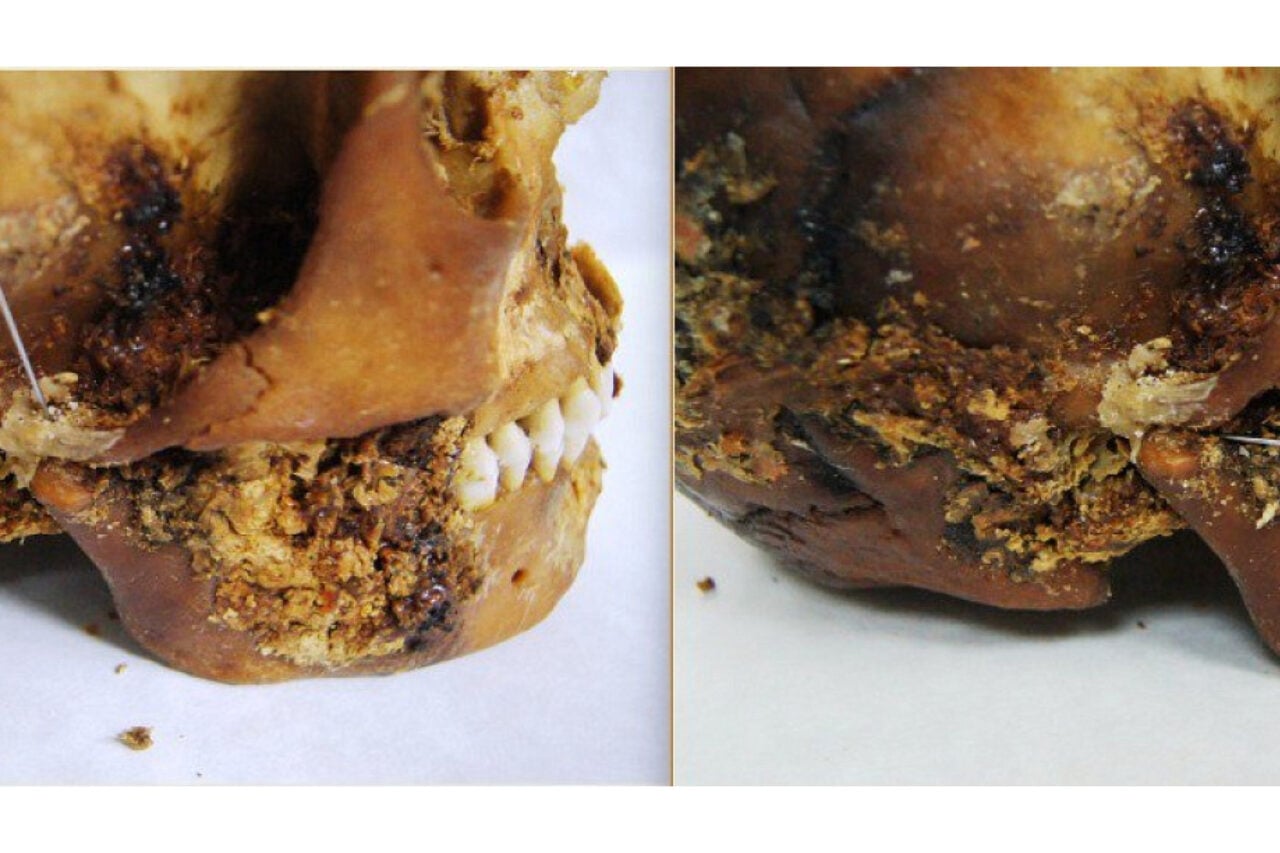
Archaeologists have uncovered evidence that an Iron Age woman survived severe facial trauma thanks to a primitive jaw prosthetic. This discovery, made by researchers from Novosibirsk State University, sheds light on the advanced surgical techniques practiced by the Pazyryk culture over 2,500 years ago.
In 1994, a team of Russian archaeologists discovered a mummified woman in a grave on the Ukok Plateau, located in southern Siberia. The burial site revealed limited information about her life, with estimates placing her age at around 25 to 30 years. A recent analysis of the remains, however, has unveiled significant insights into her medical treatment following a devastating injury.
CT Scans Reveal Remarkable Details
The research team utilized advanced imaging technology, including CT scans, to examine the woman’s skull without disturbing her remains. Vladimir Kanygin, head of the university’s Laboratory of Nuclear and Innovative Medicine, described the CT scanner as a “time machine” that provided invaluable access to the anatomical structures of the mummy. The scans indicated severe damage to her right temporomandibular joint (TMJ), rendering her unable to eat or speak effectively.
In addition to the physical trauma, the scans uncovered remnants of an “elastic material” that likely served as a surgical ligature to stabilize her jaw following the injury. This discovery highlights the ingenuity of Iron Age medical practices, as the prosthetic may have been made from materials like horsehair or animal tendon.
Implications of the Discovery
The findings depict a woman who endured significant suffering after her injury, which may have occurred due to an accident, possibly from falling off a horse. Despite the challenges she faced, the evidence suggests she adapted to her condition, primarily using the left side of her mouth for chewing, indicating she survived for some time post-surgery.
Researchers emphasized that the Pazyryk culture had a sophisticated understanding of medical care, as demonstrated by the treatment afforded to this woman. Natalia Polosmak, an archaeologist with the Russian Academy of Sciences, noted the Pazyryk’s expertise in preservation and their detailed approach to injuries and death. This culture is also famous for the Siberian Ice Maiden, whose remains exhibited incredible preservation, including tattoos.
The burial of the woman in a wooden coffin, a valuable resource in the region, suggests that she was honored despite her injuries. The context of her burial, deemed “ordinary” compared to others of higher status, raises questions about her societal role and the values of the Pazyryk people.
Researchers speculate that, although her injuries may have limited her contributions to her community, her existence was still valued. “Everyone was valued in life simply for their existence and honored after death,” Polosmak reflected, emphasizing the respect the Pazyryk culture held for life, regardless of an individual’s circumstances.
This remarkable discovery not only highlights the evolution of surgical practices in ancient societies but also reflects the deep cultural values of the Pazyryk people, who demonstrated compassion and care for their community members even in the face of hardship.

Urgent Swatting Incident Ties Up Emergency Resources in Alabama

Urgent Tax Alert: Claim Your Deductions Before April 15!

Scientists Investigate Cosmic Defects: Where Are They Now?

Spring Bocce Leagues Open Registration in Rapid City

CALV Offers Essential Communication Class for Real Estate Pros

Samsung Galaxy Watch 9 Set for Larger 435mAh Battery Upgrade

Healthy Choice Wellness Reports Earnings, Stock Sees Uptick

Prince Harry Claims to Be ‘Antidote to Andrew’ Amid Royal Crisis

Pet Owners Weigh Kibble Against Fresh Dog Food Options

ALMA Discovers Companion Orbiting Giant Star π 1 Gruis

U.S. Visa Rescheduling Hits H‐1B Applicants as New Vetting Rules Take Effect

University of Hawaiʻi Joins $25.6M AI Project for Disaster Monitoring

F-22 Raptor vs. Su-57 Felon: A 2025 Fighter Jet Comparison

Recent Divorce Judgments from Iberia Parish Court Records

Urgent: Flight Cancellations Loom at Texas Airports Amid Shutdown

Ohio State Study Uncovers Brain Connectivity and Function Links

Frank Dunn, Esteemed Builder and Community Leader, Passes Away at 89

Appian Recognizes 2025 Partner Award Winners for Enterprise Innovation
-
 Science9 months ago
ALMA Discovers Companion Orbiting Giant Star π 1 Gruis
-
 Politics7 months ago
U.S. Visa Rescheduling Hits H‐1B Applicants as New Vetting Rules Take Effect
-
Science10 months ago
University of Hawaiʻi Joins $25.6M AI Project for Disaster Monitoring
-
 World10 months ago
F-22 Raptor vs. Su-57 Felon: A 2025 Fighter Jet Comparison
-
 Politics9 months ago
Recent Divorce Judgments from Iberia Parish Court Records
-
 Top Stories10 months ago
Urgent: Flight Cancellations Loom at Texas Airports Amid Shutdown
-
 Science10 months ago
Ohio State Study Uncovers Brain Connectivity and Function Links
-
 Lifestyle10 months ago
Frank Dunn, Esteemed Builder and Community Leader, Passes Away at 89
-
 Business9 months ago
Appian Recognizes 2025 Partner Award Winners for Enterprise Innovation
-

 World10 months ago
Prince Andrew Faces Fallout from Scandals and Allegations
-

 Entertainment8 months ago
Malachi Barton Tops Google Searches as Disney’s Rising Star of 2025
-

 Top Stories9 months ago
Republican Matt Van Epps Wins Tennessee Special Election