
Science
Exploring the Multiverse: Physics Theories Challenge Reality

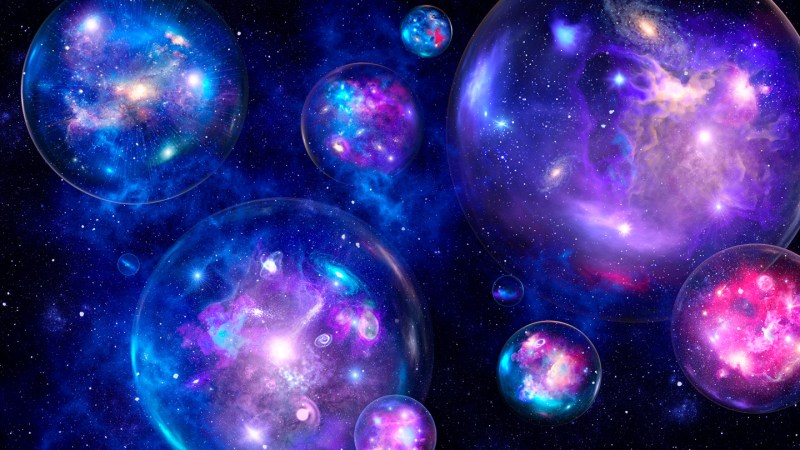
The concept of a multiverse, once confined to the realm of science fiction, has gained traction among physicists as a potential explanation for some of the universe’s most perplexing mysteries. This idea suggests that our universe may be just one of many, each with its own unique properties and laws of physics. Notable scientists, such as Andrei Linde from Stanford University, argue that the existence of multiple universes could provide answers to fundamental questions regarding the nature of reality.
The theory of inflation, proposed shortly after the Big Bang, plays a significant role in this discussion. During this rapid expansion, small quantum fluctuations grew to enormous scales, leading to variations in density that ultimately influenced the formation of galaxies. Linde posits that these fluctuations might have also caused the creation of regions of space with radically different characteristics, potentially leading to universes where fundamental forces and particle masses differ significantly from those in our own.
In this context, Linde suggests that unseen parts of space could harbor different physical laws. For instance, electrons in these alternate realms might possess greater mass, or gravity could operate differently, rendering those areas inhospitable to life. This leads to a compelling implication: if a multiverse exists, it would not be surprising that conditions suitable for life emerged somewhere among the countless bubble universes.
The existence of these bubbles raises intriguing possibilities for empirical investigation. Physicists speculate that interactions between our universe and others might leave detectable signs in the cosmic background radiation from the Big Bang. According to Paul Halpern of Saint Joseph’s University, “No one has seen yet the rings that would represent the scars of bubble collisions.” This highlights the current limitations in confirming the multiverse theory through observational evidence.
Another perspective on the multiverse arises from quantum mechanics. Traditional interpretations suggest that particles exist in a superposition of states until measured, at which point the possibilities collapse into one reality. Hugh Everett III proposed a radical alternative in 1957: rather than collapsing, all potential outcomes occur in separate, parallel universes. Under this view, an observer would split into multiple versions, each perceiving a different outcome without awareness of the others.
Halpern notes the challenges in testing this theory. “We can’t have somebody split in an experiment between two possibilities and ask each one what it was like,” he explained. The implications of this theory stretch the boundaries of our understanding and complicate the notion of measurement and existence.
The prospects of traversing these hypothetical universes remain largely within the speculative domain. Some scientists theorize the existence of wormholes—hypothetical tunnels in the fabric of spacetime—that could connect different realities. Yet, Halpern cautions that creating such structures would demand energy and mass far beyond current technological capabilities. “It’s not like you can have a wormhole in a secret closet in your bedroom and jump in every night,” he said.
While the allure of teaming up with alternate versions of oneself may be enticing, the reality is that the multiverse, if it exists, remains frustratingly out of reach. Nonetheless, the ongoing exploration of these theories drives a deeper understanding of the universe and our place within it, challenging our perceptions of reality and existence.

Urgent Swatting Incident Ties Up Emergency Resources in Alabama

Urgent Tax Alert: Claim Your Deductions Before April 15!

Scientists Investigate Cosmic Defects: Where Are They Now?

Spring Bocce Leagues Open Registration in Rapid City

CALV Offers Essential Communication Class for Real Estate Pros

Samsung Galaxy Watch 9 Set for Larger 435mAh Battery Upgrade

Healthy Choice Wellness Reports Earnings, Stock Sees Uptick

Prince Harry Claims to Be ‘Antidote to Andrew’ Amid Royal Crisis

Pet Owners Weigh Kibble Against Fresh Dog Food Options

ALMA Discovers Companion Orbiting Giant Star π 1 Gruis

U.S. Visa Rescheduling Hits H‐1B Applicants as New Vetting Rules Take Effect

University of Hawaiʻi Joins $25.6M AI Project for Disaster Monitoring

F-22 Raptor vs. Su-57 Felon: A 2025 Fighter Jet Comparison

Recent Divorce Judgments from Iberia Parish Court Records

Urgent: Flight Cancellations Loom at Texas Airports Amid Shutdown

Ohio State Study Uncovers Brain Connectivity and Function Links

Frank Dunn, Esteemed Builder and Community Leader, Passes Away at 89

Appian Recognizes 2025 Partner Award Winners for Enterprise Innovation
-
 Science9 months ago
ALMA Discovers Companion Orbiting Giant Star π 1 Gruis
-
 Politics7 months ago
U.S. Visa Rescheduling Hits H‐1B Applicants as New Vetting Rules Take Effect
-
Science10 months ago
University of Hawaiʻi Joins $25.6M AI Project for Disaster Monitoring
-
 World10 months ago
F-22 Raptor vs. Su-57 Felon: A 2025 Fighter Jet Comparison
-
 Politics9 months ago
Recent Divorce Judgments from Iberia Parish Court Records
-
 Top Stories10 months ago
Urgent: Flight Cancellations Loom at Texas Airports Amid Shutdown
-
 Science10 months ago
Ohio State Study Uncovers Brain Connectivity and Function Links
-
 Lifestyle10 months ago
Frank Dunn, Esteemed Builder and Community Leader, Passes Away at 89
-
 Business9 months ago
Appian Recognizes 2025 Partner Award Winners for Enterprise Innovation
-

 World10 months ago
Prince Andrew Faces Fallout from Scandals and Allegations
-

 Entertainment8 months ago
Malachi Barton Tops Google Searches as Disney’s Rising Star of 2025
-

 Top Stories9 months ago
Republican Matt Van Epps Wins Tennessee Special Election