
Science
Explorers Uncover Secrets of Ancient Ice Age Cave in Yucatán

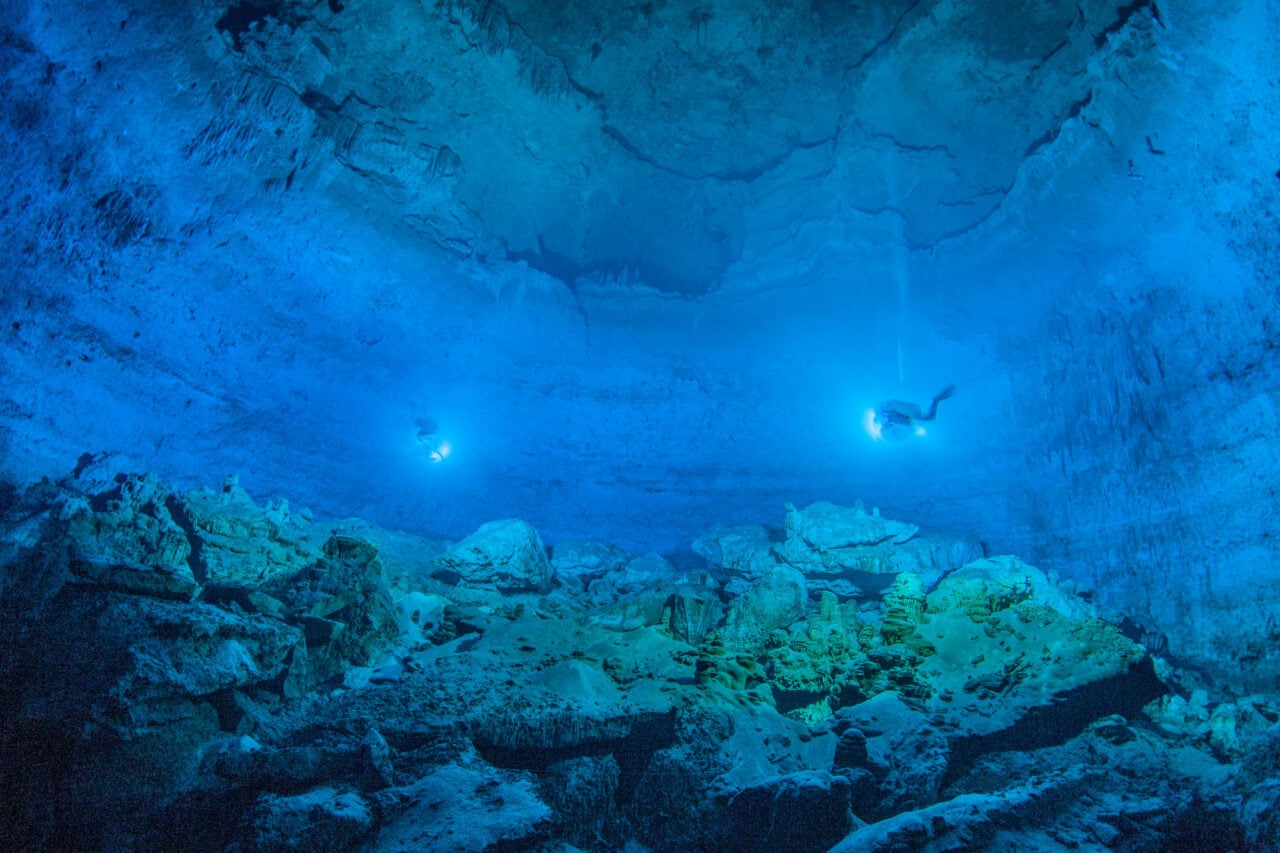
Deep beneath the Yucatán Peninsula’s tropical forests lies Hoyo Negro, an extensive underwater cave that serves as a portal to the Ice Age. This submerged cave system is part of Sac Actun, the second largest cave system in Mexico’s Quintana Roo state. Researchers have discovered fossils and artifacts that provide insight into the lives of humans and animals that inhabited this region during the Late Pleistocene, approximately 126,000 to 11,700 years ago.
The remarkable history of Hoyo Negro came to light in 2014, following the discovery of numerous fossils, including the remains of Naia, one of the three oldest human skeletons found in the Americas. The discovery was made by divers Alejandro Alvarez, Franco Attolini, and Alberto Nava Blank in 2007. In response to the significance of the find, Mexico’s National Institute of Anthropology and History (INAH) established the Hoyo Negro Underwater Archaeological Project in 2010, bringing together an international team of paleontologists, archaeologists, and divers.
Exploring the Depths of Hoyo Negro
Diving into Hoyo Negro presents unique challenges. The cave system is largely unmapped and submerged in darkness, requiring divers to carry specialized safety equipment, including breathing apparatus, navigation lines, and lights. Roberto Chávez Arce, a project co-director and diver, emphasized the importance of redundancy in their gear, saying, “We need spares of the spares. If anything fails, it could be dangerous.”
Initially, divers entered Sac Actun from a cenote located approximately 3,000 feet (914 meters) from Hoyo Negro, taking nearly an hour to reach the pit. Recent advancements have improved access significantly, with the discovery of a new cenote just 250 to 300 feet (76 to 91 meters) away and the use of motorized scooters to navigate the water.
The mapping of the cave system has evolved from basic techniques, such as compasses and tape measures, to advanced structure-from-motion (SfM) photogrammetry. This method creates a 3D point cloud from overlapping photographs, allowing scientists to visualize Hoyo Negro and parts of Sac Actun without physically exploring every inch.
Fossils and Ancient Ecosystems
The significance of Hoyo Negro extends beyond human remains. Researchers have studied sediment cores, ancient bat guano, and seeds to understand the cave’s water levels over time. They discovered that Hoyo Negro was underwater at least 9,850 years ago, with rising sea levels completely flooding the cave system by around 6,000 years ago.
During the Pleistocene, the ecosystem of Quintana Roo was vastly different, resembling a savanna rather than the lush jungle that exists today. The caves provided a vital source of drinking water, drawing both humans and animals. Yet, the caves also posed dangers, as evidenced by the fossils found at the bottom of Hoyo Negro, including Naia, who tragically fell to her death at approximately 15 to 17 years old.
Naia’s remains were meticulously handled underwater by team member Susan Bird, who transported them to safety after concerns over disturbances by outside divers. Analysis of Naia’s bones has revealed much about her life and diet. Despite being located near the coast, isotopic studies suggest she did not rely on marine resources, indicating her community may not have been adapted to a coastal lifestyle.
The motivations for human activity in Hoyo Negro remain speculative. Some researchers theorize that early inhabitants may have sought clay or hunted animals, while others propose that these caves served as burial sites. The evidence of ochre mining in other Yucatán cave systems suggests a broader cultural significance associated with these subterranean realms.
As divers continue to explore and document the complex cave system, they are uncovering a wealth of information about the region’s ancient ecosystems. The fossil remains of extinct species, including the short-faced bear Arctotherium wingei and the newly discovered ground sloth Nohochichak xibalbahkah, enhance our understanding of the Great American Biotic Interchange. These findings highlight the diversity of life that thrived in the Yucatán before the dramatic shifts in climate and geography.
The ongoing research at Hoyo Negro and Sac Actun promises to shed light on the evolutionary history of North American fauna. As scientists explore these remarkably preserved caves, they uncover not just the remnants of ancient life but also the intricate relationships that once existed in this hidden underworld.
With each dive, the team moves closer to answering long-standing questions about the past, revealing a rich tapestry of life that once flourished in the depths of the Yucatán Peninsula.

Urgent Swatting Incident Ties Up Emergency Resources in Alabama

Urgent Tax Alert: Claim Your Deductions Before April 15!

Scientists Investigate Cosmic Defects: Where Are They Now?

Spring Bocce Leagues Open Registration in Rapid City

CALV Offers Essential Communication Class for Real Estate Pros

Samsung Galaxy Watch 9 Set for Larger 435mAh Battery Upgrade

Healthy Choice Wellness Reports Earnings, Stock Sees Uptick

Prince Harry Claims to Be ‘Antidote to Andrew’ Amid Royal Crisis

Pet Owners Weigh Kibble Against Fresh Dog Food Options

ALMA Discovers Companion Orbiting Giant Star π 1 Gruis

U.S. Visa Rescheduling Hits H‐1B Applicants as New Vetting Rules Take Effect

University of Hawaiʻi Joins $25.6M AI Project for Disaster Monitoring

F-22 Raptor vs. Su-57 Felon: A 2025 Fighter Jet Comparison

Recent Divorce Judgments from Iberia Parish Court Records

Ohio State Study Uncovers Brain Connectivity and Function Links

Prince Andrew Faces Fallout from Scandals and Allegations

Urgent: Flight Cancellations Loom at Texas Airports Amid Shutdown

Frank Dunn, Esteemed Builder and Community Leader, Passes Away at 89
-
 Science8 months ago
ALMA Discovers Companion Orbiting Giant Star π 1 Gruis
-
 Politics6 months ago
U.S. Visa Rescheduling Hits H‐1B Applicants as New Vetting Rules Take Effect
-
Science8 months ago
University of Hawaiʻi Joins $25.6M AI Project for Disaster Monitoring
-
 World8 months ago
F-22 Raptor vs. Su-57 Felon: A 2025 Fighter Jet Comparison
-
 Politics8 months ago
Recent Divorce Judgments from Iberia Parish Court Records
-
 Science9 months ago
Ohio State Study Uncovers Brain Connectivity and Function Links
-
 World8 months ago
Prince Andrew Faces Fallout from Scandals and Allegations
-
 Top Stories8 months ago
Urgent: Flight Cancellations Loom at Texas Airports Amid Shutdown
-
 Lifestyle8 months ago
Frank Dunn, Esteemed Builder and Community Leader, Passes Away at 89
-

 Business8 months ago
Appian Recognizes 2025 Partner Award Winners for Enterprise Innovation
-

 Entertainment6 months ago
Malachi Barton Tops Google Searches as Disney’s Rising Star of 2025
-

 Science9 months ago
Innovator Captures Light at 2 Billion Frames Per Second