
Science
Earth’s Atmosphere Has Been Nourishing the Moon for Billions of Years

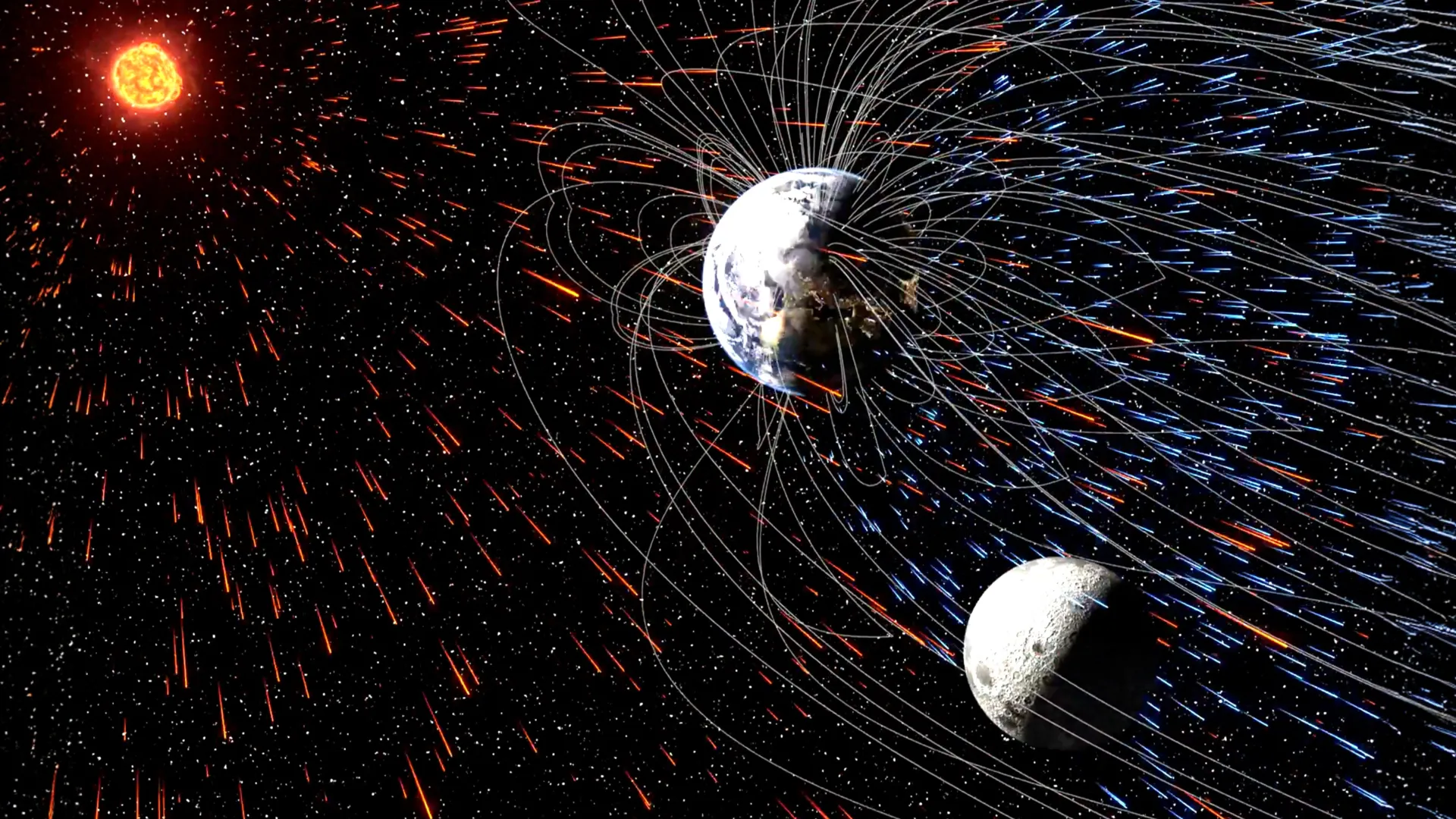
Earth’s atmosphere has been subtly nourishing the moon for billions of years, according to new research from the University of Rochester. Tiny particles from Earth’s atmosphere have traveled through space, guided by the planet’s magnetic field, and deposited on the lunar surface. This discovery not only sheds light on the composition of lunar soil but also hints at the moon’s potential as a resource for future exploration.
Research published in the journal Nature Communications Earth and Environment reveals that Earth’s magnetic field has played a crucial role in facilitating the transfer of atmospheric particles to the moon. Instead of blocking these particles, the magnetic field serves as a funnel, allowing them to traverse the vast distance between Earth and the moon.
For many years, scientists have puzzled over how materials from Earth could reach the moon, especially given its seemingly lifeless and inert surface. The research suggests that over billions of years, fragments of Earth’s atmosphere have become embedded in lunar soil, potentially offering invaluable resources for future lunar missions.
Eric Blackman, a professor in the Department of Physics and Astronomy, explained, “By combining data from particles preserved in lunar soil with computational modeling of how solar wind interacts with Earth’s atmosphere, we can trace the history of Earth’s atmosphere and its magnetic field.”
The findings indicate that lunar soil may serve as a long-term archive of Earth’s atmospheric history. This could provide scientists with insights into how conditions on Earth have changed over time, including its climate and the evolution of life.
Understanding Lunar Resources through Apollo Samples
Central to this research are the moon rocks and soil collected during the Apollo missions in the 1970s. Analysis of these samples has shown that the moon’s regolith, or surface layer, contains volatile substances such as water, carbon dioxide, helium, argon, and nitrogen. While some of these materials are known to come from the solar wind, the quantities present—especially nitrogen—are too large to be attributed solely to that source.
In 2005, scientists from the University of Tokyo posited that some of these volatiles originated from Earth’s atmosphere, but suggested this transfer could only have occurred before Earth developed its magnetic field. They believed the magnetic field would block atmospheric particles from escaping into space. The Rochester team challenged this view by demonstrating that the magnetic field can indeed facilitate the transfer.
To further explore this phenomenon, researchers employed advanced computer simulations. The team, including graduate student Shubhonkar Paramanick and professor John Tarduno, tested two scenarios: one depicting an early Earth without a magnetic field and another representing the current state with a robust magnetic field.
The simulations revealed that particle transfer to the moon is significantly more efficient in modern Earth conditions. As charged particles are released from the upper atmosphere due to solar wind, they follow the magnetic field lines extending into space, some of which intersect with the moon’s orbit. Over billions of years, this process acts like a slow funnel, allowing small amounts of Earth’s atmosphere to settle onto the lunar surface.
Implications for Future Lunar Exploration
This research not only suggests that the moon may preserve a chemical record of Earth’s atmospheric history but also points to the possibility that it contains valuable resources. Elements like water and nitrogen could support future human activities on the moon, reducing reliance on supplies from Earth and making long-term lunar habitation more feasible.
Paramanick highlighted the broader implications of their findings, stating, “Our study may also have broader implications for understanding early atmospheric escape on planets like Mars, which lacks a global magnetic field today but had one similar to Earth in the past.”
The study was funded in part by NASA and the National Science Foundation, underscoring the significance of this research in the context of ongoing space exploration efforts. As scientists continue to examine lunar soil, they may unlock further insights into Earth’s past and the potential for future human presence on the moon.

Urgent Swatting Incident Ties Up Emergency Resources in Alabama

Urgent Tax Alert: Claim Your Deductions Before April 15!

Scientists Investigate Cosmic Defects: Where Are They Now?

Spring Bocce Leagues Open Registration in Rapid City

CALV Offers Essential Communication Class for Real Estate Pros

Samsung Galaxy Watch 9 Set for Larger 435mAh Battery Upgrade

Healthy Choice Wellness Reports Earnings, Stock Sees Uptick

Prince Harry Claims to Be ‘Antidote to Andrew’ Amid Royal Crisis

Pet Owners Weigh Kibble Against Fresh Dog Food Options

ALMA Discovers Companion Orbiting Giant Star π 1 Gruis

U.S. Visa Rescheduling Hits H‐1B Applicants as New Vetting Rules Take Effect

University of Hawaiʻi Joins $25.6M AI Project for Disaster Monitoring

F-22 Raptor vs. Su-57 Felon: A 2025 Fighter Jet Comparison

Recent Divorce Judgments from Iberia Parish Court Records

Urgent: Flight Cancellations Loom at Texas Airports Amid Shutdown

Ohio State Study Uncovers Brain Connectivity and Function Links

Frank Dunn, Esteemed Builder and Community Leader, Passes Away at 89

Appian Recognizes 2025 Partner Award Winners for Enterprise Innovation
-
 Science10 months ago
ALMA Discovers Companion Orbiting Giant Star π 1 Gruis
-
 Politics8 months ago
U.S. Visa Rescheduling Hits H‐1B Applicants as New Vetting Rules Take Effect
-
Science10 months ago
University of Hawaiʻi Joins $25.6M AI Project for Disaster Monitoring
-
 World10 months ago
F-22 Raptor vs. Su-57 Felon: A 2025 Fighter Jet Comparison
-
 Politics9 months ago
Recent Divorce Judgments from Iberia Parish Court Records
-
 Top Stories10 months ago
Urgent: Flight Cancellations Loom at Texas Airports Amid Shutdown
-
 Science10 months ago
Ohio State Study Uncovers Brain Connectivity and Function Links
-
 Lifestyle10 months ago
Frank Dunn, Esteemed Builder and Community Leader, Passes Away at 89
-
 Business10 months ago
Appian Recognizes 2025 Partner Award Winners for Enterprise Innovation
-

 World10 months ago
Prince Andrew Faces Fallout from Scandals and Allegations
-

 Entertainment8 months ago
Malachi Barton Tops Google Searches as Disney’s Rising Star of 2025
-

 Top Stories9 months ago
Republican Matt Van Epps Wins Tennessee Special Election