
Science
Discovering Dark Matter: 7 Cosmic Mysteries Explained

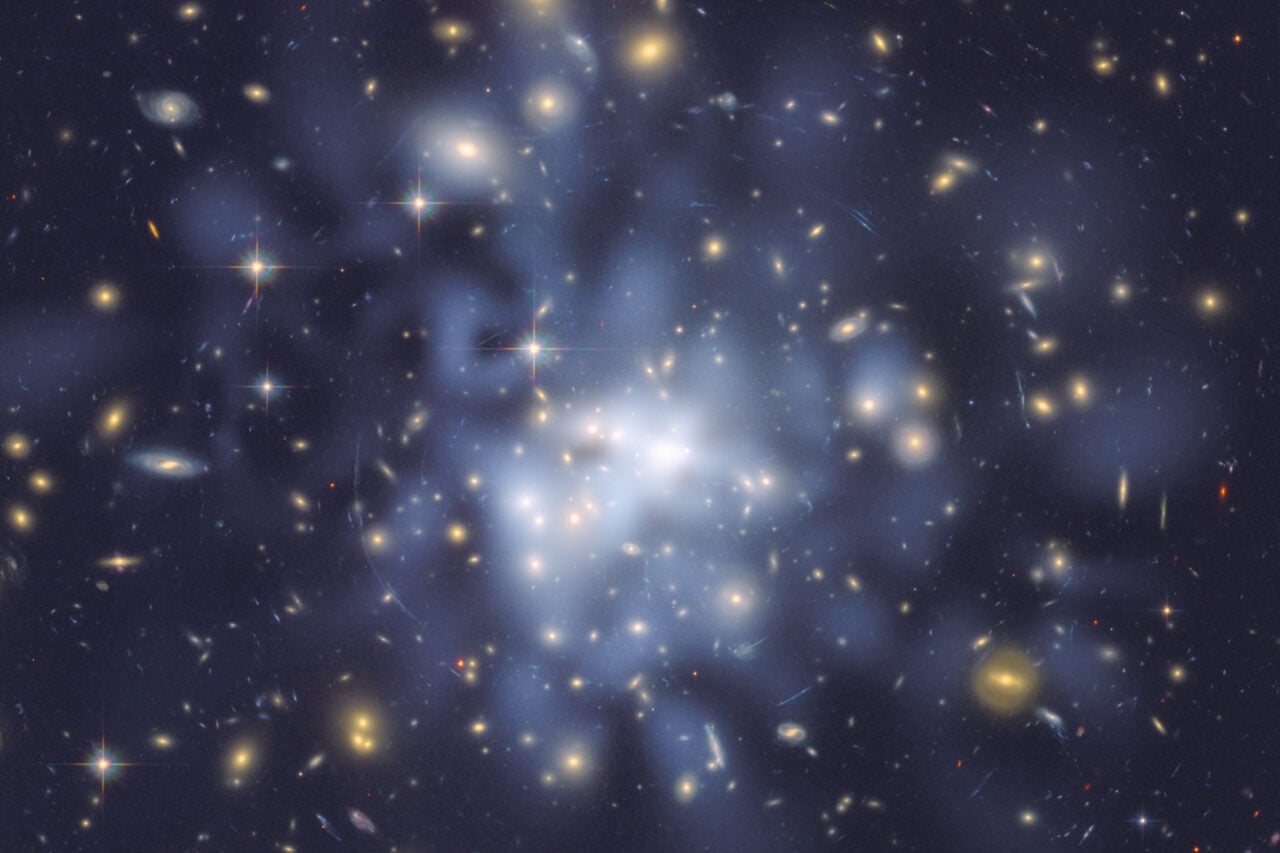
Dark matter, an invisible substance constituting approximately 85% of the universe’s mass, remains one of the most intriguing aspects of modern astrophysics. Unlike ordinary matter, it neither absorbs, emits, nor reflects light, making it undetectable by traditional means. Despite its elusive nature, astronomers continually observe its gravitational influence on various cosmic phenomena, leading to the conclusion that dark matter is crucial for understanding the universe. Here, we explore seven significant astronomical mysteries that point towards the existence of dark matter.
The Universe’s Missing Mass
The foundation of the dark matter hypothesis stems from the discovery that only 15% of the universe’s mass is composed of ordinary matter, which includes visible elements such as planets and stars. This discrepancy has prompted scientists to propose that dark matter accounts for the remaining mass, exerting a gravitational force that influences visible matter. As such, dark matter plays a pivotal role in the structure and behavior of the universe.
Unraveling Spiral Galaxies
The existence of dark matter gained widespread acceptance in the 1970s, particularly due to the work of American astronomer Vera Rubin. Her studies of spiral galaxies, including our own Milky Way, revealed that stars at the edges of galaxies moved at speeds that contradicted established laws of physics. According to current understanding, faster orbiting stars should be found near the galaxy’s center, where mass and gravity are concentrated. However, Rubin’s observations indicated that stars in the outer regions moved just as quickly, suggesting that an unseen mass, likely dark matter, is holding these galaxies together.
The Galactic Center’s Mysteries
Research indicates that dark matter may significantly affect our understanding of the Milky Way. For instance, a 2022 study from Johns Hopkins University proposed that an excess of gamma rays detected at the Galactic Center could result from dark matter particle collisions. This hypothesis aligns with earlier findings from the Institute of Astrophysics La Plata in Argentina, which suggested a massive dark matter core may influence the dynamics of stars in the region.
Gravitational Lensing Insights
General relativity describes gravity as the warping of spacetime by massive objects. This bending effect creates a phenomenon known as gravitational lensing, enabling astronomers to observe celestial bodies that would otherwise be hidden. Dark matter, with its substantial mass, contributes significantly to these lensing effects. Observations often reveal distorted images of background galaxies, leading astronomers to infer the presence of dark matter in these regions.
The Bullet Cluster’s Revelation
In 2006, NASA’s Chandra X-ray Observatory captured a striking image of the Bullet Cluster, a galaxy cluster formed by one of the most energetic events observed since the Big Bang. This collision produced hot gas that should exhibit electromagnetic interactions, allowing researchers to track its movement. However, gravitational lensing showed that the majority of the cluster’s mass lay around the galaxies rather than at the center, where the gas was located. This observation provided strong evidence supporting the existence of dark matter.
Supersymmetry’s Potential Link
Particle physicists speculate that dark matter may be intertwined with the concept of supersymmetry. This theory suggests that every fundamental particle has a corresponding partner, which could help explain discrepancies in the Standard Model of particle physics. According to CERN, many supersymmetric models propose that these partner particles would possess properties consistent with those sought in dark matter. While no direct evidence for supersymmetry has been found at CERN’s Large Hadron Collider, researchers remain hopeful about uncovering connections between the two concepts.
Cosmic Microwave Background Anomalies
The cosmic microwave background (CMB) is a remnant radiation from the Big Bang, serving as a record of the universe’s early state. Recent research utilizing advanced detectors has identified unusual temperature variations in the CMB, believed to be imprints of dark matter’s gravitational effects. Although dark matter does not interact directly with radiation, its presence would result in anisotropies within the CMB. Such variations have allowed scientists to infer essential physical properties regarding the shape and evolution of the universe.
Dark matter’s profound influence on cosmic phenomena continues to challenge our understanding and encourages further exploration into its nature. As astronomers and physicists advance their research, the quest to uncover the mysteries of dark matter remains a central focus in the field of astrophysics.

Urgent Swatting Incident Ties Up Emergency Resources in Alabama

Urgent Tax Alert: Claim Your Deductions Before April 15!

Scientists Investigate Cosmic Defects: Where Are They Now?

Spring Bocce Leagues Open Registration in Rapid City

CALV Offers Essential Communication Class for Real Estate Pros

Samsung Galaxy Watch 9 Set for Larger 435mAh Battery Upgrade

Healthy Choice Wellness Reports Earnings, Stock Sees Uptick

Prince Harry Claims to Be ‘Antidote to Andrew’ Amid Royal Crisis

Pet Owners Weigh Kibble Against Fresh Dog Food Options

ALMA Discovers Companion Orbiting Giant Star π 1 Gruis

U.S. Visa Rescheduling Hits H‐1B Applicants as New Vetting Rules Take Effect

University of Hawaiʻi Joins $25.6M AI Project for Disaster Monitoring

F-22 Raptor vs. Su-57 Felon: A 2025 Fighter Jet Comparison

Recent Divorce Judgments from Iberia Parish Court Records

Urgent: Flight Cancellations Loom at Texas Airports Amid Shutdown

Ohio State Study Uncovers Brain Connectivity and Function Links

Frank Dunn, Esteemed Builder and Community Leader, Passes Away at 89

Appian Recognizes 2025 Partner Award Winners for Enterprise Innovation
-
 Science9 months ago
ALMA Discovers Companion Orbiting Giant Star π 1 Gruis
-
 Politics7 months ago
U.S. Visa Rescheduling Hits H‐1B Applicants as New Vetting Rules Take Effect
-
Science10 months ago
University of Hawaiʻi Joins $25.6M AI Project for Disaster Monitoring
-
 World10 months ago
F-22 Raptor vs. Su-57 Felon: A 2025 Fighter Jet Comparison
-
 Politics9 months ago
Recent Divorce Judgments from Iberia Parish Court Records
-
 Top Stories10 months ago
Urgent: Flight Cancellations Loom at Texas Airports Amid Shutdown
-
 Science10 months ago
Ohio State Study Uncovers Brain Connectivity and Function Links
-
 Lifestyle10 months ago
Frank Dunn, Esteemed Builder and Community Leader, Passes Away at 89
-
 Business9 months ago
Appian Recognizes 2025 Partner Award Winners for Enterprise Innovation
-

 World10 months ago
Prince Andrew Faces Fallout from Scandals and Allegations
-

 Entertainment8 months ago
Malachi Barton Tops Google Searches as Disney’s Rising Star of 2025
-

 Top Stories9 months ago
Republican Matt Van Epps Wins Tennessee Special Election