
Science
Cornell’s Microscopic Robots Learn to Walk with AI Precision

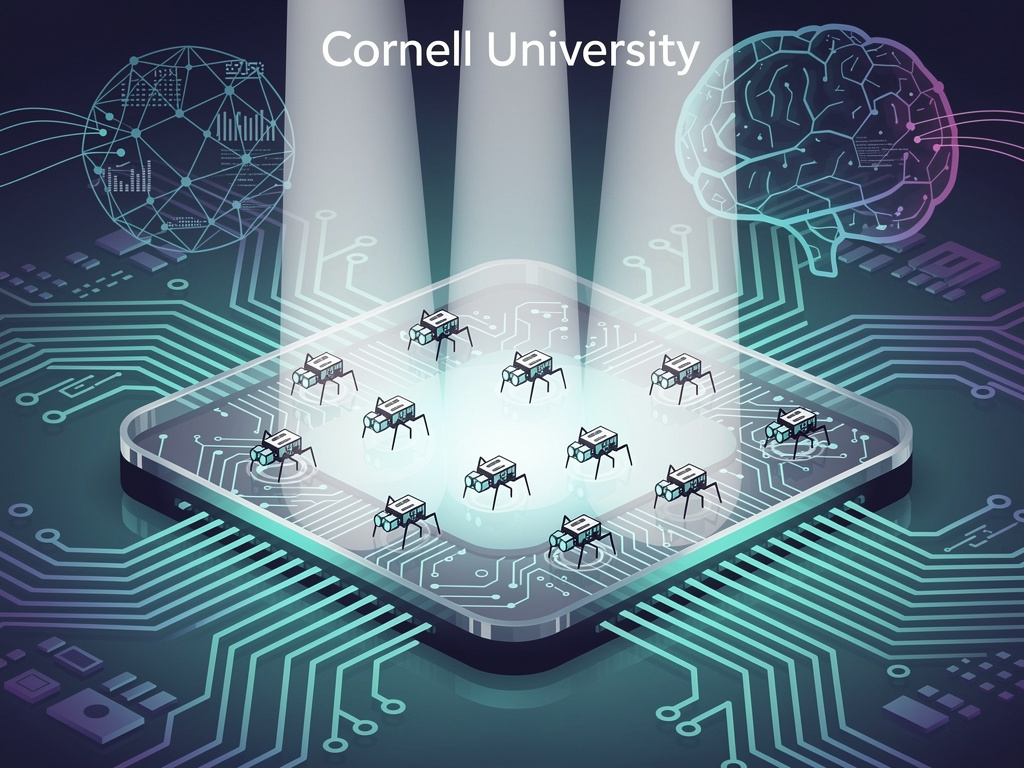
In a groundbreaking advancement, researchers at Cornell University have developed autonomous robots smaller than a grain of salt that can walk independently, marking a significant milestone in the field of microrobotics. This innovation, led by physicist Paul McEuen and researcher Itai Cohen, represents a decade-long effort to create fully functional robots that operate without external controls, opening up new possibilities in various applications such as medicine and manufacturing.
Revolutionizing Microrobotics with Autonomous Design
These microscopic robots, measuring approximately 100 microns in width, are equipped with onboard electronic systems, enabling them to execute pre-programmed tasks without relying on external wires or magnetic fields. Traditionally, microrobots were limited by tethered power sources, which restricted their functionality in complex environments like the human body.
The Cornell team’s innovation stems from the integration of complementary metal-oxide-semiconductor (CMOS) technology directly onto the robot’s chassis. This allows each microbot to carry its own control system, effectively functioning as a miniature brain. According to a foundational paper published in the journal Nature, this autonomy represents a monumental leap forward in microrobotics.
“This is the first time we’ve been able to build, in a very standard, scalable way, an autonomous robot at this scale,” Professor Cohen stated in an interview. The robots are powered by a laser beam, which activates photovoltaic cells on their backs, generating electricity to drive their movements.
Innovative Propulsion System and AI-Driven Locomotion
The propulsion mechanism of these robots is equally remarkable. Their legs are crafted from thin strips of platinum layered over titanium or graphene. When an electrical current runs through these legs, it triggers an electrochemical reaction with water, creating bubbles that propel the robots forward. This bubble-based propulsion allows for movement but initially resulted in erratic locomotion. Early prototypes were programmed with simple commands, leading to less controlled movement.
In a significant breakthrough announced in March 2023, the research team utilized artificial intelligence to enhance the robots’ locomotion. By simulating the robots’ movements in software, they employed a reinforcement learning algorithm to discover optimal walking patterns. Former student Michael Reynolds emphasized the effectiveness of this approach, stating, “The AI was able to find gaits that were more clever and effective than we could have imagined.” This new method enables the robots to achieve speeds exceeding 10 micrometers per second.
The long-term vision for these autonomous microbots is transformative. Potential applications include using swarms of these robots for cancer detection, targeted drug delivery, and even performing microsurgery. Their small size allows for in-vivo diagnostics, paving the way for advanced medical interventions.
Despite the promising advancements, challenges remain. Currently, the robots rely on external laser power, which cannot penetrate deep into opaque materials such as human tissue. Future iterations will require enhanced energy storage solutions or the ability to harvest energy from their surroundings. Additionally, the complexities of navigating within the bloodstream necessitate advanced sensors and onboard intelligence.
Another critical hurdle is ensuring biocompatibility, as materials used must not provoke an immune response. Furthermore, the propulsion system must be safe for use in living organisms.
The scalability of this technology is one of its most significant advantages. Since the robots are manufactured on silicon wafers, they can be produced in large quantities, drastically reducing costs and making microrobotics more accessible for practical applications.
The Cornell team is now focused on integrating more sophisticated sensors capable of detecting temperature and specific biological markers. As the robots evolve, they will not only be more adaptable but also capable of making decisions based on sensory input, enhancing their effectiveness in real-world applications.
As research progresses, these tiny robots are set to redefine the boundaries of technology and medicine, operating on a scale that mirrors biological systems. The journey from laboratory prototypes to mass-produced autonomous agents is underway, signaling an exciting future for microrobotics.

Urgent Swatting Incident Ties Up Emergency Resources in Alabama

Urgent Tax Alert: Claim Your Deductions Before April 15!

Scientists Investigate Cosmic Defects: Where Are They Now?

Spring Bocce Leagues Open Registration in Rapid City

CALV Offers Essential Communication Class for Real Estate Pros

Samsung Galaxy Watch 9 Set for Larger 435mAh Battery Upgrade

Healthy Choice Wellness Reports Earnings, Stock Sees Uptick

Prince Harry Claims to Be ‘Antidote to Andrew’ Amid Royal Crisis

Pet Owners Weigh Kibble Against Fresh Dog Food Options

ALMA Discovers Companion Orbiting Giant Star π 1 Gruis

U.S. Visa Rescheduling Hits H‐1B Applicants as New Vetting Rules Take Effect

University of Hawaiʻi Joins $25.6M AI Project for Disaster Monitoring

F-22 Raptor vs. Su-57 Felon: A 2025 Fighter Jet Comparison

Recent Divorce Judgments from Iberia Parish Court Records

Urgent: Flight Cancellations Loom at Texas Airports Amid Shutdown

Ohio State Study Uncovers Brain Connectivity and Function Links

Frank Dunn, Esteemed Builder and Community Leader, Passes Away at 89

Appian Recognizes 2025 Partner Award Winners for Enterprise Innovation
-
 Science9 months ago
ALMA Discovers Companion Orbiting Giant Star π 1 Gruis
-
 Politics7 months ago
U.S. Visa Rescheduling Hits H‐1B Applicants as New Vetting Rules Take Effect
-
Science10 months ago
University of Hawaiʻi Joins $25.6M AI Project for Disaster Monitoring
-
 World10 months ago
F-22 Raptor vs. Su-57 Felon: A 2025 Fighter Jet Comparison
-
 Politics9 months ago
Recent Divorce Judgments from Iberia Parish Court Records
-
 Top Stories10 months ago
Urgent: Flight Cancellations Loom at Texas Airports Amid Shutdown
-
 Science10 months ago
Ohio State Study Uncovers Brain Connectivity and Function Links
-
 Lifestyle10 months ago
Frank Dunn, Esteemed Builder and Community Leader, Passes Away at 89
-
 Business9 months ago
Appian Recognizes 2025 Partner Award Winners for Enterprise Innovation
-

 World10 months ago
Prince Andrew Faces Fallout from Scandals and Allegations
-

 Entertainment8 months ago
Malachi Barton Tops Google Searches as Disney’s Rising Star of 2025
-

 Top Stories9 months ago
Republican Matt Van Epps Wins Tennessee Special Election