
Science
Community-Driven Bird Tourism Boosts Conservation and Income in China

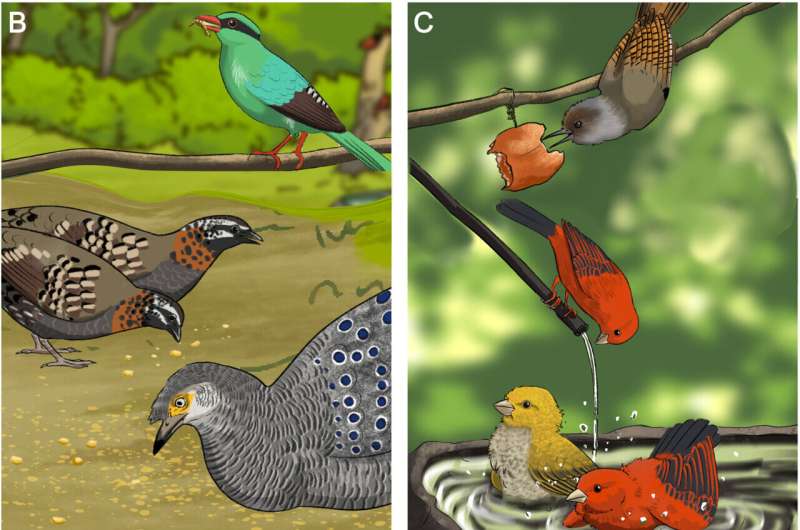
A recent study published in *Avian Research* reveals that the Hide-in-Bird Pond (HIBP) model is transforming avitourism in China. This community-based initiative allows local populations to create artificial ponds and feeding stations, attracting various bird species for observation and photography. The findings indicate that this model not only supports a wide array of avian species but also provides significant supplementary income for rural communities.
Researchers from the Kunming Institute of Zoology at the Chinese Academy of Sciences conducted the first national-scale assessment of the HIBP approach. They performed semi-structured interviews with 98 operators and spatial analysis, identifying 251 HIBP sites across 24 provinces. Notably, approximately 40% of these sites are located in Yunnan Province. Together, they documented a remarkable 524 bird species, which constitutes about 36% of China’s total avifauna. This impressive total includes 148 species that are either nationally protected or globally threatened.
The study highlights that 72% of the HIBP sites are situated within 5 km of protected areas, while 87% are located in economically disadvantaged regions. This significant overlap between HIBP sites and areas exhibiting high biodiversity and socioeconomic challenges underscores the potential of this model to reconcile ecological conservation with rural development.
Researchers assert that HIBP could serve as a viable strategy for providing communities with alternatives to resource-dependent livelihoods, thus enhancing conservation efforts. Nevertheless, the study also points to potential risks stemming from the lack of standardized management protocols, systematic ecological monitoring, and effective regulatory oversight. Without appropriate governance frameworks, the initiative could lead to unintended ecological and management consequences.
In light of these findings, the researchers advocate for science-based guidelines, registration systems, and adaptive management strategies to ensure ecological integrity and long-term sustainability. The evidence presented in this study contributes to ongoing discussions on how community-driven ecotourism can align with international biodiversity goals, such as those outlined in the Kunming-Montreal Global Biodiversity Framework.
The implications of this research extend beyond mere economic benefits, as it offers insights into sustainable development that respects both local communities and biodiversity. By fostering a connection between conservation and rural revitalization, the HIBP model exemplifies how grassroots initiatives can play a pivotal role in preserving ecological heritage while providing livelihoods for those in economically vulnerable areas.
For more information, see Lin He et al., “Hide-in-Bird Pond: A new pathway to synergize biodiversity conservation and sustainable development in China,” *Avian Research* (2026). DOI: 10.1016/j.avrs.2025.100323.

Urgent Swatting Incident Ties Up Emergency Resources in Alabama

Urgent Tax Alert: Claim Your Deductions Before April 15!

Scientists Investigate Cosmic Defects: Where Are They Now?

Spring Bocce Leagues Open Registration in Rapid City

CALV Offers Essential Communication Class for Real Estate Pros

Samsung Galaxy Watch 9 Set for Larger 435mAh Battery Upgrade

Healthy Choice Wellness Reports Earnings, Stock Sees Uptick

Prince Harry Claims to Be ‘Antidote to Andrew’ Amid Royal Crisis

Pet Owners Weigh Kibble Against Fresh Dog Food Options

ALMA Discovers Companion Orbiting Giant Star π 1 Gruis

U.S. Visa Rescheduling Hits H‐1B Applicants as New Vetting Rules Take Effect

University of Hawaiʻi Joins $25.6M AI Project for Disaster Monitoring

F-22 Raptor vs. Su-57 Felon: A 2025 Fighter Jet Comparison

Recent Divorce Judgments from Iberia Parish Court Records

Urgent: Flight Cancellations Loom at Texas Airports Amid Shutdown

Ohio State Study Uncovers Brain Connectivity and Function Links

Frank Dunn, Esteemed Builder and Community Leader, Passes Away at 89

Appian Recognizes 2025 Partner Award Winners for Enterprise Innovation
-
 Science10 months ago
ALMA Discovers Companion Orbiting Giant Star π 1 Gruis
-
 Politics8 months ago
U.S. Visa Rescheduling Hits H‐1B Applicants as New Vetting Rules Take Effect
-
Science10 months ago
University of Hawaiʻi Joins $25.6M AI Project for Disaster Monitoring
-
 World10 months ago
F-22 Raptor vs. Su-57 Felon: A 2025 Fighter Jet Comparison
-
 Politics9 months ago
Recent Divorce Judgments from Iberia Parish Court Records
-
 Top Stories10 months ago
Urgent: Flight Cancellations Loom at Texas Airports Amid Shutdown
-
 Science10 months ago
Ohio State Study Uncovers Brain Connectivity and Function Links
-
 Lifestyle10 months ago
Frank Dunn, Esteemed Builder and Community Leader, Passes Away at 89
-
 Business10 months ago
Appian Recognizes 2025 Partner Award Winners for Enterprise Innovation
-

 World10 months ago
Prince Andrew Faces Fallout from Scandals and Allegations
-

 Entertainment8 months ago
Malachi Barton Tops Google Searches as Disney’s Rising Star of 2025
-

 Top Stories9 months ago
Republican Matt Van Epps Wins Tennessee Special Election