
Science
Celebrating Emmy Noether: A Pioneer in Mathematics Overcoming Adversity

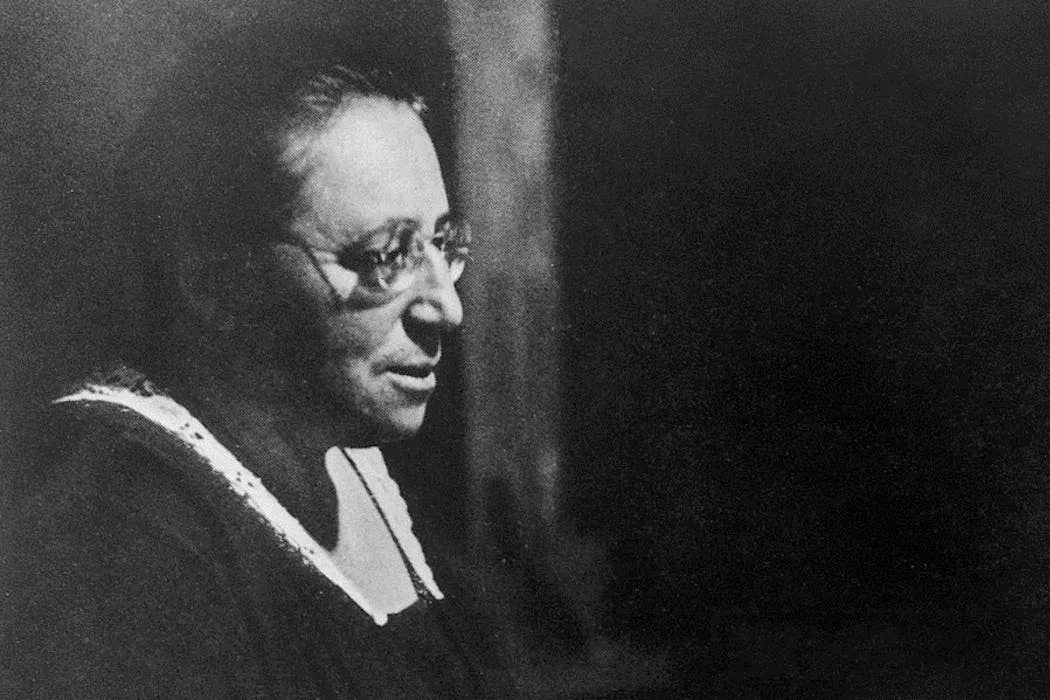
Emmy Noether, a groundbreaking mathematician, faced significant barriers due to sexism and the rise of Nazism during her lifetime. Despite these challenges, her contributions to ring theory continue to influence modern mathematics. In 1935, renowned physicist Albert Einstein penned an obituary for Noether, describing her as a “creative mathematical genius” whose substantial work went largely unrecognized during her life.
Born in 1882 in Erlangen, Germany, Noether grew up in a household steeped in academia, with her father serving as a mathematics professor. However, the societal norms of her time made it seem unlikely that she would follow in his footsteps. Women were largely excluded from academic pursuits, often only able to audit classes without the right to earn degrees. In a turning point for her career, 1903 marked the beginning of women’s enrollment at Erlangen University. Noether seized the opportunity, eventually earning her doctorate in mathematics.
Despite her academic achievements, Noether’s path remained fraught with obstacles. Women were not permitted to teach at universities in Germany, which left her in a precarious position. Undeterred, she continued her mathematical work, unofficially supervising doctoral students. In 1915, she sought a position at the prestigious University of Göttingen. While the dean supported her candidacy, he also expressed a prevailing sentiment of the time, stating that “the female brain is unsuitable for mathematical production.” Unfortunately, the Prussian Ministry of Education blocked her appointment, leading Noether to teach courses under a male faculty member’s name.
A pivotal moment in her career came in 1919 when she finally gained lecturer status at Göttingen. This period allowed her to make significant contributions to theoretical physics, including insights related to Einstein’s theory of relativity. Her most notable work emerged in 1921 with the publication of her paper on ring theory, which transformed the field of mathematics.
Noether’s work in ring theory focuses on mathematical objects called rings, which, contrary to what the name suggests, do not resemble circular shapes. Instead, a ring is defined as a set of elements that allows for addition, subtraction, and multiplication. A fundamental example is the set of integers, known as Z. This foundational work led to the classification of rings into Noetherian rings, which share a common internal structure. This classification has ramifications beyond ring theory, influencing areas such as number theory and algebraic geometry.
The rise of the Nazi regime in 1933 devastated Noether’s academic career. The university received a telegram mandating the removal of six faculty members, including Noether, due to their Jewish heritage. In her calm response, she noted, “This thing is much less terrible for me than it is for many others.” Despite her resilience, she found herself without employment in Germany, where no institution could hire her.
A lifeline emerged from the United States when Bryn Mawr College in Pennsylvania offered her a professorship through a special fund for refugee scholars. During her brief tenure there, she mentored young women in advanced mathematics, continuing to inspire future generations.
Tragically, Noether’s life was cut short in 1935 when she died unexpectedly after surgery. Mathematician Hermann Weyl poignantly remarked that her passing echoed “the thunderclap” of her impact on the field of mathematics.
One hundred years after her landmark contributions, Noether’s legacy endures. Her story serves as a powerful reminder of the hurdles she overcame and the indelible mark she left on mathematics. Noether’s genius and unwavering optimism continue to resonate in the academic community, inspiring both men and women pursuing careers in mathematics today.

Urgent Swatting Incident Ties Up Emergency Resources in Alabama

Urgent Tax Alert: Claim Your Deductions Before April 15!

Scientists Investigate Cosmic Defects: Where Are They Now?

Spring Bocce Leagues Open Registration in Rapid City

CALV Offers Essential Communication Class for Real Estate Pros

Samsung Galaxy Watch 9 Set for Larger 435mAh Battery Upgrade

Healthy Choice Wellness Reports Earnings, Stock Sees Uptick

Prince Harry Claims to Be ‘Antidote to Andrew’ Amid Royal Crisis

Pet Owners Weigh Kibble Against Fresh Dog Food Options

ALMA Discovers Companion Orbiting Giant Star π 1 Gruis

U.S. Visa Rescheduling Hits H‐1B Applicants as New Vetting Rules Take Effect

University of Hawaiʻi Joins $25.6M AI Project for Disaster Monitoring

F-22 Raptor vs. Su-57 Felon: A 2025 Fighter Jet Comparison

Recent Divorce Judgments from Iberia Parish Court Records

Urgent: Flight Cancellations Loom at Texas Airports Amid Shutdown

Ohio State Study Uncovers Brain Connectivity and Function Links

Frank Dunn, Esteemed Builder and Community Leader, Passes Away at 89

Appian Recognizes 2025 Partner Award Winners for Enterprise Innovation
-
 Science9 months ago
ALMA Discovers Companion Orbiting Giant Star π 1 Gruis
-
 Politics7 months ago
U.S. Visa Rescheduling Hits H‐1B Applicants as New Vetting Rules Take Effect
-
Science10 months ago
University of Hawaiʻi Joins $25.6M AI Project for Disaster Monitoring
-
 World10 months ago
F-22 Raptor vs. Su-57 Felon: A 2025 Fighter Jet Comparison
-
 Politics9 months ago
Recent Divorce Judgments from Iberia Parish Court Records
-
 Top Stories10 months ago
Urgent: Flight Cancellations Loom at Texas Airports Amid Shutdown
-
 Science10 months ago
Ohio State Study Uncovers Brain Connectivity and Function Links
-
 Lifestyle10 months ago
Frank Dunn, Esteemed Builder and Community Leader, Passes Away at 89
-
 Business9 months ago
Appian Recognizes 2025 Partner Award Winners for Enterprise Innovation
-

 World10 months ago
Prince Andrew Faces Fallout from Scandals and Allegations
-

 Entertainment8 months ago
Malachi Barton Tops Google Searches as Disney’s Rising Star of 2025
-

 Top Stories9 months ago
Republican Matt Van Epps Wins Tennessee Special Election