
Science
Ariane 6 Rocket Launches with Enhanced Payload Capacity

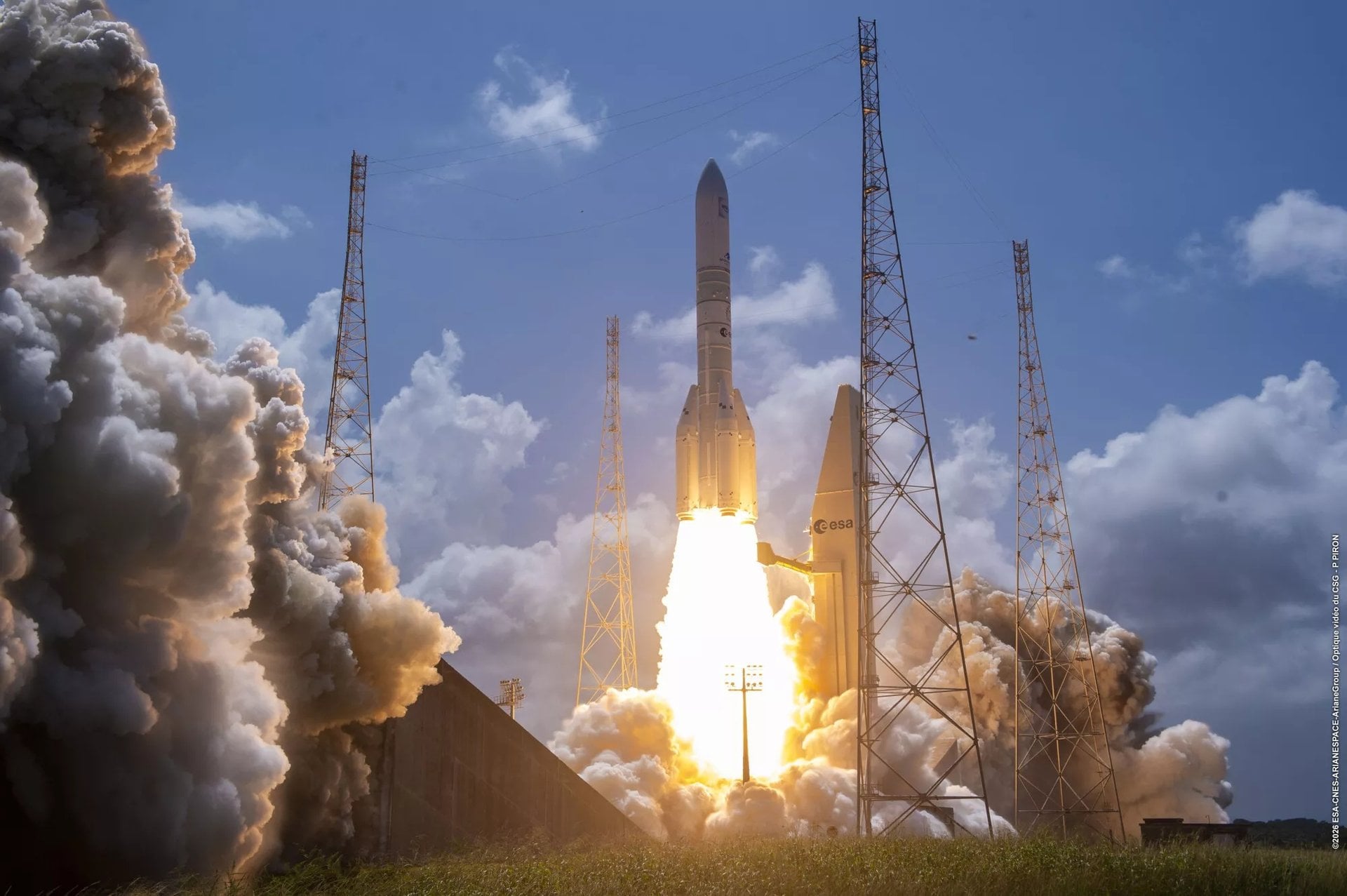
The European Space Agency (ESA) successfully launched the new Ariane 6 rocket on February 12, 2024, marking a significant milestone in European space exploration. The launch took place from Europe’s Spaceport in Kourou, French Guiana, at 13:45 local time (16:45 UTC), and carried a payload of 32 satellites destined for Amazon’s Leo constellation. This mission, designated VA267, underscores the enhanced capabilities of the Ariane 6, which is designed to offer greater versatility and payload capacity than its predecessor, the Ariane 5.
The Ariane 6 rocket operates as a three-stage expendable launch system, featuring a main stage and an upper stage, complemented by strap-on boosters. Its configuration has evolved from the original Ariane 62, which included two strap-on boosters with a medium payload capacity of 10,350 kg (22,820 lb) to Low Earth Orbit (LEO) and 4,500 kg (9,900 lb) to geostationary orbit (GSO). The latest variant, the Ariane 64, is equipped with four strap-on boosters, enabling a heavy-lift capacity of 21,650 kg (47,730 lb) to LEO and 11,500 kg (25,400 lb) to GSO.
New Era for European Space Launches
This launch represents the first time a European rocket has serviced a satellite constellation. The mission is part of a broader agenda, with a total of 18 launches planned to support the Amazon Leo constellation. The successful flight signals a new chapter for the ESA, allowing the organization to pursue ambitious projects ranging from scientific exploration to commercial satellite deployments.
The heavy-lift capabilities of the Ariane 64 mean that the ESA can now extend its launch services to commercial partners, a shift from its previous focus predominantly on government and scientific missions. David Cavaillolès, CEO of Arianespace, emphasized the significance of this development, stating, “The P120C solid rocket booster is one of the largest and most powerful currently in operation.” This booster features a carbon-fibre design and carries approximately 143.6 metric tons (158.3 U.S. tons) of propellant, contributing to its impressive thrust of about 4.5 meganewtons (1,000,000 lbf).
The ESA has released a video showcasing the capabilities of the Ariane 6, highlighting its role in upcoming missions. Notable among these is the PLAnetary Transits and Oscillations of stars (PLATO) satellite, slated for launch in January 2027. This mission aims to enhance the existing exoplanet census by measuring the sizes of distant planets, identifying exomoons, and assessing the habitability of planetary systems.
Future Missions and Lunar Exploration
Another crucial mission on the horizon is the Argonaut lunar lander, which plays a vital role in the ESA’s lunar exploration plans. The agency envisions deploying numerous landers to deliver cargo to the Moon’s surface, facilitating both robotic and crewed missions, including those associated with NASA’s Artemis program. The ultimate goal remains the establishment of an international lunar outpost, providing access to the lunar surface for both ESA and its commercial partners.
As the ESA continues to develop its launch capabilities, the Ariane 6 rocket positions Europe to be a significant player in the global space industry. As Martin Sion, CEO of ArianeGroup, noted, the advancements represented by the Ariane 6 could redefine Europe’s role in space exploration and commercial satellite services.
The successful launch of the Ariane 6 is not just a technical achievement; it marks a pivotal moment that could propel Europe’s ambitions in outer space. As the ESA gears up for future missions, the enhanced capabilities of the Ariane 6 are set to play a central role in the next generation of space exploration and commercial activities.

Urgent Swatting Incident Ties Up Emergency Resources in Alabama

Urgent Tax Alert: Claim Your Deductions Before April 15!

Scientists Investigate Cosmic Defects: Where Are They Now?

Spring Bocce Leagues Open Registration in Rapid City

CALV Offers Essential Communication Class for Real Estate Pros

Samsung Galaxy Watch 9 Set for Larger 435mAh Battery Upgrade

Healthy Choice Wellness Reports Earnings, Stock Sees Uptick

Prince Harry Claims to Be ‘Antidote to Andrew’ Amid Royal Crisis

Pet Owners Weigh Kibble Against Fresh Dog Food Options

ALMA Discovers Companion Orbiting Giant Star π 1 Gruis

U.S. Visa Rescheduling Hits H‐1B Applicants as New Vetting Rules Take Effect

University of Hawaiʻi Joins $25.6M AI Project for Disaster Monitoring

F-22 Raptor vs. Su-57 Felon: A 2025 Fighter Jet Comparison

Recent Divorce Judgments from Iberia Parish Court Records

Urgent: Flight Cancellations Loom at Texas Airports Amid Shutdown

Ohio State Study Uncovers Brain Connectivity and Function Links

Frank Dunn, Esteemed Builder and Community Leader, Passes Away at 89

Appian Recognizes 2025 Partner Award Winners for Enterprise Innovation
-
 Science9 months ago
ALMA Discovers Companion Orbiting Giant Star π 1 Gruis
-
 Politics7 months ago
U.S. Visa Rescheduling Hits H‐1B Applicants as New Vetting Rules Take Effect
-
Science10 months ago
University of Hawaiʻi Joins $25.6M AI Project for Disaster Monitoring
-
 World10 months ago
F-22 Raptor vs. Su-57 Felon: A 2025 Fighter Jet Comparison
-
 Politics9 months ago
Recent Divorce Judgments from Iberia Parish Court Records
-
 Top Stories10 months ago
Urgent: Flight Cancellations Loom at Texas Airports Amid Shutdown
-
 Science10 months ago
Ohio State Study Uncovers Brain Connectivity and Function Links
-
 Lifestyle10 months ago
Frank Dunn, Esteemed Builder and Community Leader, Passes Away at 89
-
 Business9 months ago
Appian Recognizes 2025 Partner Award Winners for Enterprise Innovation
-

 World10 months ago
Prince Andrew Faces Fallout from Scandals and Allegations
-

 Entertainment8 months ago
Malachi Barton Tops Google Searches as Disney’s Rising Star of 2025
-

 Top Stories9 months ago
Republican Matt Van Epps Wins Tennessee Special Election