
Science
Archaeologists Unearth Bronze Age City in Kazakhstan’s Steppe

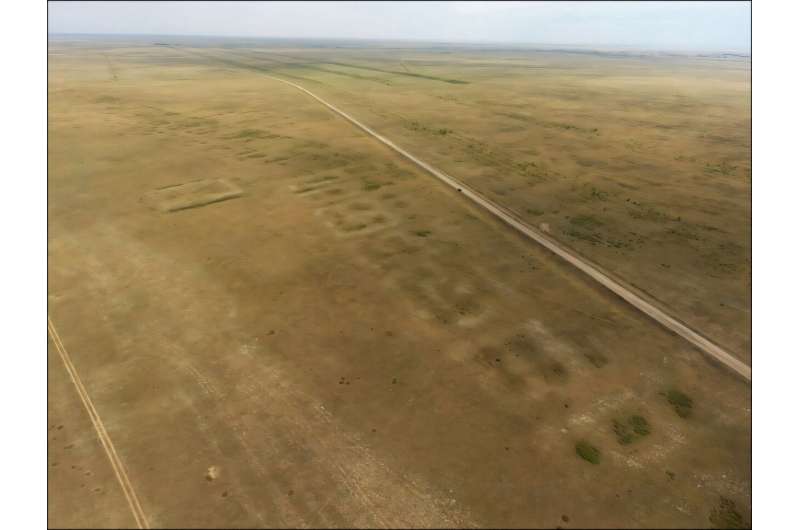
An international team of archaeologists has made a groundbreaking discovery in the Kazakh steppe, unearthing the remains of a vast Bronze Age settlement known as Semiyarka. This site, positioned dramatically above the Irtysh River in northeastern Kazakhstan, offers new insights into urban life and metal production in prehistoric Eurasia, as reported on November 17, 2025.
Covering an impressive area of 140 hectares, Semiyarka has been dubbed the “City of Seven Ravines” due to its strategic location overlooking a network of seven valleys. This settlement, which thrived around 1600 BC, represents a significant departure from the small, scattered camps typically associated with mobile steppe communities. Instead, it showcases an early form of city, featuring organized layouts with rectilinear earthworks, enclosed household compounds, and a central monumental structure that may have served religious or governance purposes.
Revolutionizing Our Understanding of Steppe Societies
The archaeological findings indicate that Semiyarka housed a likely industrial zone dedicated to large-scale production of copper and tin bronze. Excavations and geophysical surveys uncovered crucibles, slag, and tin bronze artifacts, marking the first solid evidence of complex metallurgical operations in this region. The presence of such advanced production systems challenges previous assumptions about the capabilities of steppe societies.
“Semiyarka transforms our understanding of steppe societies,” stated Dr. Miljana Radivojević from the UCL Institute of Archaeology. “It demonstrates that mobile communities were capable of building and sustaining permanent, well-organized settlements centered on large-scale metallurgical production, including the elusive manufacture of tin bronze, a cornerstone of Eurasia’s Bronze Age economy.”
The settlement’s strategic placement also highlights its role as a hub for trade and regional influence. Its proximity to significant copper and tin deposits in the Altai Mountains suggests that Semiyarka was a crucial node within the extensive Bronze Age metal networks that connected Central Asia with other parts of the continent.
Collaboration and Future Excavations
The excavation project was spearheaded by Dr. Viktor Merz and Dr. Ilya Merz from Toraighyrov University in Kazakhstan, alongside Dr. Radivojević and Professor Dan Lawrence from Durham University. Their collaboration has combined innovative methods to reconstruct the social and technological landscape of Bronze Age Kazakhstan.
“The scale and structure of Semiyarka are unlike anything else we’ve seen in the steppe zone,” Professor Lawrence remarked. “The rectilinear compounds and the potentially monumental building show that Bronze Age communities here were developing sophisticated, planned settlements similar to those found in more traditionally urbanized areas of the ancient world.”
Reflecting on the long-term research efforts at the site, Dr. Viktor Merz emphasized the importance of this collaboration. “Having surveyed Semiyarka for many years, this partnership has significantly enhanced our understanding of the site. The expertise brought in from UCL and Durham has been invaluable, and I look forward to the next phase of excavation, where we can leverage their knowledge in archaeometallurgy and landscape archaeology.”
The discovery of Semiyarka stands as a powerful testament to the urban ingenuity of prehistoric societies in Central Asia, revealing that the open grasslands once hosted a vibrant Bronze Age city, thriving above the Irtysh valley. This remarkable site not only enriches our knowledge of ancient civilizations but also prompts further exploration into the complexities of their social and technological advancements.
More information on this discovery can be found in the journal Antiquity, where the team’s findings have been published.

Urgent Swatting Incident Ties Up Emergency Resources in Alabama

Urgent Tax Alert: Claim Your Deductions Before April 15!

Scientists Investigate Cosmic Defects: Where Are They Now?

Spring Bocce Leagues Open Registration in Rapid City

CALV Offers Essential Communication Class for Real Estate Pros

Samsung Galaxy Watch 9 Set for Larger 435mAh Battery Upgrade

Healthy Choice Wellness Reports Earnings, Stock Sees Uptick

Prince Harry Claims to Be ‘Antidote to Andrew’ Amid Royal Crisis

Pet Owners Weigh Kibble Against Fresh Dog Food Options

ALMA Discovers Companion Orbiting Giant Star π 1 Gruis

U.S. Visa Rescheduling Hits H‐1B Applicants as New Vetting Rules Take Effect

University of Hawaiʻi Joins $25.6M AI Project for Disaster Monitoring

F-22 Raptor vs. Su-57 Felon: A 2025 Fighter Jet Comparison

Recent Divorce Judgments from Iberia Parish Court Records

Urgent: Flight Cancellations Loom at Texas Airports Amid Shutdown

Ohio State Study Uncovers Brain Connectivity and Function Links

Frank Dunn, Esteemed Builder and Community Leader, Passes Away at 89

Appian Recognizes 2025 Partner Award Winners for Enterprise Innovation
-
 Science9 months ago
ALMA Discovers Companion Orbiting Giant Star π 1 Gruis
-
 Politics7 months ago
U.S. Visa Rescheduling Hits H‐1B Applicants as New Vetting Rules Take Effect
-
Science10 months ago
University of Hawaiʻi Joins $25.6M AI Project for Disaster Monitoring
-
 World10 months ago
F-22 Raptor vs. Su-57 Felon: A 2025 Fighter Jet Comparison
-
 Politics9 months ago
Recent Divorce Judgments from Iberia Parish Court Records
-
 Top Stories10 months ago
Urgent: Flight Cancellations Loom at Texas Airports Amid Shutdown
-
 Science10 months ago
Ohio State Study Uncovers Brain Connectivity and Function Links
-
 Lifestyle10 months ago
Frank Dunn, Esteemed Builder and Community Leader, Passes Away at 89
-
 Business9 months ago
Appian Recognizes 2025 Partner Award Winners for Enterprise Innovation
-

 World10 months ago
Prince Andrew Faces Fallout from Scandals and Allegations
-

 Entertainment8 months ago
Malachi Barton Tops Google Searches as Disney’s Rising Star of 2025
-

 Top Stories9 months ago
Republican Matt Van Epps Wins Tennessee Special Election