
Science
Antarctica’s Gravity Anomaly Reveals Earth’s Deep Evolution

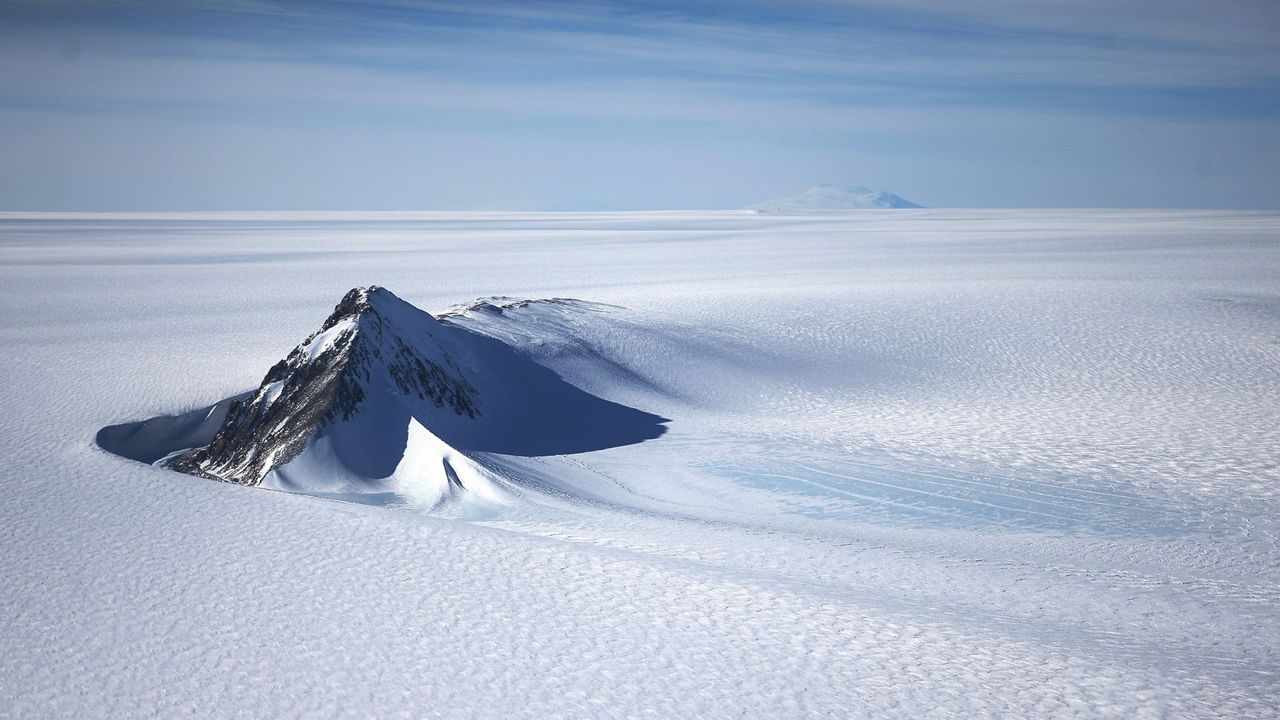
A recent study led by researchers from the University of Florida has uncovered significant insights about Earth’s deep interior through a phenomenon known as the Antarctic Geoid Low, often referred to as a “gravity hole.” This anomaly, located beneath Antarctica, offers a dynamic record of geological processes that have shaped our planet over the past 70 million years. By reconstructing the evolution of this gravity feature, scientists have revealed it to be a persistent indication of the slow, powerful currents of rock beneath the continent.
The Antarctic Geoid Low represents a gentle dip in Earth’s gravity field, indicating how mass is distributed deep within the planet. According to Alessandro Forte, Ph.D., a geophysics professor at the University of Florida and a co-author of the study, this feature is not a fleeting anomaly but rather a long-lasting imprint of deep Earth dynamics. Forte described it as “a window into deep Earth movements over tens of millions of years,” emphasising that these processes can reshape the planet’s gravity field in surprising ways.
While the term “gravity hole” might suggest a hazardous area, the impact on individuals is minimal. For instance, a person weighing 198 pounds (90 kilograms) would experience a weight reduction of merely 5 to 6 grams in this region. Despite its benign effect on human life, the scientific implications of this anomaly are profound, revealing critical information about the arrangement of materials deep within the Earth.
Understanding Gravity Variations
Gravity varies across the globe due to the non-uniform nature of Earth’s interior. Hot, buoyant mantle rock rises, while colder, denser slabs sink. These movements redistribute mass within the planet, subtly altering its gravity field. In Antarctica, where the gravitational pull is slightly weaker, the ocean’s “level surface,” defined by gravity, sits closer to the planet’s center. If Earth were covered by a calm ocean, the water would settle into broad hills and valleys based purely on gravity. The Antarctic Geoid Low, identified as the deepest long-wavelength valley on Earth, is one such valley.
To reconstruct the history of this gravity low, researchers utilized seismic images of the current mantle, acquired from earthquake waves. They ran physics-based models backward in time using high-performance computing. This method allows scientists to simulate how rocks have flowed over millions of years, testing various assumptions about properties such as viscosity, which measures how resistant the mantle is to deformation.
Forte noted, “What surprised me most is how coherent the long-term story appears to be. The gravity low is not a random, short-lived feature.” Their findings indicate that this gravity anomaly has persisted through much of the last 70 million years, with its strength and shape evolving alongside major shifts in the flow of rocks beneath Antarctica.
Implications for Climate and Sea Level
The study highlights that the Antarctic gravity low intensified around the time Antarctica became permanently ice-covered, approximately 34 million years ago. This timing suggests a potentially testable hypothesis: significant changes in Earth’s gravity field may influence regional sea levels and ice-sheet boundaries.
Today, within the Antarctic Geoid Low, the gravity-defined sea surface sits about 394 feet (120 meters) below the global average, a substantial difference in geophysical terms. Gradual changes in this gravitational landscape could affect how regional sea levels are measured in relation to land. While the study does not directly link gravity changes to ice growth, it underscores an internal-Earth process that occurred synchronously with significant climatic shifts.
“Our study illustrates how deep Earth dynamics can reshape the gravity field over geological time,” Forte stated. “Determining whether this has a measurable influence on climate and ice is a separate question that requires additional research.”
Beyond its implications for understanding Earth’s dynamics, the study of Antarctica’s gravity anomaly could also inform planetary science. Long-wavelength gravity anomalies across different celestial bodies, such as Mars and Venus, provide clues about their internal structures and geological histories. Earth stands out as it allows for cross-verification of gravity measurements against seismic data, enabling scientists to reconstruct not only present conditions but also the evolutionary processes that have shaped them.
The findings from this research were published in the journal Scientific Reports on December 19, 2025. This study represents a decade of collaborative research, led by first author Petar Glišović, and builds on ongoing partnerships with seismologists from the University of Texas at Austin who contributed to the critical imaging of Earth’s interior.

Urgent Swatting Incident Ties Up Emergency Resources in Alabama

Urgent Tax Alert: Claim Your Deductions Before April 15!

Scientists Investigate Cosmic Defects: Where Are They Now?

Spring Bocce Leagues Open Registration in Rapid City

CALV Offers Essential Communication Class for Real Estate Pros

Samsung Galaxy Watch 9 Set for Larger 435mAh Battery Upgrade

Healthy Choice Wellness Reports Earnings, Stock Sees Uptick

Prince Harry Claims to Be ‘Antidote to Andrew’ Amid Royal Crisis

Pet Owners Weigh Kibble Against Fresh Dog Food Options

ALMA Discovers Companion Orbiting Giant Star π 1 Gruis

U.S. Visa Rescheduling Hits H‐1B Applicants as New Vetting Rules Take Effect

University of Hawaiʻi Joins $25.6M AI Project for Disaster Monitoring

F-22 Raptor vs. Su-57 Felon: A 2025 Fighter Jet Comparison

Recent Divorce Judgments from Iberia Parish Court Records

Urgent: Flight Cancellations Loom at Texas Airports Amid Shutdown

Ohio State Study Uncovers Brain Connectivity and Function Links

Frank Dunn, Esteemed Builder and Community Leader, Passes Away at 89

Appian Recognizes 2025 Partner Award Winners for Enterprise Innovation
-
 Science9 months ago
ALMA Discovers Companion Orbiting Giant Star π 1 Gruis
-
 Politics7 months ago
U.S. Visa Rescheduling Hits H‐1B Applicants as New Vetting Rules Take Effect
-
Science10 months ago
University of Hawaiʻi Joins $25.6M AI Project for Disaster Monitoring
-
 World10 months ago
F-22 Raptor vs. Su-57 Felon: A 2025 Fighter Jet Comparison
-
 Politics9 months ago
Recent Divorce Judgments from Iberia Parish Court Records
-
 Top Stories10 months ago
Urgent: Flight Cancellations Loom at Texas Airports Amid Shutdown
-
 Science10 months ago
Ohio State Study Uncovers Brain Connectivity and Function Links
-
 Lifestyle10 months ago
Frank Dunn, Esteemed Builder and Community Leader, Passes Away at 89
-
 Business9 months ago
Appian Recognizes 2025 Partner Award Winners for Enterprise Innovation
-

 World10 months ago
Prince Andrew Faces Fallout from Scandals and Allegations
-

 Entertainment8 months ago
Malachi Barton Tops Google Searches as Disney’s Rising Star of 2025
-

 Top Stories9 months ago
Republican Matt Van Epps Wins Tennessee Special Election