
Science
Ancient Pottery Reveals Advanced Math Concepts Over 8,000 Years Ago

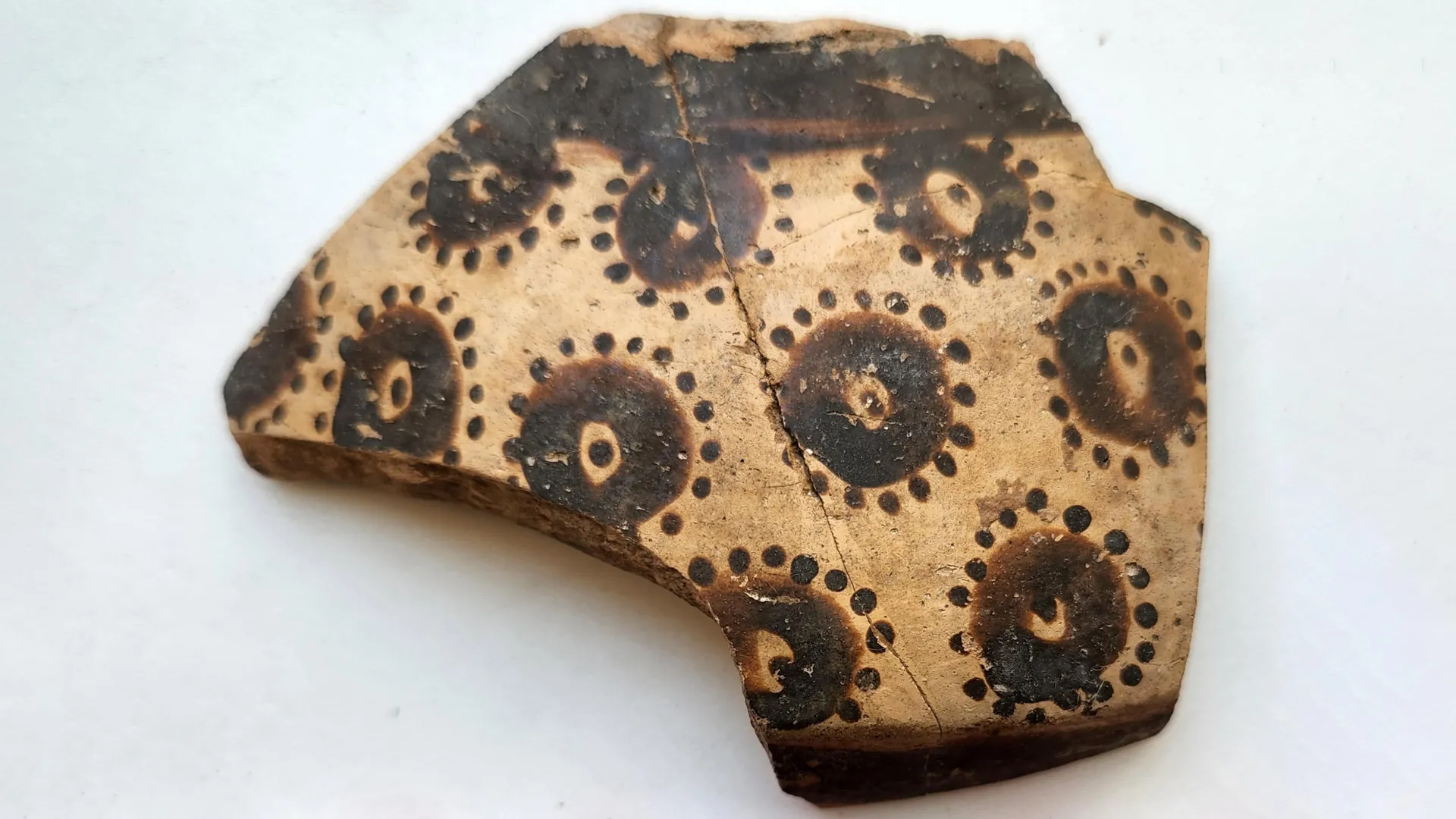
Researchers have uncovered evidence that early farming communities in northern Mesopotamia were engaging in mathematical thinking over 8,000 years ago, well before the advent of written numbers. A study conducted by experts from the Hebrew University of Jerusalem highlights intricate designs on Halafian pottery that reveal a sophisticated understanding of geometry and numerical patterns.
This research, published in the Journal of World Prehistory, indicates that some of the earliest artistic representations of plants served a dual purpose. While these designs were visually appealing, they also reflect early mathematical concepts. Prof. Yosef Garfinkel and researcher Sarah Krulwich traced the consistent use of plant imagery in human art back to the Halafian culture, which thrived between 6200 and 5500 BCE.
Significant Findings in Prehistoric Art
The study examined artifacts from 29 archaeological sites, revealing that early artists carefully arranged floral motifs with striking symmetry. Unlike earlier periods that focused predominantly on animals and human figures, Halafian pottery introduced plants as central themes in artistic expression. The researchers documented hundreds of plant designs, some realistic and others abstract, but all demonstrating intentional composition.
“The pottery represents a pivotal moment in history where people chose to portray the botanical world as worthy of artistic attention,” the authors noted. This shift in focus is linked to the development of village life and a heightened appreciation for aesthetics and symmetry.
Mathematical Precision in Floral Arrangements
One of the most intriguing aspects of the study involves the numerical patterns evident in the floral designs. Many bowls feature flowers arranged in sequences, such as 4, 8, 16, 32, and even 64 petals. The researchers argue these patterns were deliberately designed, showcasing an ability to conceptualize space and symmetry long before the establishment of written numerical systems.
Prof. Garfinkel explained, “The ability to divide space evenly, reflected in these floral motifs, likely had practical roots in daily life, such as sharing harvests or allocating communal fields.” This insight contributes to the emerging field of ethnomathematics, which examines how mathematical ideas manifest through cultural practices and artistic traditions.
The variety of plant motifs identified in the pottery is extensive, but notably, none depict edible plants. This absence suggests that the designs were not intended to document agricultural practices or rituals. Instead, the preference for flowers may indicate an association with positive emotional responses, enhancing their appeal as decorative subjects.
The findings challenge conventional understandings of the origins of mathematics. While written records of mathematical concepts appear much later in Sumer, the Halafian pottery provides evidence of an intuitive form of mathematical reasoning. This reasoning was based on visual organization, symmetry, and repetition rather than written symbols.
As Krulwich stated, “These patterns show that mathematical thinking began long before writing. People visualized divisions, sequences, and balance through their art.” By systematically documenting these plant-based designs, the research sheds light on how early societies perceived their environment and organized communal spaces, revealing complex cognitive abilities that predate formal mathematics.
The study offers a fresh perspective on the intersection of art and mathematics, emphasizing that the roots of mathematical reasoning are deeply intertwined with human creativity and cultural expression.

Urgent Swatting Incident Ties Up Emergency Resources in Alabama

Urgent Tax Alert: Claim Your Deductions Before April 15!

Scientists Investigate Cosmic Defects: Where Are They Now?

Spring Bocce Leagues Open Registration in Rapid City

CALV Offers Essential Communication Class for Real Estate Pros

Samsung Galaxy Watch 9 Set for Larger 435mAh Battery Upgrade

Healthy Choice Wellness Reports Earnings, Stock Sees Uptick

Prince Harry Claims to Be ‘Antidote to Andrew’ Amid Royal Crisis

Pet Owners Weigh Kibble Against Fresh Dog Food Options

ALMA Discovers Companion Orbiting Giant Star π 1 Gruis

U.S. Visa Rescheduling Hits H‐1B Applicants as New Vetting Rules Take Effect

University of Hawaiʻi Joins $25.6M AI Project for Disaster Monitoring

F-22 Raptor vs. Su-57 Felon: A 2025 Fighter Jet Comparison

Recent Divorce Judgments from Iberia Parish Court Records

Ohio State Study Uncovers Brain Connectivity and Function Links

Prince Andrew Faces Fallout from Scandals and Allegations

Urgent: Flight Cancellations Loom at Texas Airports Amid Shutdown

Frank Dunn, Esteemed Builder and Community Leader, Passes Away at 89
-
 Science8 months ago
ALMA Discovers Companion Orbiting Giant Star π 1 Gruis
-
 Politics6 months ago
U.S. Visa Rescheduling Hits H‐1B Applicants as New Vetting Rules Take Effect
-
Science8 months ago
University of Hawaiʻi Joins $25.6M AI Project for Disaster Monitoring
-
 World8 months ago
F-22 Raptor vs. Su-57 Felon: A 2025 Fighter Jet Comparison
-
 Politics8 months ago
Recent Divorce Judgments from Iberia Parish Court Records
-
 Science9 months ago
Ohio State Study Uncovers Brain Connectivity and Function Links
-
 World8 months ago
Prince Andrew Faces Fallout from Scandals and Allegations
-
 Top Stories8 months ago
Urgent: Flight Cancellations Loom at Texas Airports Amid Shutdown
-
 Lifestyle8 months ago
Frank Dunn, Esteemed Builder and Community Leader, Passes Away at 89
-

 Business8 months ago
Appian Recognizes 2025 Partner Award Winners for Enterprise Innovation
-

 Entertainment6 months ago
Malachi Barton Tops Google Searches as Disney’s Rising Star of 2025
-
 Science9 months ago
Innovator Captures Light at 2 Billion Frames Per Second