
Politics
U.S. and Israel Launch Coordinated Strikes Against Iran

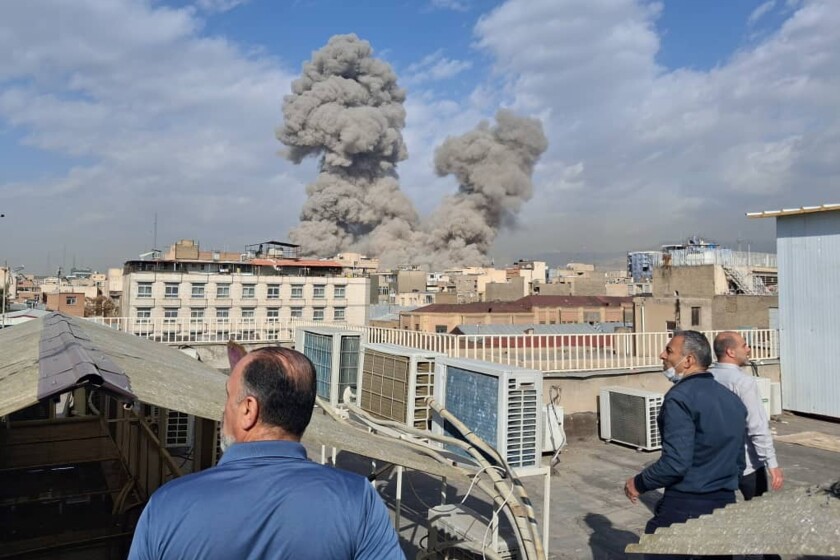
The United States and Israel initiated a series of military strikes against Iran on July 8, 2023, targeting the country’s military capabilities in a significant escalation of hostilities. President Donald Trump characterized the operation as a decisive action aimed at dismantling Iran’s potential to develop nuclear weapons. In a video addressed to the Iranian people, Trump urged them to “seize control of your destiny” and challenge the leadership that has governed since the 1979 revolution.
The Iranian government responded swiftly. The Foreign Ministry vowed to defend the nation, while the Revolutionary Guard launched counterattacks, deploying drones and missiles towards Israel and striking U.S. military installations in Bahrain, Kuwait, and Qatar. Reports indicated that some of the initial strikes targeted areas near the offices of Supreme Leader Ayatollah Ali Khamenei, resulting in visible smoke rising from the capital, Tehran.
The series of strikes marks a dramatic shift in U.S. intervention in Iran, highlighting the increasing tensions in the region. This operation is the second military action taken by the Trump administration against Iran within eight months. The action follows Trump’s previous order for a military operation aimed at capturing Venezuela‘s President Nicolás Maduro.
Iran reported significant casualties from the coordinated strikes, with 40 fatalities at a girls’ school in southern Iran, according to the state-run IRNA news agency. Additionally, at least 45 others were wounded in Minab, part of the Hormozgan province. An Iranian missile strike in Syrian territory reportedly killed four individuals in the city of Sweida.
As the situation escalated, Oman‘s Foreign Minister Badr al-Busaidi expressed dismay over the U.S. and Israeli actions, stating that ongoing diplomatic efforts had been undermined. He emphasized the need for peaceful negotiations, urging the U.S. to reconsider its military approach.
The Israeli government confirmed that the operation had been meticulously planned over several months, with a focus on degrading Iran’s military infrastructure. Trump justified the military action by claiming that Iran had continuously pursued nuclear ambitions while also threatening U.S. interests and allies in the region. He highlighted long-standing grievances against the Iranian regime, which has transformed from a former ally to a principal adversary since the revolution.
Despite the ongoing military actions, Iran’s leaders reiterated their commitment to their nuclear program, asserting their right to enrich uranium. The Iranian government has indicated that it will not engage in discussions regarding its ballistic missile capabilities or its support for armed groups, including Hamas and Hezbollah.
The conflict’s repercussions extend beyond military engagements, with potential consequences for global markets. The Strait of Hormuz, a crucial passage for oil transportation, could be impacted, as approximately 14 million barrels of oil per day transit this route, accounting for about a third of total global maritime oil exports.
As the attacks unfolded, airspace in the United Arab Emirates and Iraq was closed. Reports indicated that missile alerts were issued in Israel, while the Iranian Revolutionary Guard threatened further retaliation. The Iranian-backed Houthis in Yemen also vowed to resume attacks on shipping routes in the Red Sea.
U.S. diplomatic missions in Qatar, United Arab Emirates, and Israel advised their personnel to shelter in place amidst escalating tensions. The ongoing military operations signal a critical juncture in U.S.-Iran relations, leaving many to ponder the implications for regional stability and international security.

Urgent Swatting Incident Ties Up Emergency Resources in Alabama

Urgent Tax Alert: Claim Your Deductions Before April 15!

Scientists Investigate Cosmic Defects: Where Are They Now?

Spring Bocce Leagues Open Registration in Rapid City

CALV Offers Essential Communication Class for Real Estate Pros

Samsung Galaxy Watch 9 Set for Larger 435mAh Battery Upgrade

Healthy Choice Wellness Reports Earnings, Stock Sees Uptick

Prince Harry Claims to Be ‘Antidote to Andrew’ Amid Royal Crisis

Pet Owners Weigh Kibble Against Fresh Dog Food Options

ALMA Discovers Companion Orbiting Giant Star π 1 Gruis

U.S. Visa Rescheduling Hits H‐1B Applicants as New Vetting Rules Take Effect

University of Hawaiʻi Joins $25.6M AI Project for Disaster Monitoring

F-22 Raptor vs. Su-57 Felon: A 2025 Fighter Jet Comparison

Ohio State Study Uncovers Brain Connectivity and Function Links

Recent Divorce Judgments from Iberia Parish Court Records

Prince Andrew Faces Fallout from Scandals and Allegations

Urgent: Flight Cancellations Loom at Texas Airports Amid Shutdown

Frank Dunn, Esteemed Builder and Community Leader, Passes Away at 89
-
 Science8 months ago
ALMA Discovers Companion Orbiting Giant Star π 1 Gruis
-
 Politics6 months ago
U.S. Visa Rescheduling Hits H‐1B Applicants as New Vetting Rules Take Effect
-
Science8 months ago
University of Hawaiʻi Joins $25.6M AI Project for Disaster Monitoring
-
 World8 months ago
F-22 Raptor vs. Su-57 Felon: A 2025 Fighter Jet Comparison
-
 Science8 months ago
Ohio State Study Uncovers Brain Connectivity and Function Links
-
 Politics8 months ago
Recent Divorce Judgments from Iberia Parish Court Records
-
 World8 months ago
Prince Andrew Faces Fallout from Scandals and Allegations
-
 Top Stories8 months ago
Urgent: Flight Cancellations Loom at Texas Airports Amid Shutdown
-
 Lifestyle8 months ago
Frank Dunn, Esteemed Builder and Community Leader, Passes Away at 89
-

 Business8 months ago
Appian Recognizes 2025 Partner Award Winners for Enterprise Innovation
-

 Entertainment6 months ago
Malachi Barton Tops Google Searches as Disney’s Rising Star of 2025
-

 Science9 months ago
Innovator Captures Light at 2 Billion Frames Per Second