
Politics
Trump’s Tariff Announcement Triggers Market Volatility and Recovery

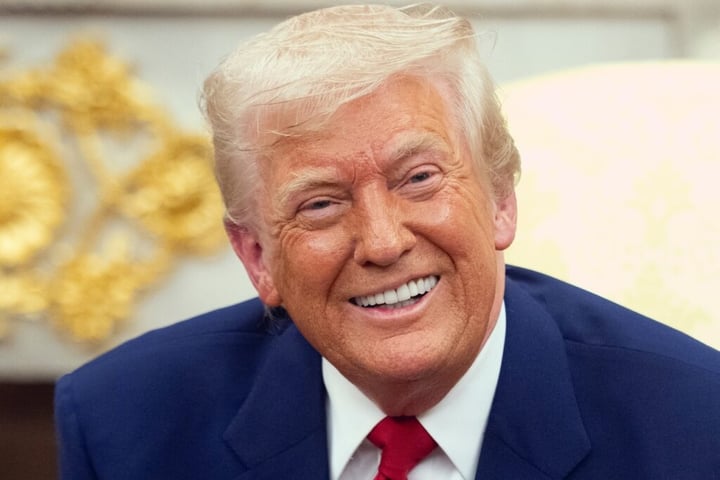
President Donald Trump announced a significant global tariff on April 2, 2025, declaring the day as “Liberation Day.” He introduced a 10% baseline global tariff along with reciprocal duties ranging from 11% to 50% on various countries. This move sent shockwaves through financial markets, leading to immediate and dramatic reactions.
The volatility that followed Trump’s announcement was unprecedented. Over the course of just one week, major indexes experienced both their worst two-day sell-off since the COVID-19 pandemic and one of their strongest single-day rallies. The SPDR S&P 500 ETF Trust (NYSE: SPY) climbed approximately 17% in 2025, reflecting the market’s rollercoaster response to the tariff situation.
Market Reaction to Tariff Announcement
Following the tariff announcement, the financial markets faced extreme fluctuations. According to data from Benzinga Pro, here is a breakdown of the daily market performance in early April 2025:
– **April 3**: The immediate fallout saw the Dow Jones drop by 3.98% (1,679 points), while the S&P 500 and Nasdaq fell by 4.88% and 5.97%, respectively.
– **April 4**: The situation worsened as news of China’s retaliation, implementing a 34% tariff, led to a further decrease of 5.20% (2,231 points) in the Dow.
– **April 7**: Markets experienced wild swings, with unverified rumors of a delay resulting in a 2,500-point intra-day fluctuation. The Dow closed with a slight drop of 0.90%.
– **April 8**: As the baseline 10% tariff took effect, concerns about a potential recession kept volatility high, with the Dow losing 0.80%.
– **April 9**: A turning point occurred when Trump announced a 90-day pause on reciprocal rates for most allies. This led to a remarkable recovery, with the Dow surging by 7.90% (2,962 points).
– **April 10**: The optimism was short-lived as the U.S. raised specific rates on China to 145%, resulting in a 2.50% drop in the Dow.
This sequence of events marked what some analysts have termed the “Black April,” highlighting the extreme volatility and rapid shifts in investor sentiment.
Recovery and Future Outlook
In the months following the initial upheaval, the markets began to stabilize. By mid-summer, Trump’s administration negotiated truce agreements with countries such as the United Kingdom, Japan, and South Korea, which replaced broad tariffs with more targeted investment frameworks. This strategic pivot helped restore investor confidence.
Key takeaways from the initial phase include the staggering loss of approximately $6.6 trillion in market capitalization during the first two days of the turmoil, marking the largest two-day loss on record, according to the Wall Street Journal. Moreover, technology stocks were hit hard; for example, Apple shares plummeted by 9.4%, shedding $315 billion in value during the initial fallout.
As 2025 draws to a close, the market has demonstrated a remarkable recovery. The S&P 500 is projected to finish the year up around 17%, rebounding over 30% from its April lows. The Dow Jones is expected to gain 13% for the year, while the Nasdaq 100 has risen more than 21% and is up over 50% from its April lows. Notably, the Nasdaq remains just 2.25% off its all-time high, set on October 29, 2025, making it the top-performing major U.S. index of the year.
As financial analysts continue to assess the longer-term implications of Trump’s tariff policies, the immediate aftermath serves as a critical lesson in market dynamics and investor psychology.

Urgent Swatting Incident Ties Up Emergency Resources in Alabama

Urgent Tax Alert: Claim Your Deductions Before April 15!

Scientists Investigate Cosmic Defects: Where Are They Now?

Spring Bocce Leagues Open Registration in Rapid City

CALV Offers Essential Communication Class for Real Estate Pros

Samsung Galaxy Watch 9 Set for Larger 435mAh Battery Upgrade

Healthy Choice Wellness Reports Earnings, Stock Sees Uptick

Prince Harry Claims to Be ‘Antidote to Andrew’ Amid Royal Crisis

Pet Owners Weigh Kibble Against Fresh Dog Food Options

ALMA Discovers Companion Orbiting Giant Star π 1 Gruis

U.S. Visa Rescheduling Hits H‐1B Applicants as New Vetting Rules Take Effect

University of Hawaiʻi Joins $25.6M AI Project for Disaster Monitoring

F-22 Raptor vs. Su-57 Felon: A 2025 Fighter Jet Comparison

Ohio State Study Uncovers Brain Connectivity and Function Links

Recent Divorce Judgments from Iberia Parish Court Records

Prince Andrew Faces Fallout from Scandals and Allegations

Urgent: Flight Cancellations Loom at Texas Airports Amid Shutdown

Frank Dunn, Esteemed Builder and Community Leader, Passes Away at 89
-
 Science8 months ago
ALMA Discovers Companion Orbiting Giant Star π 1 Gruis
-
 Politics6 months ago
U.S. Visa Rescheduling Hits H‐1B Applicants as New Vetting Rules Take Effect
-
Science8 months ago
University of Hawaiʻi Joins $25.6M AI Project for Disaster Monitoring
-
 World8 months ago
F-22 Raptor vs. Su-57 Felon: A 2025 Fighter Jet Comparison
-
 Science8 months ago
Ohio State Study Uncovers Brain Connectivity and Function Links
-
 Politics8 months ago
Recent Divorce Judgments from Iberia Parish Court Records
-
 World8 months ago
Prince Andrew Faces Fallout from Scandals and Allegations
-
 Top Stories8 months ago
Urgent: Flight Cancellations Loom at Texas Airports Amid Shutdown
-
 Lifestyle8 months ago
Frank Dunn, Esteemed Builder and Community Leader, Passes Away at 89
-

 Business8 months ago
Appian Recognizes 2025 Partner Award Winners for Enterprise Innovation
-

 Entertainment6 months ago
Malachi Barton Tops Google Searches as Disney’s Rising Star of 2025
-

 Science9 months ago
Innovator Captures Light at 2 Billion Frames Per Second