
Science
Researchers Claim First Direct Detection of Dark Matter via Gamma Rays

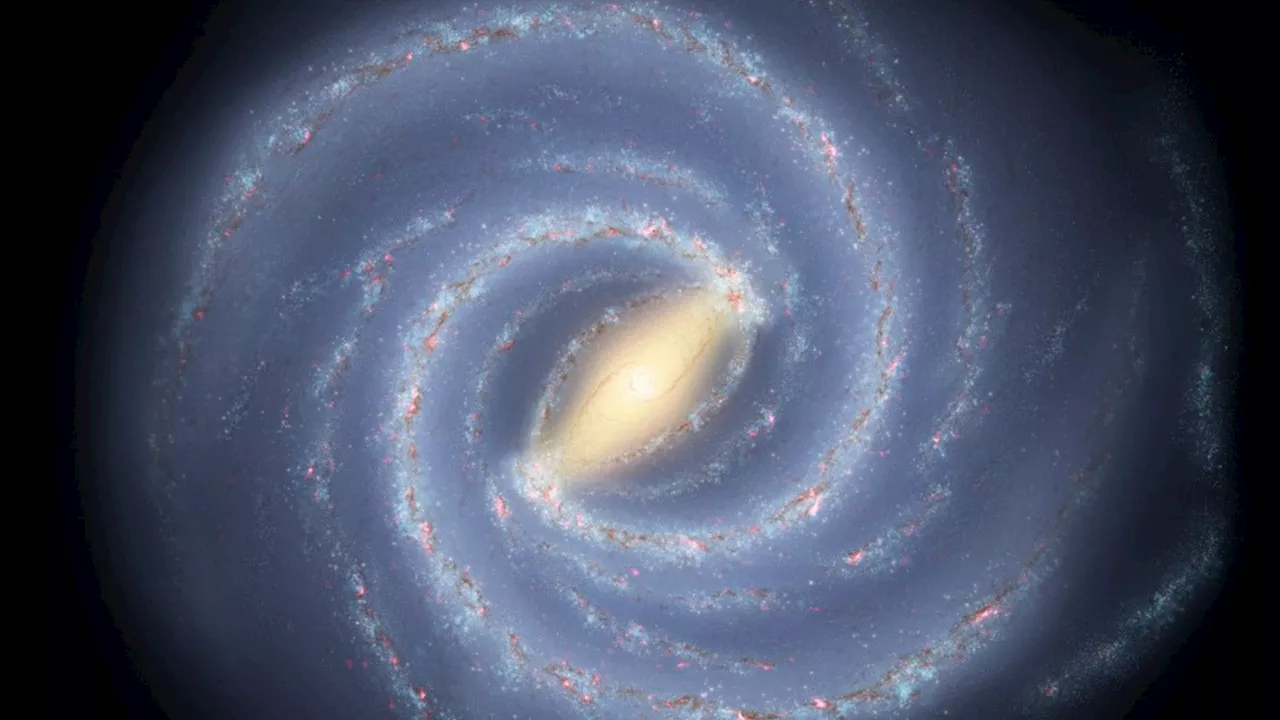
A team of researchers from the University of Tokyo has announced a significant breakthrough in the quest to understand dark matter. They claim to have gathered what they describe as the first “direct evidence” of dark matter, a phenomenon that has eluded scientists for decades. This discovery could represent a pivotal moment in humanity’s understanding of the universe, as it may allow us to “see” the unseen.
The findings stem from data collected by NASA’s Fermi Gamma-ray Space Telescope, a satellite specifically designed to detect high-energy light from across the universe. The team observed gamma rays that align closely with predictions made by theoretical models regarding the annihilation of dark matter particles. Professor Tomonori Totani, from the Department of Astronomy at the University of Tokyo, emphasized the importance of these observations, stating, “If this is correct, it would mark the first time humanity has ‘seen’ dark matter.”
Understanding Dark Matter’s Role
The concept of dark matter dates back to the early 1930s when Swiss astronomer Fritz Zwicky noted that galaxies within the Coma cluster were moving at speeds too high to be accounted for by visible matter alone. He proposed that an unseen substance, which he termed “dunkle Materie,” provided the necessary gravitational force to hold these galaxies together. Over the years, scientists have come to accept that dark matter constitutes approximately 85% of the universe’s total mass, yet direct evidence remained elusive.
Dark matter does not interact with light; it neither absorbs nor emits it. The leading hypothesis suggests that dark matter is made up of Weakly Interacting Massive Particles (WIMPs). When two WIMPs collide, they can annihilate each other, releasing a variety of particles, including gamma-ray photons.
In their recent study, the researchers focused on the center of the Milky Way Galaxy, a region expected to have a high concentration of dark matter. Their analysis revealed an unexpected spike in high-energy gamma rays, specifically detecting emissions with an energy of 20 gigaelectronvolts from the galactic core.
“We detected gamma rays with an extremely large amount of energy, extending in a halo-like structure toward the center of the Milky Way galaxy,” Totani explained. “The gamma-ray emission closely matches the expected shape from the dark matter halo.”
Implications and Next Steps
The energy spectrum detected aligns perfectly with theoretical predictions for WIMP annihilation, suggesting these particles may have a mass approximately 500 times that of a proton. This finding is remarkable, as it provides a precise “fingerprint” of dark matter interactions. Notably, the researchers assert that this specific radiation pattern cannot easily be attributed to other astronomical events, such as supernovae or pulsars.
“This signifies a major development in astronomy and physics,” Totani said. The scientific community is intrigued but cautious about these findings. The results will undergo rigorous scrutiny, and independent research groups will need to verify the signals.
Totani underscored the necessity for additional data to confirm this discovery. Future validation may come from detecting the same 20 GeV gamma-ray signal in other dark matter-rich environments, such as dwarf galaxies orbiting the Milky Way.
On November 25, 2023, the research team published their findings in the Journal of Cosmology and Astroparticle Physics. As scientists continue to delve into the mysteries of dark matter, this potential breakthrough could illuminate one of the universe’s most profound secrets.

Urgent Swatting Incident Ties Up Emergency Resources in Alabama

Urgent Tax Alert: Claim Your Deductions Before April 15!

Scientists Investigate Cosmic Defects: Where Are They Now?

Spring Bocce Leagues Open Registration in Rapid City

CALV Offers Essential Communication Class for Real Estate Pros

Samsung Galaxy Watch 9 Set for Larger 435mAh Battery Upgrade

Healthy Choice Wellness Reports Earnings, Stock Sees Uptick

Prince Harry Claims to Be ‘Antidote to Andrew’ Amid Royal Crisis

Pet Owners Weigh Kibble Against Fresh Dog Food Options

ALMA Discovers Companion Orbiting Giant Star π 1 Gruis

U.S. Visa Rescheduling Hits H‐1B Applicants as New Vetting Rules Take Effect

University of Hawaiʻi Joins $25.6M AI Project for Disaster Monitoring

F-22 Raptor vs. Su-57 Felon: A 2025 Fighter Jet Comparison

Recent Divorce Judgments from Iberia Parish Court Records

Ohio State Study Uncovers Brain Connectivity and Function Links

Urgent: Flight Cancellations Loom at Texas Airports Amid Shutdown

Frank Dunn, Esteemed Builder and Community Leader, Passes Away at 89

Appian Recognizes 2025 Partner Award Winners for Enterprise Innovation
-
 Science9 months ago
ALMA Discovers Companion Orbiting Giant Star π 1 Gruis
-
 Politics8 months ago
U.S. Visa Rescheduling Hits H‐1B Applicants as New Vetting Rules Take Effect
-
Science10 months ago
University of Hawaiʻi Joins $25.6M AI Project for Disaster Monitoring
-
 World10 months ago
F-22 Raptor vs. Su-57 Felon: A 2025 Fighter Jet Comparison
-
 Politics9 months ago
Recent Divorce Judgments from Iberia Parish Court Records
-
 Science10 months ago
Ohio State Study Uncovers Brain Connectivity and Function Links
-
 Top Stories10 months ago
Urgent: Flight Cancellations Loom at Texas Airports Amid Shutdown
-
 Lifestyle10 months ago
Frank Dunn, Esteemed Builder and Community Leader, Passes Away at 89
-
 Business10 months ago
Appian Recognizes 2025 Partner Award Winners for Enterprise Innovation
-

 World10 months ago
Prince Andrew Faces Fallout from Scandals and Allegations
-

 Entertainment8 months ago
Malachi Barton Tops Google Searches as Disney’s Rising Star of 2025
-

 Top Stories9 months ago
Republican Matt Van Epps Wins Tennessee Special Election