
World
Iraqi Security Forces and Yazidis Cast Ballots in Early Election

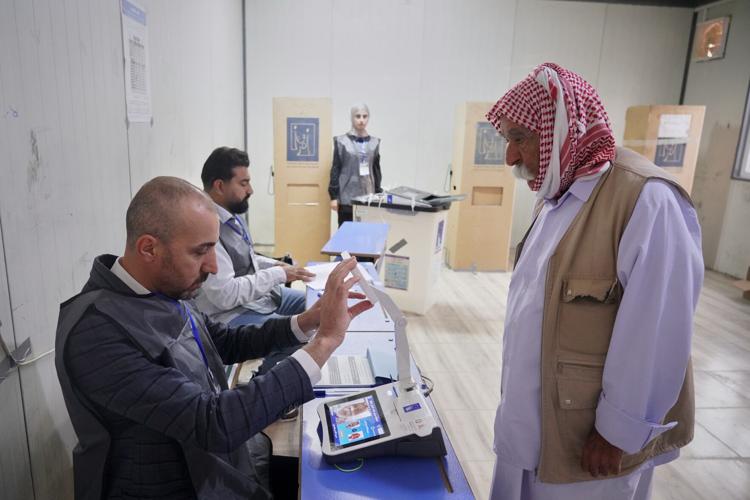
Members of the Iraqi security forces and displaced individuals, including many from the Yazidi community, participated in early voting on March 3, 2024, ahead of the parliamentary elections scheduled for March 5. This election is pivotal as it may determine whether Prime Minister Mohammed Shia al-Sudani secures a second term. The voting occurs amid concerns regarding potential conflicts in the region, notably between Israel and Iran, and Iraq’s delicate balance between Tehran and Washington.
Approximately 1.3 million military and security personnel, along with around 26,000 displaced individuals, are eligible to cast their votes, with a total of 7,744 candidates competing, predominantly from sectarian-aligned parties. Many Yazidis, who fled their homes over a decade ago due to violence from the Islamic State group, voted at a polling station in a camp near Dohuk, located in the semi-autonomous Kurdish region of northern Iraq.
Challenges for Displaced Yazidis
Despite some Yazidis returning to their homes in Sinjar, many still face significant obstacles. Political disputes and a lack of infrastructure prevent a full return. As Khedhir Qassim, a displaced Yazidi from Sinjar, noted, “Eleven years passed and the situation is the same.” He expressed skepticism about the ability of new leaders to effect change, emphasizing the need for support to rebuild their devastated areas.
Another displaced Yazidi, Edris Zozani, indicated his support for the Kurdish Democratic Party (KDP), one of Iraq’s primary Kurdish political entities. He articulated the challenge of independent Yazidi candidates, stating, “If we have independent Yazidi candidates, they wouldn’t be able to represent us effectively.” He believes that candidates aligned with strong political lists, like the KDP, would be better positioned to advocate for the Yazidi community.
Military Voting in Baghdad
In the capital city of Baghdad, early voting also included Iraqi soldiers, police forces, and members of the Popular Mobilization Forces (PMF), a coalition primarily made up of Shiite militias supported by Iran. Although the PMF was formally integrated into Iraq’s military structure in 2016, it continues to operate with considerable autonomy, complicating the relationship between Baghdad and Washington.
One militiaman, who spoke anonymously due to restrictions on media interaction, expressed his support for a list that defends the PMF, though he did not specify further. This sentiment reflects the ongoing tension surrounding the PMF’s role in Iraqi politics and its future, particularly amid legislative discussions about solidifying the ties between the military and the PMF.
The elections not only serve as a critical moment for Iraq’s governance but also highlight the ongoing struggles faced by marginalized communities like the Yazidis. As they navigate the political landscape, many hope for a future that supports their rights and facilitates the rebuilding of their communities.

Urgent Swatting Incident Ties Up Emergency Resources in Alabama

Urgent Tax Alert: Claim Your Deductions Before April 15!

Scientists Investigate Cosmic Defects: Where Are They Now?

Spring Bocce Leagues Open Registration in Rapid City

CALV Offers Essential Communication Class for Real Estate Pros

Samsung Galaxy Watch 9 Set for Larger 435mAh Battery Upgrade

Healthy Choice Wellness Reports Earnings, Stock Sees Uptick

Prince Harry Claims to Be ‘Antidote to Andrew’ Amid Royal Crisis

Pet Owners Weigh Kibble Against Fresh Dog Food Options

ALMA Discovers Companion Orbiting Giant Star π 1 Gruis

U.S. Visa Rescheduling Hits H‐1B Applicants as New Vetting Rules Take Effect

University of Hawaiʻi Joins $25.6M AI Project for Disaster Monitoring

F-22 Raptor vs. Su-57 Felon: A 2025 Fighter Jet Comparison

Recent Divorce Judgments from Iberia Parish Court Records

Urgent: Flight Cancellations Loom at Texas Airports Amid Shutdown

Ohio State Study Uncovers Brain Connectivity and Function Links

Frank Dunn, Esteemed Builder and Community Leader, Passes Away at 89

Appian Recognizes 2025 Partner Award Winners for Enterprise Innovation
-
 Science9 months ago
ALMA Discovers Companion Orbiting Giant Star π 1 Gruis
-
 Politics7 months ago
U.S. Visa Rescheduling Hits H‐1B Applicants as New Vetting Rules Take Effect
-
Science10 months ago
University of Hawaiʻi Joins $25.6M AI Project for Disaster Monitoring
-
 World10 months ago
F-22 Raptor vs. Su-57 Felon: A 2025 Fighter Jet Comparison
-
 Politics9 months ago
Recent Divorce Judgments from Iberia Parish Court Records
-
 Top Stories10 months ago
Urgent: Flight Cancellations Loom at Texas Airports Amid Shutdown
-
 Science10 months ago
Ohio State Study Uncovers Brain Connectivity and Function Links
-
 Lifestyle10 months ago
Frank Dunn, Esteemed Builder and Community Leader, Passes Away at 89
-
 Business9 months ago
Appian Recognizes 2025 Partner Award Winners for Enterprise Innovation
-

 World10 months ago
Prince Andrew Faces Fallout from Scandals and Allegations
-

 Entertainment8 months ago
Malachi Barton Tops Google Searches as Disney’s Rising Star of 2025
-

 Top Stories9 months ago
Republican Matt Van Epps Wins Tennessee Special Election