
Health
Phenoxyl Chemistry Revolutionizes Antibiotic Degradation in Water Treatment

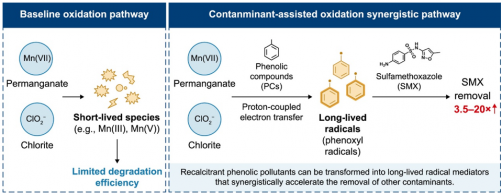
Emerging contaminants, particularly antibiotics and persistent organic pollutants, pose significant threats to global water security and public health. A recent study by researchers from Sichuan University and collaborating institutions has unveiled a novel approach to enhance the degradation of these contaminants through the use of phenoxyl chemistry. Published in the journal Environmental Science and Ecotechnology, this research demonstrates how the presence of phenolic compounds can unexpectedly accelerate the breakdown of antibiotics in wastewater treatment processes.
The study, which focuses on the interactions between various pollutants during oxidation processes, reveals that phenolic compounds, typically viewed as detrimental to treatment efficiency, can actually serve as beneficial mediators. Using sulfamethoxazole, a common antibiotic, as a model, the researchers found that when phenolic contaminants are present, the removal of sulfamethoxazole increased from approximately 15% to nearly complete degradation within minutes under optimized conditions.
In conventional settings, the presence of multiple contaminants often inhibits the effectiveness of advanced oxidation processes, as competing reactions take precedence. However, the findings of this study indicate that phenolic compounds undergo unique proton-coupled electron transfer reactions with permanganate and chlorite, forming stable phenoxyl radicals. Unlike short-lived oxidants, these radicals persist beyond the initial reaction phase, continuing the degradation of antibiotics independently.
The researchers employed a combination of experimental chemistry, spectroscopy, and computational modeling to elucidate the mechanisms at play. Advanced spectroscopic trapping experiments confirmed the existence of phenoxyl radicals, while inhibition tests demonstrated that their removal halted degradation entirely. This indicates a critical role for these radicals in enhancing the treatment process.
Importantly, the study highlights the selective behavior of the radicals, which preferentially target amino-containing antibiotics through radical–radical coupling reactions. The efficiency of this process correlates with the hydrophobicity of the pollutants, revealing a unique selectivity mechanism rarely observed in traditional inorganic oxidation systems. Notably, these radicals maintained their effectiveness even in complex real water matrices that included inorganic ions and natural organic matter, suggesting a robust resistance to environmental interference.
The implications of this research challenge the conventional wisdom that the coexistence of contaminants is inherently detrimental to water treatment efforts. Instead, the study posits that phenolic pollutants can be engineered to facilitate beneficial chemical interactions. The long-lived phenoxyl radicals embody a combination of stability, selectivity, and matrix tolerance—traits that are seldom achieved simultaneously in advanced oxidation systems.
As a result, the findings open new avenues for treating pharmaceutical wastewater, where phenolic byproducts and antibiotics frequently coexist. Rather than removing phenolic compounds prior to treatment, the study suggests that treatment systems could leverage these compounds to enhance oxidation efficiency through controlled pre-oxidation stages. This approach could lead to improved pollutant removal, reduced chemical consumption, and lower operational costs.
The research aligns with a broader move towards “self-adaptive” remediation technologies that utilize contaminant networks rather than treating pollutants in isolation. Future investigations will focus on pilot-scale testing, process optimization, and the development of intelligent control systems designed to adjust oxidant dosing in response to varying wastewater conditions.
In conclusion, the work by the Sichuan University team not only transforms our understanding of pollutant interactions but also sets the stage for smarter water treatment designs that turn the complexity of pollution into an operational advantage. As the challenges of water contamination continue to grow, such innovative solutions will be critical in safeguarding public health and environmental integrity.
For further details, the study is accessible through the DOI: 10.1016/j.ese.2026.100680. The authors acknowledge the financial support from the National Key Research and Development Program of China (2023YFC3210100), the National Natural Science Foundation of China (52470107), and the Sichuan Science and Technology Program (2023NSFSC1949).

Urgent Swatting Incident Ties Up Emergency Resources in Alabama

Urgent Tax Alert: Claim Your Deductions Before April 15!

Scientists Investigate Cosmic Defects: Where Are They Now?

Spring Bocce Leagues Open Registration in Rapid City

CALV Offers Essential Communication Class for Real Estate Pros

Samsung Galaxy Watch 9 Set for Larger 435mAh Battery Upgrade

Healthy Choice Wellness Reports Earnings, Stock Sees Uptick

Prince Harry Claims to Be ‘Antidote to Andrew’ Amid Royal Crisis

Pet Owners Weigh Kibble Against Fresh Dog Food Options

ALMA Discovers Companion Orbiting Giant Star π 1 Gruis

U.S. Visa Rescheduling Hits H‐1B Applicants as New Vetting Rules Take Effect

University of Hawaiʻi Joins $25.6M AI Project for Disaster Monitoring

F-22 Raptor vs. Su-57 Felon: A 2025 Fighter Jet Comparison

Ohio State Study Uncovers Brain Connectivity and Function Links

Recent Divorce Judgments from Iberia Parish Court Records

Prince Andrew Faces Fallout from Scandals and Allegations

Urgent: Flight Cancellations Loom at Texas Airports Amid Shutdown

Frank Dunn, Esteemed Builder and Community Leader, Passes Away at 89
-
 Science8 months ago
ALMA Discovers Companion Orbiting Giant Star π 1 Gruis
-
 Politics6 months ago
U.S. Visa Rescheduling Hits H‐1B Applicants as New Vetting Rules Take Effect
-
Science8 months ago
University of Hawaiʻi Joins $25.6M AI Project for Disaster Monitoring
-
 World8 months ago
F-22 Raptor vs. Su-57 Felon: A 2025 Fighter Jet Comparison
-
 Science8 months ago
Ohio State Study Uncovers Brain Connectivity and Function Links
-
 Politics8 months ago
Recent Divorce Judgments from Iberia Parish Court Records
-
 World8 months ago
Prince Andrew Faces Fallout from Scandals and Allegations
-
 Top Stories8 months ago
Urgent: Flight Cancellations Loom at Texas Airports Amid Shutdown
-
 Lifestyle8 months ago
Frank Dunn, Esteemed Builder and Community Leader, Passes Away at 89
-

 Business8 months ago
Appian Recognizes 2025 Partner Award Winners for Enterprise Innovation
-

 Entertainment6 months ago
Malachi Barton Tops Google Searches as Disney’s Rising Star of 2025
-

 Science9 months ago
Innovator Captures Light at 2 Billion Frames Per Second