
Science
NASA’s Webb Telescope Reveals Surprising Insights in Circinus Galaxy

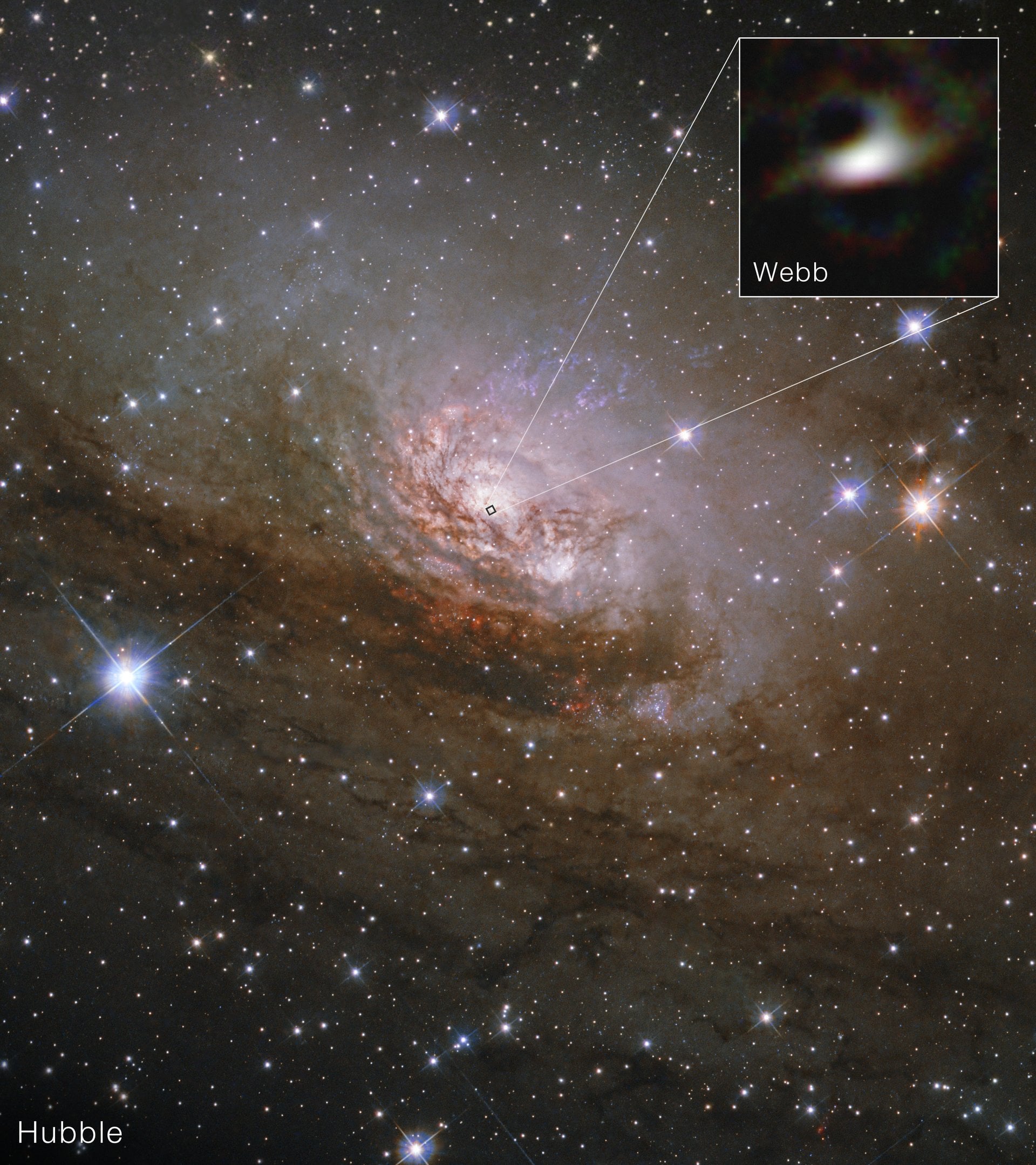
New observations from the NASA/ESA/CSA James Webb Space Telescope (JWST) have provided unprecedented insights into the Circinus Galaxy, located approximately 13 million light-years from Earth. This galaxy contains a supermassive black hole (SMBH) at its center, and the findings challenge existing theories about how these cosmic giants interact with their surroundings.
Supermassive black holes are known to influence the evolution of galaxies by powering Active Galactic Nuclei (AGNs). These AGNs emit radiation so intense that they can temporarily outshine all the stars within a galaxy’s disk. While scientists have long understood the general role of SMBHs, direct observations of their cores have been limited.
The latest data from the JWST reveals that the primary source of infrared light in the Circinus Galaxy’s core is not from outflows of superheated material, as previously thought, but rather from material actively feeding the black hole. This revelation shifts the focus of AGN research and opens new avenues for understanding the dynamics of galaxy cores.
Transformative Techniques Enhance Observations
The challenge of studying AGNs stems from their brightness, which obscures features in the parent galaxy’s interior. In the case of Circinus, the interference of bright starlight added another layer of complexity. For decades, researchers have developed models that categorize different spectra within these regions, but the inability to fully resolve the interior has left some wavelengths elusive.
Using the Aperture Masking Interferometer on the JWST’s Near-Infrared Imager and Slitless Spectrograph (NIRISS), astronomers were able to overcome these obstacles. The innovative instrument employs a special aperture with seven hexagonal holes to combine light from multiple sources. This technique produces interference patterns that can be analyzed to reconstruct the size, shape, and features of distant objects in remarkable detail.
Enrique Lopez-Rodriguez, the lead author from the University of South Carolina, noted in a NASA press release, “Previous models found that most of the infrared emission from the center of Circinus could be traced to outflows.” The new observations confirm that 87% of the infrared emission arises from regions closest to the SMBH, with less than 1% attributable to hot dusty outflows.
Implications for Future Research
Co-author Joel Sanchez-Bermudez from the National University of Mexico expressed excitement about the findings, stating, “The team’s observations revealed that contrary to previous models’ predictions, the infrared excess arises from outflows.” The remaining 12% of infrared emissions were traced to hot dust located farther from the black hole, a detail previously difficult to distinguish.
This groundbreaking research is significant not only for its findings but also for the methodology employed. The use of high-contrast observations by the JWST allows for clearer insights into other nearby black holes. Julien Girard, a senior research scientist at the Space Telescope Science Institute (STScI), emphasized the potential for future studies, saying, “We hope our work inspires other astronomers to use the Aperture Masking Interferometer mode to study faint, but relatively small, dusty structures in the vicinity of any bright object.”
The implications of this research extend beyond the Circinus Galaxy, as further studies could help astronomers establish whether its characteristics are unique or part of a broader trend among other galaxies. The team’s findings were published on January 13, 2024, in *Nature Communications*, marking a significant milestone in the study of AGNs and the role of supermassive black holes in galaxy evolution.

Urgent Swatting Incident Ties Up Emergency Resources in Alabama

Urgent Tax Alert: Claim Your Deductions Before April 15!

Scientists Investigate Cosmic Defects: Where Are They Now?

Spring Bocce Leagues Open Registration in Rapid City

CALV Offers Essential Communication Class for Real Estate Pros

Samsung Galaxy Watch 9 Set for Larger 435mAh Battery Upgrade

Healthy Choice Wellness Reports Earnings, Stock Sees Uptick

Prince Harry Claims to Be ‘Antidote to Andrew’ Amid Royal Crisis

Pet Owners Weigh Kibble Against Fresh Dog Food Options

ALMA Discovers Companion Orbiting Giant Star π 1 Gruis

U.S. Visa Rescheduling Hits H‐1B Applicants as New Vetting Rules Take Effect

University of Hawaiʻi Joins $25.6M AI Project for Disaster Monitoring

F-22 Raptor vs. Su-57 Felon: A 2025 Fighter Jet Comparison

Recent Divorce Judgments from Iberia Parish Court Records

Urgent: Flight Cancellations Loom at Texas Airports Amid Shutdown

Ohio State Study Uncovers Brain Connectivity and Function Links

Frank Dunn, Esteemed Builder and Community Leader, Passes Away at 89

Appian Recognizes 2025 Partner Award Winners for Enterprise Innovation
-
 Science9 months ago
ALMA Discovers Companion Orbiting Giant Star π 1 Gruis
-
 Politics7 months ago
U.S. Visa Rescheduling Hits H‐1B Applicants as New Vetting Rules Take Effect
-
Science10 months ago
University of Hawaiʻi Joins $25.6M AI Project for Disaster Monitoring
-
 World10 months ago
F-22 Raptor vs. Su-57 Felon: A 2025 Fighter Jet Comparison
-
 Politics9 months ago
Recent Divorce Judgments from Iberia Parish Court Records
-
 Top Stories10 months ago
Urgent: Flight Cancellations Loom at Texas Airports Amid Shutdown
-
 Science10 months ago
Ohio State Study Uncovers Brain Connectivity and Function Links
-
 Lifestyle10 months ago
Frank Dunn, Esteemed Builder and Community Leader, Passes Away at 89
-
 Business9 months ago
Appian Recognizes 2025 Partner Award Winners for Enterprise Innovation
-

 World10 months ago
Prince Andrew Faces Fallout from Scandals and Allegations
-

 Entertainment8 months ago
Malachi Barton Tops Google Searches as Disney’s Rising Star of 2025
-

 Top Stories9 months ago
Republican Matt Van Epps Wins Tennessee Special Election