
Top Stories
Boston Dynamics Unveils Atlas Robot Set to Transform Factories

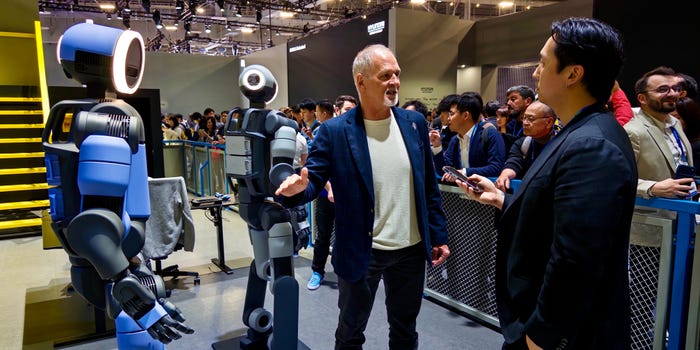
BREAKING: Boston Dynamics has just unveiled its latest humanoid robot, Atlas, poised to revolutionize factory workspaces by 2028. CEO Robert Playter detailed how Atlas, a 200-pound, six-foot-tall machine, will soon assist employees at Hyundai’s Georgia plant, marking a significant step towards automation in manufacturing.
In a groundbreaking demonstration at the Consumer Electronics Show in Las Vegas, Atlas showcased its capabilities by moving car parts with precision and even waving to the audience. This is not just a concept; it’s a glimpse into the future of industry, where robots will increasingly take on tasks traditionally performed by humans.
“We’re starting with the simpler stuff, which is parts sequencing,” Playter explained in an exclusive interview. As the robot’s capabilities evolve, it will transition to more complex roles on the assembly line, potentially transforming the way factories operate. He emphasized, “Robots will enter our homes in five to ten years.”
Atlas, designed for modularity and efficiency, features an all-electric platform, replacing hydraulic systems used in earlier models. Its battery lasts for up to four hours and can be swapped autonomously, showcasing its advanced engineering. Playter described the design process, revealing that the robot’s face is inspired by Disney’s Pixar lamp, aiming to create a friendly, approachable image rather than the “scary, dystopian” faces often seen in robotics.
The CEO, who has been with Boston Dynamics for over 30 years, noted that advancements in artificial intelligence are crucial for the robot’s success. “AI is the enabler that lets a robot like this do a huge variety of tasks,” he said, hinting at the potential for Atlas to learn new tasks rapidly—ideally within 24 to 48 hours.
With the growing anxiety surrounding job displacement due to automation, Playter reassured that the introduction of Atlas will not eliminate jobs but rather enhance them. “Factory workers will become the trainers of these new technologies,” he stated, highlighting the collaborative future of humans and robots in the workplace.
As Boston Dynamics prepares for Atlas’s deployment, they face challenges in ensuring the robot’s reliability and adaptability to various tasks. Playter mentioned the need for a 99.9% reliability rate, which they are working diligently to achieve. “We need robots that can perform a hundred different tasks, not just one or two,” he asserted.
Looking ahead, the integration of Atlas into the Hyundai factory signifies a major leap forward in robotics and automation. The project represents a commitment to increasing productivity in manufacturing, especially as global demographic trends shift and labor forces contract.
As excitement builds around this technological advancement, the implications for the workforce and the future of industrial operations are profound. With Atlas set to redefine what is possible in manufacturing, the world will be watching closely as Boston Dynamics enters this new era.
Stay tuned for more updates on Atlas and its impact on the workplace of tomorrow.

Urgent Swatting Incident Ties Up Emergency Resources in Alabama

Urgent Tax Alert: Claim Your Deductions Before April 15!

Scientists Investigate Cosmic Defects: Where Are They Now?

Spring Bocce Leagues Open Registration in Rapid City

CALV Offers Essential Communication Class for Real Estate Pros

Samsung Galaxy Watch 9 Set for Larger 435mAh Battery Upgrade

Healthy Choice Wellness Reports Earnings, Stock Sees Uptick

Prince Harry Claims to Be ‘Antidote to Andrew’ Amid Royal Crisis

Pet Owners Weigh Kibble Against Fresh Dog Food Options

ALMA Discovers Companion Orbiting Giant Star π 1 Gruis

U.S. Visa Rescheduling Hits H‐1B Applicants as New Vetting Rules Take Effect

University of Hawaiʻi Joins $25.6M AI Project for Disaster Monitoring

F-22 Raptor vs. Su-57 Felon: A 2025 Fighter Jet Comparison

Recent Divorce Judgments from Iberia Parish Court Records

Ohio State Study Uncovers Brain Connectivity and Function Links

Prince Andrew Faces Fallout from Scandals and Allegations

Urgent: Flight Cancellations Loom at Texas Airports Amid Shutdown

Frank Dunn, Esteemed Builder and Community Leader, Passes Away at 89
-
 Science8 months ago
ALMA Discovers Companion Orbiting Giant Star π 1 Gruis
-
 Politics6 months ago
U.S. Visa Rescheduling Hits H‐1B Applicants as New Vetting Rules Take Effect
-
Science8 months ago
University of Hawaiʻi Joins $25.6M AI Project for Disaster Monitoring
-
 World8 months ago
F-22 Raptor vs. Su-57 Felon: A 2025 Fighter Jet Comparison
-
 Politics8 months ago
Recent Divorce Judgments from Iberia Parish Court Records
-
 Science9 months ago
Ohio State Study Uncovers Brain Connectivity and Function Links
-
 World8 months ago
Prince Andrew Faces Fallout from Scandals and Allegations
-
 Top Stories8 months ago
Urgent: Flight Cancellations Loom at Texas Airports Amid Shutdown
-
 Lifestyle8 months ago
Frank Dunn, Esteemed Builder and Community Leader, Passes Away at 89
-

 Business8 months ago
Appian Recognizes 2025 Partner Award Winners for Enterprise Innovation
-

 Entertainment7 months ago
Malachi Barton Tops Google Searches as Disney’s Rising Star of 2025
-

 Top Stories7 months ago
Republican Matt Van Epps Wins Tennessee Special Election