
Science
NASA Reveals Stunning Time-Lapse of Kepler’s Supernova Remnant

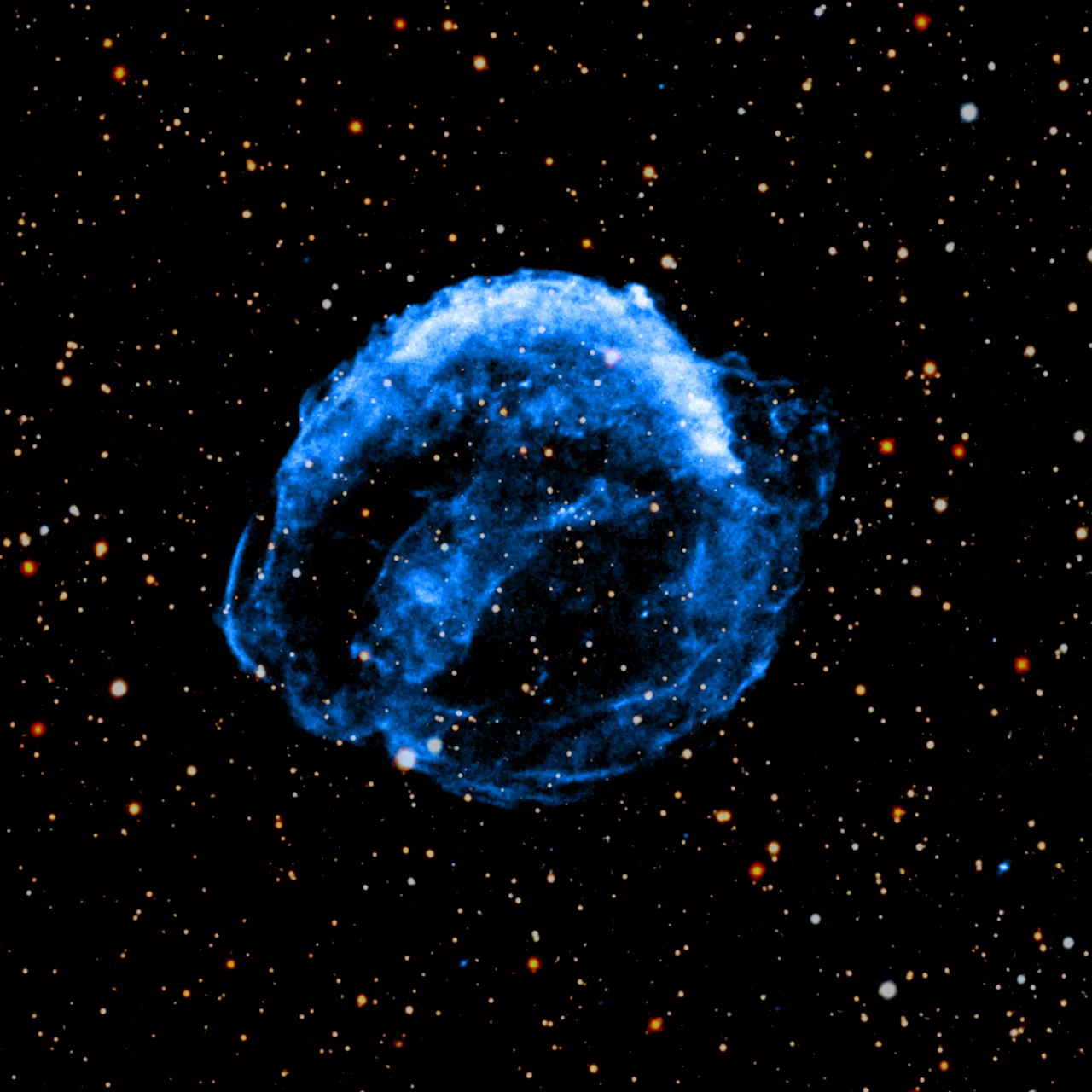
A new video released by NASA showcases the evolution of Kepler’s Supernova Remnant, utilizing data gathered from the Chandra X-ray Observatory over a period exceeding two and a half decades. This remarkable visualization combines X-ray data from multiple years—including 2000, 2004, 2006, 2014, and a projection for 2025—to illustrate the dynamic changes within the remnant of this historic supernova.
Kepler’s Supernova Remnant, named after German astronomer Johannes Kepler, was first observed in the night sky in 1604. Astronomers have since determined that a white dwarf star exploded after exceeding its critical mass, either by pulling material from a companion star or merging with another white dwarf. This phenomenon is classified as a Type Ia supernova, which plays a crucial role in measuring the expansion of the universe.
Located approximately 17,000 light-years from Earth, the remnants of this stellar explosion are known to emit strong X-ray light, a result of the debris being heated to millions of degrees by the blast. The recent video, the longest ever produced by Chandra, was presented by Jessye Gassel, a graduate student at George Mason University, at the 247th meeting of the American Astronomical Society in Phoenix.
The video reveals striking details about the remnant’s expansion. It shows that the fastest-moving sections are traveling at an astonishing 13.8 million miles per hour toward the bottom of the image, while the slower portions are moving at about 4 million miles per hour toward the top. This variance in speed is attributed to the density of the gas that the remnant encounters; the denser gas is situated at the top, affecting the movement of the debris.
“The plot of Kepler’s story is just now beginning to unfold,”
Gassel stated, emphasizing the significance of observing how the remnants from this shattered star interact with pre-existing material in space.
Brian Williams, principal investigator for the new Chandra observations at NASA’s Goddard Space Flight Center, highlighted the importance of supernovae in cosmic creation.
“Supernova explosions and the elements they hurl into space are the lifeblood of new stars and planets,”
he remarked. Understanding their behavior is essential to unraveling our cosmic history.
In addition to analyzing the expansion speeds, the researchers also focused on the characteristics of the blast wave, which is the front edge of the explosion. By measuring the width and speed of the blast wave, astronomers can gather insights into both the initial explosion and its surrounding environment.
NASA’s Marshall Space Flight Center in Huntsville, Alabama, manages the Chandra program, while the Smithsonian Astrophysical Observatory oversees science operations from Cambridge, Massachusetts, and flight operations from Burlington, Massachusetts.
The video, spanning ten seconds and silent, showcases Kepler’s expanding Supernova Remnant, resembling a cloudy neon blue ring with intricate details. As the sequence progresses, the video dramatically illustrates the remnant’s gradual expansion, akin to a balloon inflating. Researchers have captured this transformation in a visually engaging manner, allowing viewers time to absorb the data presented.
Through decades of data collection and analysis, scientists continue to enhance their understanding of the environments into which stars explode. This ongoing research not only sheds light on the life cycle of stars but also contributes to a broader comprehension of the universe’s evolution.

Urgent Swatting Incident Ties Up Emergency Resources in Alabama

Urgent Tax Alert: Claim Your Deductions Before April 15!

Scientists Investigate Cosmic Defects: Where Are They Now?

Spring Bocce Leagues Open Registration in Rapid City

CALV Offers Essential Communication Class for Real Estate Pros

Samsung Galaxy Watch 9 Set for Larger 435mAh Battery Upgrade

Healthy Choice Wellness Reports Earnings, Stock Sees Uptick

Prince Harry Claims to Be ‘Antidote to Andrew’ Amid Royal Crisis

Pet Owners Weigh Kibble Against Fresh Dog Food Options

ALMA Discovers Companion Orbiting Giant Star π 1 Gruis

U.S. Visa Rescheduling Hits H‐1B Applicants as New Vetting Rules Take Effect

University of Hawaiʻi Joins $25.6M AI Project for Disaster Monitoring

F-22 Raptor vs. Su-57 Felon: A 2025 Fighter Jet Comparison

Recent Divorce Judgments from Iberia Parish Court Records

Ohio State Study Uncovers Brain Connectivity and Function Links

Prince Andrew Faces Fallout from Scandals and Allegations

Urgent: Flight Cancellations Loom at Texas Airports Amid Shutdown

Frank Dunn, Esteemed Builder and Community Leader, Passes Away at 89
-
 Science8 months ago
ALMA Discovers Companion Orbiting Giant Star π 1 Gruis
-
 Politics6 months ago
U.S. Visa Rescheduling Hits H‐1B Applicants as New Vetting Rules Take Effect
-
Science8 months ago
University of Hawaiʻi Joins $25.6M AI Project for Disaster Monitoring
-
 World8 months ago
F-22 Raptor vs. Su-57 Felon: A 2025 Fighter Jet Comparison
-
 Politics8 months ago
Recent Divorce Judgments from Iberia Parish Court Records
-
 Science9 months ago
Ohio State Study Uncovers Brain Connectivity and Function Links
-
 World8 months ago
Prince Andrew Faces Fallout from Scandals and Allegations
-
 Top Stories8 months ago
Urgent: Flight Cancellations Loom at Texas Airports Amid Shutdown
-
 Lifestyle8 months ago
Frank Dunn, Esteemed Builder and Community Leader, Passes Away at 89
-

 Business8 months ago
Appian Recognizes 2025 Partner Award Winners for Enterprise Innovation
-

 Entertainment6 months ago
Malachi Barton Tops Google Searches as Disney’s Rising Star of 2025
-

 Science9 months ago
Innovator Captures Light at 2 Billion Frames Per Second