
Science
NASA’s Webb Telescope Uncovers a Strange New Exoplanet

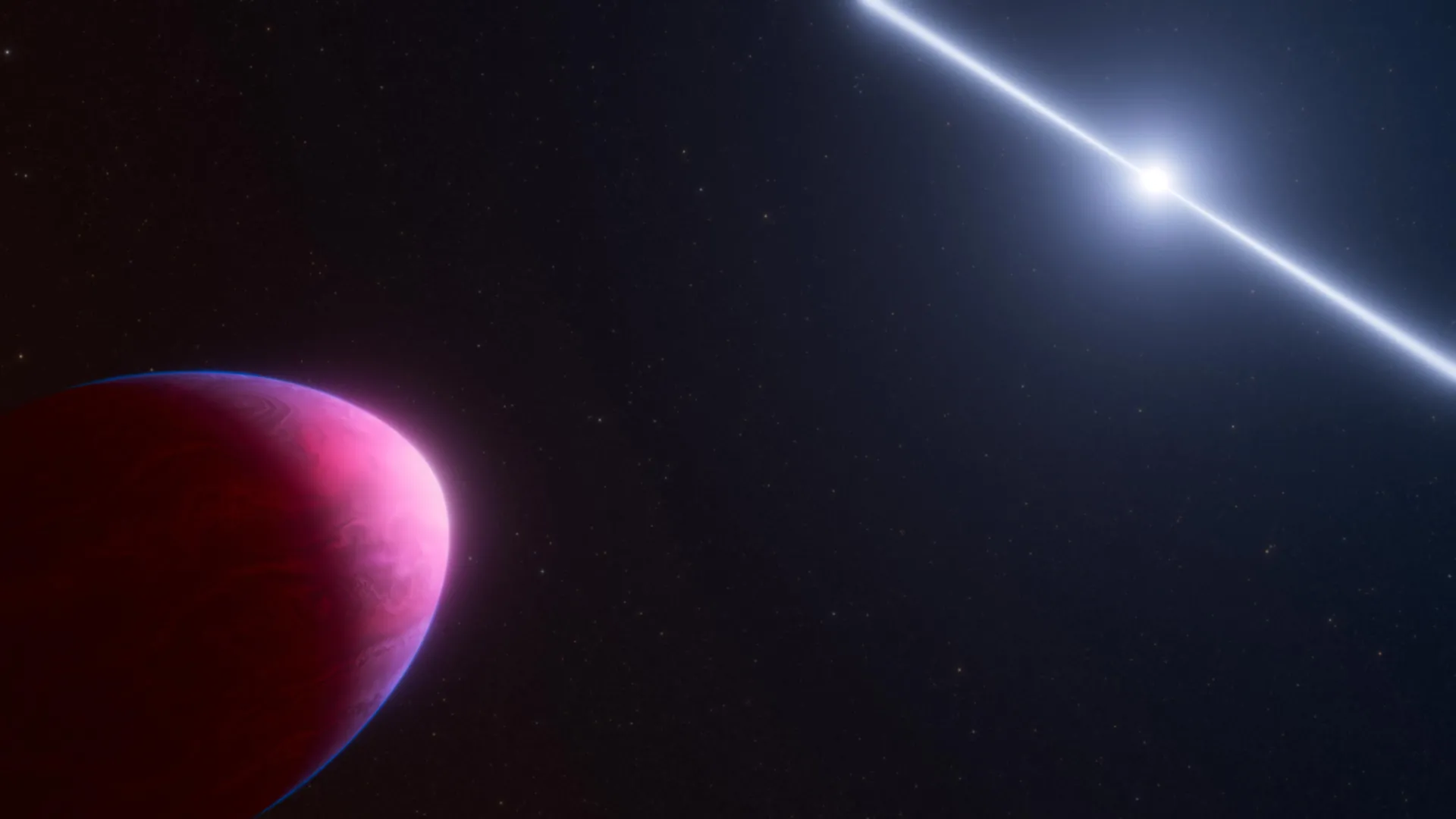
NASA’s James Webb Space Telescope has identified a remarkable exoplanet, designated PSR J2322-2650b, that challenges existing theories of planetary formation. This newly discovered world orbits a neutron star, exhibiting unusual characteristics that could reshape our understanding of planetary science.
A Planet Like No Other
PSR J2322-2650b is a Jupiter-sized exoplanet with a distinctive carbon-rich atmosphere. Unlike typical planetary compositions, its atmosphere is dominated by helium and carbon, shrouded in dark soot-like clouds. Researchers believe that under immense pressure, carbon within these clouds could crystallize into diamonds deep within the planet’s core.
Located just 1 million miles from its host neutron star, this planet completes an orbit in an astounding 7.8 hours. The extreme gravitational forces exerted by the neutron star stretch PSR J2322-2650b into a lemon-like shape, complicating its classification as either a planet or a star.
“This is a new type of planet atmosphere that nobody has ever seen before,” said Michael Zhang, an astrophysicist at the University of Chicago and the study’s principal investigator. The findings have been accepted for publication in The Astrophysical Journal Letters.
Unprecedented Observations
The unique characteristics of PSR J2322-2650b allow scientists to study it in ways that are typically not possible. Maya Beleznay, a graduate student at Stanford University, noted that this system enables researchers to observe the planet illuminated by its host star without the overwhelming brightness usually emitted by stars. “We get a really pristine spectrum,” she explained, enhancing the potential for detailed study.
Upon analyzing the planet’s atmospheric signature, researchers encountered unexpected results. Instead of the familiar molecules such as water or methane, they detected molecular carbon, specifically C3 and C2. “It’s very hard to imagine how you get this extremely carbon-enriched composition,” Zhang remarked. “It seems to rule out every known formation mechanism.”
As the planet orbits so closely to its star, it is subjected to extreme conditions that push the limits of our understanding of planetary atmospheres and structures. The research team is eager to unravel the mysteries surrounding how this unusual planet formed and whether it deviates from typical planetary formation theories.
Leading experts, including Roger Romani of Stanford University, believe that the planet’s carbon-rich atmosphere might result from a unique crystallization process as it cools. “Pure carbon crystals float to the top and get mixed into the helium,” he suggested. However, this theory also raises questions about how other elements are excluded from the atmosphere.
The discovery of PSR J2322-2650b was made possible by the advanced infrared sensitivity of the James Webb Space Telescope. Positioned about a million miles from Earth, Webb utilizes a large sunshield to maintain its instruments at extremely cold temperatures, crucial for detecting faint infrared signals.
Funding for this groundbreaking research was provided by NASA and the Heising-Simons Foundation, with contributions from various researchers at institutions including the University of Chicago. As scientists continue to explore the implications of this discovery, they remain excited about the potential to learn more about the complexities of exoplanetary atmospheres.

Urgent Swatting Incident Ties Up Emergency Resources in Alabama

Urgent Tax Alert: Claim Your Deductions Before April 15!

Scientists Investigate Cosmic Defects: Where Are They Now?

Spring Bocce Leagues Open Registration in Rapid City

CALV Offers Essential Communication Class for Real Estate Pros

Samsung Galaxy Watch 9 Set for Larger 435mAh Battery Upgrade

Healthy Choice Wellness Reports Earnings, Stock Sees Uptick

Prince Harry Claims to Be ‘Antidote to Andrew’ Amid Royal Crisis

Pet Owners Weigh Kibble Against Fresh Dog Food Options

ALMA Discovers Companion Orbiting Giant Star π 1 Gruis

U.S. Visa Rescheduling Hits H‐1B Applicants as New Vetting Rules Take Effect

University of Hawaiʻi Joins $25.6M AI Project for Disaster Monitoring

F-22 Raptor vs. Su-57 Felon: A 2025 Fighter Jet Comparison

Recent Divorce Judgments from Iberia Parish Court Records

Ohio State Study Uncovers Brain Connectivity and Function Links

Prince Andrew Faces Fallout from Scandals and Allegations

Urgent: Flight Cancellations Loom at Texas Airports Amid Shutdown

Frank Dunn, Esteemed Builder and Community Leader, Passes Away at 89
-
 Science8 months ago
ALMA Discovers Companion Orbiting Giant Star π 1 Gruis
-
 Politics6 months ago
U.S. Visa Rescheduling Hits H‐1B Applicants as New Vetting Rules Take Effect
-
Science8 months ago
University of Hawaiʻi Joins $25.6M AI Project for Disaster Monitoring
-
 World8 months ago
F-22 Raptor vs. Su-57 Felon: A 2025 Fighter Jet Comparison
-
 Politics8 months ago
Recent Divorce Judgments from Iberia Parish Court Records
-
 Science9 months ago
Ohio State Study Uncovers Brain Connectivity and Function Links
-
 World8 months ago
Prince Andrew Faces Fallout from Scandals and Allegations
-
 Top Stories8 months ago
Urgent: Flight Cancellations Loom at Texas Airports Amid Shutdown
-
 Lifestyle8 months ago
Frank Dunn, Esteemed Builder and Community Leader, Passes Away at 89
-

 Business8 months ago
Appian Recognizes 2025 Partner Award Winners for Enterprise Innovation
-

 Entertainment6 months ago
Malachi Barton Tops Google Searches as Disney’s Rising Star of 2025
-

 Science9 months ago
Innovator Captures Light at 2 Billion Frames Per Second