
Top Stories
Astronomers Discover Active Star Formation in Cosmic Christmas Tree

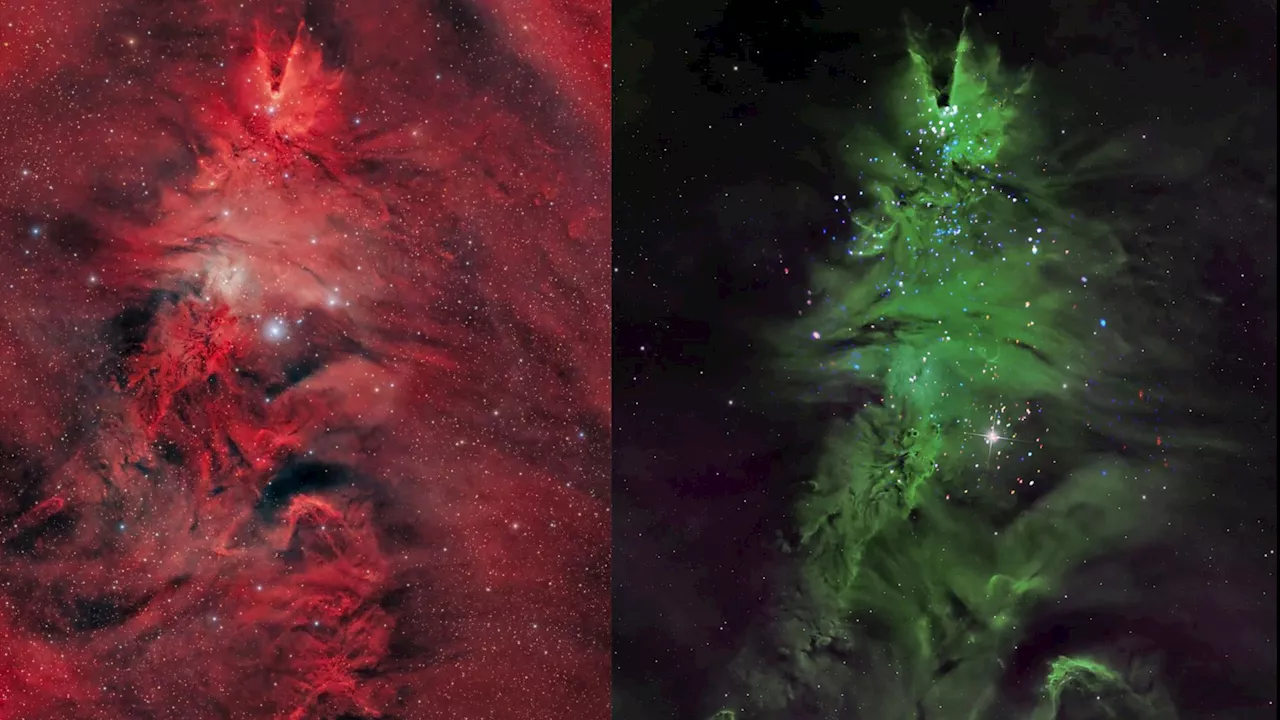
URGENT UPDATE: Astronomers have unveiled exciting new details about a star cluster known as the Cosmic Christmas Tree, located a staggering 2,700 light-years from Earth. This striking formation, nestled within the stellar nursery NGC 2264 in the constellation Monoceros, is a hotbed of active star formation, captivating scientists and stargazers alike.
The Cosmic Christmas Tree gets its name from the distinctive triangular shape created by young stars. These stars are not just beautiful; they are part of a dynamic environment where stellar birth is occurring at an astonishing pace. Observations reveal that this region captures multiple stages of star formation, making it invaluable for astronomers studying the life cycle of stars.
Inside this cosmic wonder, vast clouds of hydrogen gas and thick cosmic dust create a stunning visual contrast. As newborn stars ignite, they emit intense ultraviolet radiation that excites nearby hydrogen atoms, causing regions to glow a vivid red—classified as emission nebulae. Dark dust lanes weave through these glowing areas, while surrounding dust scatters blue wavelengths from hot stars, forming what are known as reflection nebulae.
At the heart of the Cosmic Christmas Tree lies S Monocerotis, a massive, unstable star whose brightness fluctuates dramatically over time, casting a blue glow across the surrounding dust. The cluster itself is composed of dozens of young stars, all born from the same parent cloud and only a few million years old. Their radiation heats nearby gas, and stellar winds carve out cavities in the surrounding clouds, gradually slowing down further star formation.
The region also features the Cone Nebula, a towering pillar of gas and dust, and the Fox Fur Nebula, known for its tangled and textured appearance. These structures are constantly reshaped by the radiation from nearby stars, showcasing the dynamic nature of star formation on a massive scale.
This entire region spans approximately 1.5 degrees in the sky, equivalent to about three full moons placed side by side, representing nearly 80 light-years across at its distance. The Cosmic Christmas Tree not only offers a seasonal visual delight but also serves as a crucial laboratory for understanding how stars form and interact.
As astronomers continue to study this fascinating area, the balance between star formation and the destructive forces from existing stars remains a key focus. The energy emitted by these young stars not only lights up the region but also determines how long star birth can continue in this stellar nursery.
Stay tuned for more updates as research on the Cosmic Christmas Tree advances, offering deeper insights into the complexities of stellar evolution and the universe’s mysteries. This discovery is a reminder of the breathtaking beauty and complexity of our cosmos, inspiring both scientists and the public alike to look up at the night sky with wonder.

Urgent Swatting Incident Ties Up Emergency Resources in Alabama

Urgent Tax Alert: Claim Your Deductions Before April 15!

Scientists Investigate Cosmic Defects: Where Are They Now?

Spring Bocce Leagues Open Registration in Rapid City

CALV Offers Essential Communication Class for Real Estate Pros

Samsung Galaxy Watch 9 Set for Larger 435mAh Battery Upgrade

Healthy Choice Wellness Reports Earnings, Stock Sees Uptick

Prince Harry Claims to Be ‘Antidote to Andrew’ Amid Royal Crisis

Pet Owners Weigh Kibble Against Fresh Dog Food Options

ALMA Discovers Companion Orbiting Giant Star π 1 Gruis

U.S. Visa Rescheduling Hits H‐1B Applicants as New Vetting Rules Take Effect

University of Hawaiʻi Joins $25.6M AI Project for Disaster Monitoring

F-22 Raptor vs. Su-57 Felon: A 2025 Fighter Jet Comparison

Recent Divorce Judgments from Iberia Parish Court Records

Ohio State Study Uncovers Brain Connectivity and Function Links

Prince Andrew Faces Fallout from Scandals and Allegations

Urgent: Flight Cancellations Loom at Texas Airports Amid Shutdown

Frank Dunn, Esteemed Builder and Community Leader, Passes Away at 89
-
 Science8 months ago
ALMA Discovers Companion Orbiting Giant Star π 1 Gruis
-
 Politics6 months ago
U.S. Visa Rescheduling Hits H‐1B Applicants as New Vetting Rules Take Effect
-
Science8 months ago
University of Hawaiʻi Joins $25.6M AI Project for Disaster Monitoring
-
 World8 months ago
F-22 Raptor vs. Su-57 Felon: A 2025 Fighter Jet Comparison
-
 Politics8 months ago
Recent Divorce Judgments from Iberia Parish Court Records
-
 Science9 months ago
Ohio State Study Uncovers Brain Connectivity and Function Links
-
 World9 months ago
Prince Andrew Faces Fallout from Scandals and Allegations
-
 Top Stories8 months ago
Urgent: Flight Cancellations Loom at Texas Airports Amid Shutdown
-
 Lifestyle8 months ago
Frank Dunn, Esteemed Builder and Community Leader, Passes Away at 89
-

 Business8 months ago
Appian Recognizes 2025 Partner Award Winners for Enterprise Innovation
-

 Entertainment7 months ago
Malachi Barton Tops Google Searches as Disney’s Rising Star of 2025
-

 Top Stories7 months ago
Republican Matt Van Epps Wins Tennessee Special Election