
Science
Astronomers Witness Black Hole Eject Matter at 20% Light Speed

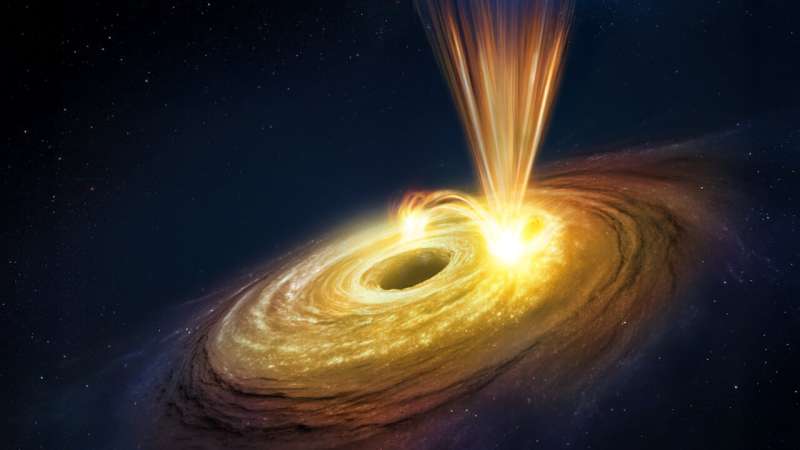
An international team of astronomers has made a remarkable observation of a supermassive black hole ejecting matter at speeds of up to 20% the speed of light. This event occurred near the black hole known as NGC 3783 and was documented over a ten-day observation period, primarily using the XRISM space telescope.
During this time, researchers noted a significant outburst of matter, a phenomenon typically driven by intense radiation. Notably, in this instance, the likely cause is attributed to a sudden change in the magnetic field surrounding the black hole, resembling solar flares on the Sun. This observation marks a groundbreaking moment in astrophysics as it is the first clear instance of high-speed material ejection coinciding with an X-ray burst.
Unique Observations and Implications
The ten-day observation represented the longest continuous monitoring conducted by XRISM to date. Scientists detected fluctuations in X-ray brightness, particularly within the softer X-ray band. While variations in brightness are common for supermassive black holes, the simultaneous expulsion of gas from the black hole’s accretion disk made this event stand out. The expelled gas reached astonishing speeds of approximately 60,000 kilometers per second, or 20% of the speed of light.
The gas ejection appeared to originate from a region roughly 50 times the size of the black hole itself. In this chaotic area, gravitational and magnetic forces interact in extreme conditions. The research team suggests that the ejection event was a result of a mechanism known as magnetic reconnection, where a sudden reconfiguration of magnetic fields releases vast quantities of energy.
Liyi Gu, the lead author of the study published in the journal Astronomy & Astrophysics, stated, “This is a unique opportunity to study the launch mechanism of ultrafast outflows. The data suggest that the acceleration of the outflow is driven by magnetic forces, similar to coronal mass ejections from the Sun.” Such solar events involve substantial blobs of hot plasma being expelled into space.
Broader Significance for Astrophysics
The findings shed light on how black holes not only consume matter but can also eject it back into space under specific conditions. This feedback process is believed to play a crucial role in the evolution of galaxies, influencing the surrounding stars and gas, thereby shaping the observable universe.
This discovery underscores the importance of collaboration among international space agencies and research institutions. The observation involved a coordinated effort from a fleet of seven space missions, with XRISM leading the campaign and receiving support from XMM-Newton, NuSTAR, Hubble, Chandra, Swift, and NICER.
The implications of this research extend beyond understanding black holes, as it provides insights into fundamental astrophysical processes. By studying these extraordinary events, scientists can better comprehend the dynamics of our universe.
For more information, refer to the study titled “Birth of an ultrafast outflow during a soft flare” published in Astronomy & Astrophysics (2025), DOI: 10.1051/0004-6361/202557189. The research was conducted by the SRON Netherlands Institute for Space Research, a credible source in space research and astronomy.

Urgent Swatting Incident Ties Up Emergency Resources in Alabama

Urgent Tax Alert: Claim Your Deductions Before April 15!

Scientists Investigate Cosmic Defects: Where Are They Now?

Spring Bocce Leagues Open Registration in Rapid City

CALV Offers Essential Communication Class for Real Estate Pros

Samsung Galaxy Watch 9 Set for Larger 435mAh Battery Upgrade

Healthy Choice Wellness Reports Earnings, Stock Sees Uptick

Prince Harry Claims to Be ‘Antidote to Andrew’ Amid Royal Crisis

Pet Owners Weigh Kibble Against Fresh Dog Food Options

ALMA Discovers Companion Orbiting Giant Star π 1 Gruis

U.S. Visa Rescheduling Hits H‐1B Applicants as New Vetting Rules Take Effect

University of Hawaiʻi Joins $25.6M AI Project for Disaster Monitoring

F-22 Raptor vs. Su-57 Felon: A 2025 Fighter Jet Comparison

Recent Divorce Judgments from Iberia Parish Court Records

Ohio State Study Uncovers Brain Connectivity and Function Links

Prince Andrew Faces Fallout from Scandals and Allegations

Urgent: Flight Cancellations Loom at Texas Airports Amid Shutdown

Frank Dunn, Esteemed Builder and Community Leader, Passes Away at 89
-
 Science8 months ago
ALMA Discovers Companion Orbiting Giant Star π 1 Gruis
-
 Politics6 months ago
U.S. Visa Rescheduling Hits H‐1B Applicants as New Vetting Rules Take Effect
-
Science8 months ago
University of Hawaiʻi Joins $25.6M AI Project for Disaster Monitoring
-
 World8 months ago
F-22 Raptor vs. Su-57 Felon: A 2025 Fighter Jet Comparison
-
 Politics8 months ago
Recent Divorce Judgments from Iberia Parish Court Records
-
 Science9 months ago
Ohio State Study Uncovers Brain Connectivity and Function Links
-
 World8 months ago
Prince Andrew Faces Fallout from Scandals and Allegations
-
 Top Stories8 months ago
Urgent: Flight Cancellations Loom at Texas Airports Amid Shutdown
-
 Lifestyle8 months ago
Frank Dunn, Esteemed Builder and Community Leader, Passes Away at 89
-

 Business8 months ago
Appian Recognizes 2025 Partner Award Winners for Enterprise Innovation
-

 Entertainment6 months ago
Malachi Barton Tops Google Searches as Disney’s Rising Star of 2025
-
 Science9 months ago
Innovator Captures Light at 2 Billion Frames Per Second