
Business
Denver Real Estate Experts Urge Calm Amid Market Slowdown

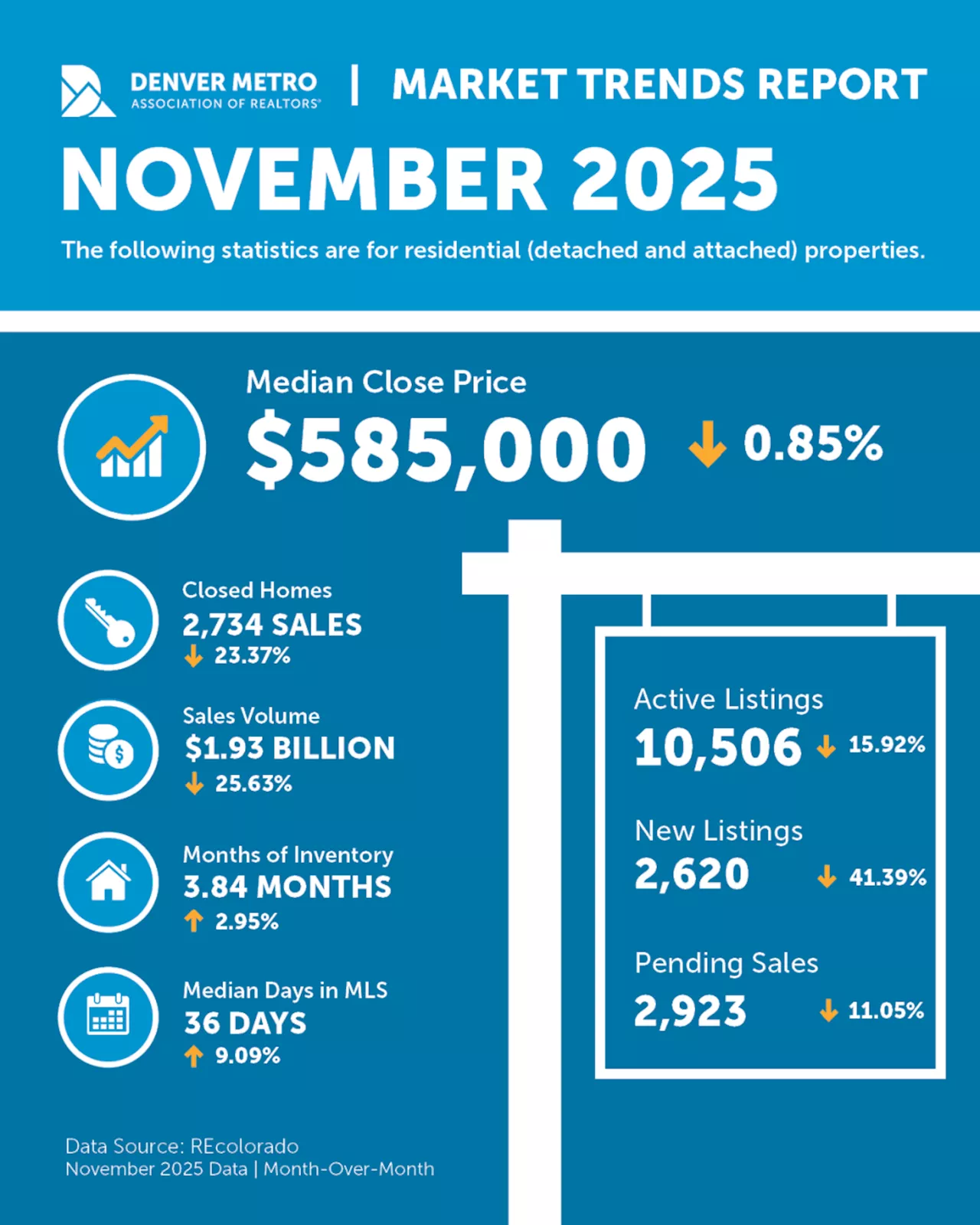
The Denver Metro real estate market is experiencing a winter slowdown, but experts advise against panic. As 2025 nears its conclusion, the market shows a disconnect between perceptions and actual trends. While potential buyers may hesitate, active inventory has surged to a decade-high, providing leverage for those looking to purchase homes.
Amanda Snitker, a member of the DMAR Market Trends Committee, attributes the current market conditions to various economic pressures, including inflation and a prolonged government shutdown. Despite a surge in inventory, the market typically experiences a seasonal decline in new listings during the transition to December. In November, new listings fell by 41% from October, while active inventory saw a decrease of 16%.
In this context, the months of inventory rose to 3.8, marking a 3% increase from the previous month, with the median days on the market extending by 9% to 36 days. According to Susan Thayer, another expert in the field, historical data shows that this seasonal shift is expected. Each year, there are noticeable declines in new listings, pending sales, and closed sales as the market prepares for the holiday season.
Price trends reflect the typical seasonal adjustments, with a slight month-over-month decline in both attached and detached home prices. The median closing price for all closed homes dropped approximately 1% to $585,000. Detached homes saw a similar decrease, dropping to $640,000, while attached homes experienced a slightly steeper decline of 2%, settling at $380,000.
As December progresses, the real estate market in Denver is expected to experience reduced inventory and fewer transactions, consistent with holiday patterns. Many sellers are likely to pause their listings until the new year, aiming to relaunch in January when buyer distractions are fewer.
Snitker reflects on the broader implications of 2025 for Denver’s housing market. “Perhaps 2025’s most significant contribution to Denver’s housing market wasn’t dramatic; it was necessary,” she stated. “This was the year the market needed to recalibrate expectations and reestablish what a typical real estate market actually looks like.”
The year has shifted the narrative from the frenzied bidding wars and double-digit appreciation of previous years to a more balanced market characterized by negotiation and reasonable timelines. Snitker emphasizes that homes sitting on the market for extended periods, such as 29 days, should not be seen as a crisis but rather a return to normalcy. Buyers engaging in negotiations are not exploiting weakness; they are participating in standard real estate transactions.
As the year wraps up, stakeholders in the Denver real estate market are encouraged to take a long-term perspective. The current conditions may reflect the market’s natural adjustments rather than signs of distress. By focusing on these fundamentals, both buyers and sellers can navigate the market with confidence as 2025 transitions into 2026.

Oklahoma Trooper Delivers Baby on Highway in Heartwarming Rescue

Denver Real Estate Experts Urge Calm Amid Market Slowdown

Thomas Markle Faces Amputation Amid Estrangement from Meghan

Sunrise Community Health Renames Clinics to Enhance Accessibility

Explore Five Charming Shops for Holiday Cheer This Season

SEPTA Strike Looms as Union Leaders Prepare for Walkout

AI Accelerates Georeferencing of Plant Specimens for Research

Canadian Dollar Surges as Jobs Report Shocks Markets Today

Park Na Rae Accuses Ex-Managers of Extortion Amid Bullying Claims

Ohio State Study Uncovers Brain Connectivity and Function Links

Hamas Chief Stresses Disarmament Tied to Occupation’s End

University of Hawaiʻi Joins $25.6M AI Project for Disaster Monitoring

Megan Thee Stallion Exposes Alleged Online Attack by Bots

Researchers Challenge 200-Year-Old Physics Principle with Atomic Engines

ALMA Discovers Companion Orbiting Giant Star π 1 Gruis

Paloma Elsesser Shines at LA Event with Iconic Slicked-Back Bun

FDA Unveils Plan to Cut Drug Prices and Boost Biosimilars

Federal Agents Detain Driver in Addison; Protests Erupt Immediately
-
 Science1 month ago
Ohio State Study Uncovers Brain Connectivity and Function Links
-
 Politics1 month ago
Hamas Chief Stresses Disarmament Tied to Occupation’s End
-
Science1 month ago
University of Hawaiʻi Joins $25.6M AI Project for Disaster Monitoring
-
 Entertainment1 month ago
Megan Thee Stallion Exposes Alleged Online Attack by Bots
-
 Science2 months ago
Researchers Challenge 200-Year-Old Physics Principle with Atomic Engines
-
 Science3 weeks ago
ALMA Discovers Companion Orbiting Giant Star π 1 Gruis
-
 Entertainment1 month ago
Paloma Elsesser Shines at LA Event with Iconic Slicked-Back Bun
-
 World1 month ago
FDA Unveils Plan to Cut Drug Prices and Boost Biosimilars
-
 Top Stories1 month ago
Federal Agents Detain Driver in Addison; Protests Erupt Immediately
-

 Business1 month ago
Motley Fool Wealth Management Reduces Medtronic Holdings by 14.7%
-

 Entertainment1 month ago
Beloved Artist and Community Leader Gloria Rosencrants Passes Away
-

 Politics2 months ago
NHP Foundation Secures Land for 158 Affordable Apartments in Denver