
Science
Interstellar Comet 3I/ATLAS Approaches Earth, Captivating Astronomers

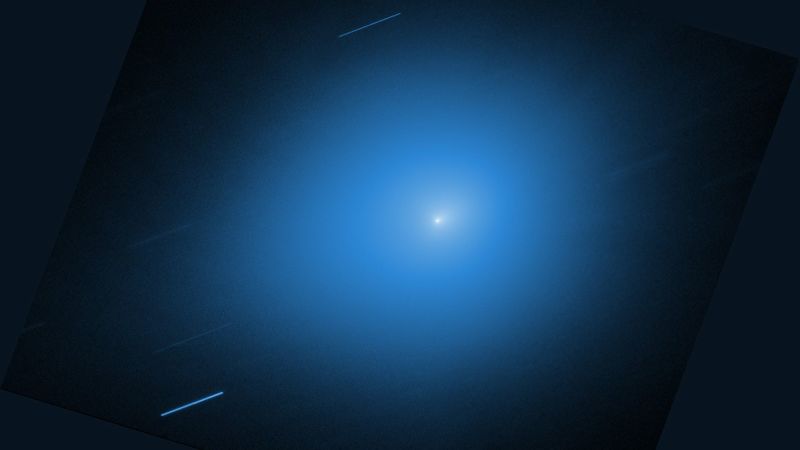
Astronomers are eagerly observing the interstellar comet 3I/ATLAS as it approaches its closest point to Earth on December 19, 2023. This remarkable comet, discovered in July 2023, has drawn attention not only because it is the third interstellar object identified within our solar system but also due to its unique origins outside of our sun’s gravitational influence.
The Hubble Space Telescope and the European Space Agency’s Jupiter Icy Moons Explorer, known as Juice, have recently captured striking images that provide insights into the comet’s features. The Hubble Space Telescope first observed 3I/ATLAS shortly after its discovery, revealing its characteristic teardrop shape. On November 30, 2023, Hubble provided another detailed view when the comet was approximately 178 million miles (286 million kilometers) from Earth.
Insights from Space Missions
The Juice mission, which launched in April 2023 and aims to explore Jupiter and its largest moons—Ganymede, Callisto, and Europa—is also contributing to the study of 3I/ATLAS. At the beginning of November, Juice was positioned roughly 41 million miles (66 million kilometers) from the comet, allowing it to observe and gather data using five scientific instruments and its onboard Navigation Camera, or NavCam.
Due to the spacecraft’s distance from Earth, most of Juice’s data will not arrive until February 2024, as it is currently using its main antenna as a heat shield during its journey to Jupiter. To expedite the process, the Juice team transmitted a quarter of an image captured by NavCam. This image reveals significant activity around the comet, including a coma—a glowing halo of gas—and two distinct tails: a plasma tail composed of charged gas and a fainter dust tail formed from solid particles.
Understanding Comet 3I/ATLAS
Comets like 3I/ATLAS are typically surrounded by a coma and have tails that form as they approach a star, such as the sun. The heating effect causes materials to sublimate, creating these features. As it nears Earth, the comet will come within 167 million miles (270 million kilometers) of our planet, positioned on the other side of the sun, which means it poses no threat to Earth.
NASA has indicated that 3I/ATLAS will remain observable for several months before it exits our solar system. The anticipated data from Juice, expected between February 18 and 20, 2024, will include high-resolution images and composition data that could shed light on the comet’s origins and its journey through space.
As scientists continue to study 3I/ATLAS, this interstellar visitor offers a rare opportunity to learn about celestial bodies from beyond our solar system, potentially enhancing our understanding of the universe.

Urgent Swatting Incident Ties Up Emergency Resources in Alabama

Urgent Tax Alert: Claim Your Deductions Before April 15!

Scientists Investigate Cosmic Defects: Where Are They Now?

Spring Bocce Leagues Open Registration in Rapid City

CALV Offers Essential Communication Class for Real Estate Pros

Samsung Galaxy Watch 9 Set for Larger 435mAh Battery Upgrade

Healthy Choice Wellness Reports Earnings, Stock Sees Uptick

Prince Harry Claims to Be ‘Antidote to Andrew’ Amid Royal Crisis

Pet Owners Weigh Kibble Against Fresh Dog Food Options

ALMA Discovers Companion Orbiting Giant Star π 1 Gruis

U.S. Visa Rescheduling Hits H‐1B Applicants as New Vetting Rules Take Effect

University of Hawaiʻi Joins $25.6M AI Project for Disaster Monitoring

F-22 Raptor vs. Su-57 Felon: A 2025 Fighter Jet Comparison

Ohio State Study Uncovers Brain Connectivity and Function Links

Recent Divorce Judgments from Iberia Parish Court Records

Prince Andrew Faces Fallout from Scandals and Allegations

Urgent: Flight Cancellations Loom at Texas Airports Amid Shutdown

Frank Dunn, Esteemed Builder and Community Leader, Passes Away at 89
-
 Science8 months ago
ALMA Discovers Companion Orbiting Giant Star π 1 Gruis
-
 Politics6 months ago
U.S. Visa Rescheduling Hits H‐1B Applicants as New Vetting Rules Take Effect
-
Science8 months ago
University of Hawaiʻi Joins $25.6M AI Project for Disaster Monitoring
-
 World8 months ago
F-22 Raptor vs. Su-57 Felon: A 2025 Fighter Jet Comparison
-
 Science9 months ago
Ohio State Study Uncovers Brain Connectivity and Function Links
-
 Politics8 months ago
Recent Divorce Judgments from Iberia Parish Court Records
-
 World8 months ago
Prince Andrew Faces Fallout from Scandals and Allegations
-
 Top Stories8 months ago
Urgent: Flight Cancellations Loom at Texas Airports Amid Shutdown
-
 Lifestyle8 months ago
Frank Dunn, Esteemed Builder and Community Leader, Passes Away at 89
-

 Business8 months ago
Appian Recognizes 2025 Partner Award Winners for Enterprise Innovation
-

 Entertainment6 months ago
Malachi Barton Tops Google Searches as Disney’s Rising Star of 2025
-

 Science9 months ago
Innovator Captures Light at 2 Billion Frames Per Second