
Science
Researchers Unveil ‘OCTOID,’ an Innovative Color-Changing Soft Robot

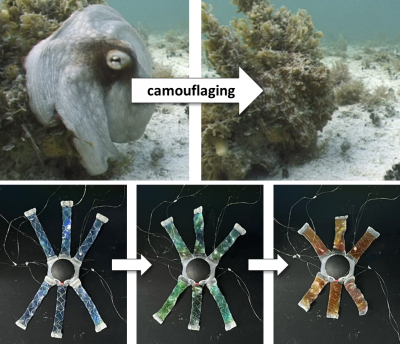
A research team led by Dr. Dae-Yoon Kim at the Korea Institute of Science and Technology (KIST) has introduced a groundbreaking soft robot named ‘OCTOID’. This innovative technology mimics the remarkable camouflage and movement capabilities of octopuses, enabling the robot to change both its color and shape dynamically.
The OCTOID robot stands out for its ability to respond to electrical stimulation. Unlike traditional soft robots that primarily bend or stretch, OCTOID can alter its appearance to blend into its environment while also moving and grasping objects effectively. This multifunctionality opens new avenues for robotics applications, particularly in environments where adaptability is crucial.
Technical Specifications and Functionality
The development of OCTOID represents a significant advancement in soft robotics. The robot comprises advanced composite materials that allow for its unique properties. When electrical currents are applied, specific parts of the robot can change color, mimicking the natural patterns found in cephalopods. This feature enhances its ability to camouflage, making it suitable for use in surveillance or exploration in diverse settings.
Moreover, OCTOID’s movement capabilities are designed to be fluid and responsive. It can navigate complex terrains and adjust its grasp on various objects, which could have implications in fields ranging from search and rescue operations to delicate assembly tasks in manufacturing.
Research conducted at KIST emphasizes the importance of interdisciplinary collaboration in bringing such innovations to life. Under the leadership of Sangrok Oh, KIST continues to focus on developing technologies that integrate seamlessly with human environments, enhancing both safety and efficiency.
Potential Applications and Future Developments
The implications of OCTOID extend beyond mere novelty. Experts believe that the technology could revolutionize industries like healthcare, where robots are increasingly being used for patient care and rehabilitation. By mimicking human-like movements and adapting to various scenarios, OCTOID could provide more effective support in therapeutic settings.
As research and development continue, the team at KIST plans to explore further enhancements to OCTOID’s capabilities. Future iterations may incorporate more sophisticated sensors for improved environmental interaction, paving the way for more autonomous operations.
In summary, OCTOID exemplifies the potential of soft robotics to transform how machines can interact with the world. With its ability to change color and shape, this innovative robot not only represents a step forward in technology but also highlights the intricate connections between biology and engineering.

Urgent: Family Conflict Escalates as Brother Alienates Loved Ones

Urgent FX Option Expiries Today: EUR/USD and USD/JPY Key Levels

Paragon Banking Group Launches Share Buyback Program Amid Analyst Upgrades

Clippers Shocked by Chris Paul’s Departure After Late-Night Talks

New $1.6M Program to Enhance Opioid Response Training in Maine

Emmie Streams Transforms into Starting Guard for UMaine Women’s Basketball

Navigating Friendship and Gift-Giving During the Holidays

Researchers Unveil ‘OCTOID,’ an Innovative Color-Changing Soft Robot

Urgent Insights: Friendships Strained by Social Media Dynamics

Ohio State Study Uncovers Brain Connectivity and Function Links

Hamas Chief Stresses Disarmament Tied to Occupation’s End

University of Hawaiʻi Joins $25.6M AI Project for Disaster Monitoring

Megan Thee Stallion Exposes Alleged Online Attack by Bots

Researchers Challenge 200-Year-Old Physics Principle with Atomic Engines

Paloma Elsesser Shines at LA Event with Iconic Slicked-Back Bun

FDA Unveils Plan to Cut Drug Prices and Boost Biosimilars

ALMA Discovers Companion Orbiting Giant Star π 1 Gruis

Federal Agents Detain Driver in Addison; Protests Erupt Immediately
-
 Science1 month ago
Ohio State Study Uncovers Brain Connectivity and Function Links
-
 Politics1 month ago
Hamas Chief Stresses Disarmament Tied to Occupation’s End
-
Science1 month ago
University of Hawaiʻi Joins $25.6M AI Project for Disaster Monitoring
-
 Entertainment1 month ago
Megan Thee Stallion Exposes Alleged Online Attack by Bots
-
 Science2 months ago
Researchers Challenge 200-Year-Old Physics Principle with Atomic Engines
-
 Entertainment1 month ago
Paloma Elsesser Shines at LA Event with Iconic Slicked-Back Bun
-
 World1 month ago
FDA Unveils Plan to Cut Drug Prices and Boost Biosimilars
-
 Science3 weeks ago
ALMA Discovers Companion Orbiting Giant Star π 1 Gruis
-
 Top Stories1 month ago
Federal Agents Detain Driver in Addison; Protests Erupt Immediately
-

 Business1 month ago
Motley Fool Wealth Management Reduces Medtronic Holdings by 14.7%
-

 Entertainment1 month ago
Beloved Artist and Community Leader Gloria Rosencrants Passes Away
-

 Politics2 months ago
NHP Foundation Secures Land for 158 Affordable Apartments in Denver