
Science
New Study Links West Texas Rock Art to Mesoamerican Beliefs

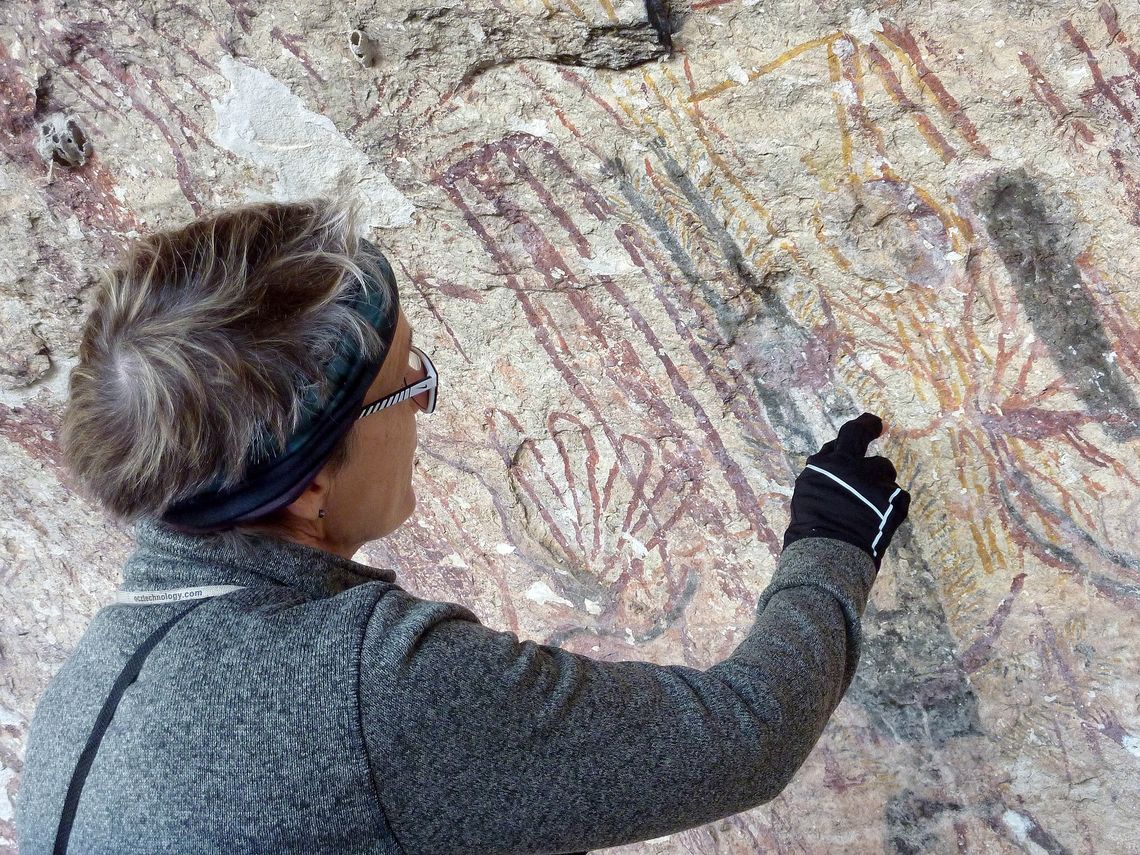
Research led by a team from Texas State University has uncovered significant findings regarding the Pecos River rock art, dating back approximately 6,000 years. The study reveals that the intricate imagery found in these rock paintings influenced the belief systems of several Mesoamerican cultures, marking a major advancement in our understanding of ancient cosmology.
The research team included Karen Steelman, Ph.D., from the Shumla Archaeological Research and Education Center, Carolyn Boyd, Ph.D., the Shumla Endowed Research Professor in the Department of Anthropology at Texas State, and Phil Dering, Ph.D., an associated faculty member in the same department. Their findings are detailed in the journal Science Advances under the title “Mapping the chronology of an ancient cosmovision: 4000 years of continuity in Pecos River style mural painting and symbolism.”
Boyd emphasized the significance of their work, stating, “We have securely dated one of the most distinctive rock art traditions in the world — the Pecos River style murals of Southwest Texas.” The team employed 57 radiocarbon dates from 12 sites, revealing that Indigenous communities began painting these vibrant murals nearly 6,000 years ago and continued this tradition for over 4,000 years.
The Pecos River style murals, often referred to as pictographs, were created by forager societies in southwest Texas and northern Mexico. These multi-colored artworks are found in limestone rock shelters and depict a variety of humanlike, animal-like, and geometric figures arranged in purposeful compositions. Some of these murals extend to lengths of over 100 feet and heights of 20 feet, benefiting from the region’s arid climate that has preserved them remarkably well.
Contrary to previous assumptions that these expansive murals evolved over centuries, the radiocarbon dating provided a different narrative. “Another huge shocker is that the dates within many of the murals clustered so closely as to be statistically indistinguishable, suggesting that they were produced during a single painting event as a visual narrative,” Boyd noted. This challenges the long-held belief that the murals represented a random collection of images accumulated over extensive periods.
The research team utilized advanced techniques, including plasma oxidation and accelerator mass spectrometry, to obtain their 57 direct radiocarbon dates along with 25 indirect oxalate dates. Bayesian modeling estimates indicate that the Pecos River style began between 5,760 and 5,385 years ago and likely ceased between 1,370 and 1,035 years ago.
Stratigraphic and iconographic analyses revealed that eight of the murals conformed to a set of artistic rules and an established iconographic vocabulary. This suggests that the messages conveyed through these artworks remained consistent, even amid changes in material culture, land use, and climate conditions.
According to the researchers, the Pecos River style paintings form part of a cultural keystone landscape that communicated complex metaphysical concepts. These ideas later influenced Mesoamerican agricultural societies. Boyd elaborated, “The compositional nature of the murals was further supported by our analysis of the painting sequence.” Using a digital microscope, the team retraced the original artists’ techniques, discovering a systematic approach to color application that created sophisticated compositions.
Boyd expressed excitement about the implications of the findings, stating, “Today, Indigenous communities in the U.S. and Mexico can relate the stories communicated through the imagery to their own cosmologies.” This connection underscores the longevity of a shared belief system that has persisted for over 6,000 years.
The Pecos River region, described by Boyd as a vast and ancient library of painted texts, holds an incredible record of 175 generations of sacred stories and Indigenous knowledge. The fusion of art and archaeology in this research not only enhances our understanding of ancient cultures but also enriches contemporary dialogues about heritage and identity.

Bears Dominate Browns 31-3; Myles Garrett Nears Sack Record

Nonprofit Sector in New York: A Double-Edged Sword for Workers

Research Reveals Impact of Gender Bias on Scientific Progress

Philip Rivers Returns to NFL Action with Colts Against Seahawks

U.S. Rabbis Strengthen Security After Deadly Sydney Hanukkah Attack

Macaulay Culkin and Chris Columbus Reveal Home Alone Sequel Ideas

Wayfair Offers Millwood Pines Lift-Top Coffee Table at 54% Off

Macaulay Culkin and Chris Columbus Explore New Ideas for Home Alone Sequel

Major Study Reveals Urgent Risks of Cancer Immunotherapy Side Effects

Ohio State Study Uncovers Brain Connectivity and Function Links

Hamas Chief Stresses Disarmament Tied to Occupation’s End

University of Hawaiʻi Joins $25.6M AI Project for Disaster Monitoring

ALMA Discovers Companion Orbiting Giant Star π 1 Gruis

Megan Thee Stallion Exposes Alleged Online Attack by Bots

Researchers Challenge 200-Year-Old Physics Principle with Atomic Engines

Paloma Elsesser Shines at LA Event with Iconic Slicked-Back Bun

FDA Unveils Plan to Cut Drug Prices and Boost Biosimilars

Innovator Captures Light at 2 Billion Frames Per Second
-
 Science2 months ago
Ohio State Study Uncovers Brain Connectivity and Function Links
-
 Politics2 months ago
Hamas Chief Stresses Disarmament Tied to Occupation’s End
-
Science1 month ago
University of Hawaiʻi Joins $25.6M AI Project for Disaster Monitoring
-
 Science1 month ago
ALMA Discovers Companion Orbiting Giant Star π 1 Gruis
-
 Entertainment2 months ago
Megan Thee Stallion Exposes Alleged Online Attack by Bots
-
 Science2 months ago
Researchers Challenge 200-Year-Old Physics Principle with Atomic Engines
-
 Entertainment2 months ago
Paloma Elsesser Shines at LA Event with Iconic Slicked-Back Bun
-
 World2 months ago
FDA Unveils Plan to Cut Drug Prices and Boost Biosimilars
-
 Science2 months ago
Innovator Captures Light at 2 Billion Frames Per Second
-

 Top Stories2 months ago
Federal Agents Detain Driver in Addison; Protests Erupt Immediately
-

 Business2 months ago
Motley Fool Wealth Management Reduces Medtronic Holdings by 14.7%
-

 Entertainment2 months ago
Beloved Artist and Community Leader Gloria Rosencrants Passes Away