
Science
New Antibody Therapy 77A Enhances Immune Response Against Cancers

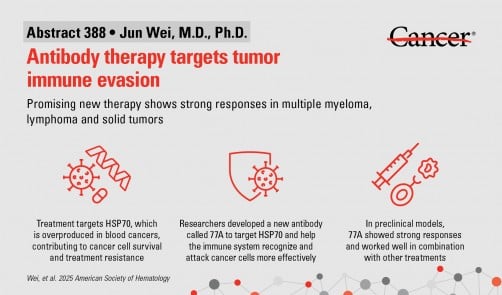
Researchers at The University of Texas MD Anderson Cancer Center have developed a promising new antibody therapy, known as 77A, which shows potential in enhancing immune responses against various forms of cancer, including blood cancers like myeloma and lymphoma, as well as solid tumors. The findings were presented by Jun Wei, M.D., Ph.D., during the 67th American Society of Hematology (ASH) Annual Meeting on December 6, 2025.
The investigational therapy 77A works by targeting HSP70, a heat shock protein that aids tumor cells in evading the immune system. This protein is often overproduced in certain cancers, creating a hostile environment for immune responses and promoting cancer cell survival. By converting HSP70 into an immune system trigger, 77A activates T cells and natural killer (NK) cells, which are crucial for combating tumors.
In laboratory studies, 77A significantly enhanced the effectiveness of existing treatments, including chemotherapy, radiation therapy, and immunotherapies. The therapy demonstrated strong antitumor effects across multiple tumor types, indicating its potential as a versatile addition to cancer treatment protocols.
Robert Z. Orlowski, M.D., Ph.D., who served as the principal investigator, expressed optimism about the implications of the research, stating, “These results give us confidence that 77A could become a versatile immunotherapy.” The next step involves advancing a humanized version of the antibody into clinical trials to evaluate its effectiveness in patients suffering from various cancers.
The initial results with human immune cells have been promising, suggesting that 77A could enhance immune responses in healthy donors. These developments set the stage for further clinical investigations, as researchers aim to explore the full potential of this treatment modality.
The study was supported by Blood Cancer United (formerly known as the Leukemia & Lymphoma Society), highlighting the importance of collaboration in advancing cancer research. A complete list of collaborating authors and their disclosures can be found alongside the abstract presented at ASH.
As researchers continue to refine the 77A therapy, the medical community remains hopeful that it could represent a significant advancement in immunotherapy, offering new hope to patients battling resistant forms of cancer.

Verdigris Falls to Holland Hall: First-Round Playoff Defeat

Judge Approves Release of Epstein Case Records in Landmark Ruling

Research Team Analyzes Hydration Impact at Boston Marathon

49ers Aim for Playoffs: Key Strategy to Secure NFC’s Top Seed

Bali Arrests Sex Worker Bonnie Blue and Associates in Police Raid

Barista of the Year: How One Employee Stands Out at Biggby

Iconic Game Show ‘The Wheel’ Launches Live Performances in Sarasota

Stocks Fluctuate as Market Faces New Challenges on December 10

Judge Orders Trump to Halt California National Guard Troop Deployment

Ohio State Study Uncovers Brain Connectivity and Function Links

Hamas Chief Stresses Disarmament Tied to Occupation’s End

University of Hawaiʻi Joins $25.6M AI Project for Disaster Monitoring

Megan Thee Stallion Exposes Alleged Online Attack by Bots

ALMA Discovers Companion Orbiting Giant Star π 1 Gruis

Researchers Challenge 200-Year-Old Physics Principle with Atomic Engines

Paloma Elsesser Shines at LA Event with Iconic Slicked-Back Bun

FDA Unveils Plan to Cut Drug Prices and Boost Biosimilars

Motley Fool Wealth Management Reduces Medtronic Holdings by 14.7%
-
 Science1 month ago
Ohio State Study Uncovers Brain Connectivity and Function Links
-
 Politics1 month ago
Hamas Chief Stresses Disarmament Tied to Occupation’s End
-
Science1 month ago
University of Hawaiʻi Joins $25.6M AI Project for Disaster Monitoring
-
 Entertainment1 month ago
Megan Thee Stallion Exposes Alleged Online Attack by Bots
-
 Science4 weeks ago
ALMA Discovers Companion Orbiting Giant Star π 1 Gruis
-
 Science2 months ago
Researchers Challenge 200-Year-Old Physics Principle with Atomic Engines
-
 Entertainment1 month ago
Paloma Elsesser Shines at LA Event with Iconic Slicked-Back Bun
-
 World1 month ago
FDA Unveils Plan to Cut Drug Prices and Boost Biosimilars
-
 Business1 month ago
Motley Fool Wealth Management Reduces Medtronic Holdings by 14.7%
-

 Top Stories1 month ago
Federal Agents Detain Driver in Addison; Protests Erupt Immediately
-

 Entertainment1 month ago
Beloved Artist and Community Leader Gloria Rosencrants Passes Away
-

 Science2 months ago
Innovator Captures Light at 2 Billion Frames Per Second