
Science
Mars Time Dilation: Scientists Reveal How We Age Faster on the Red Planet

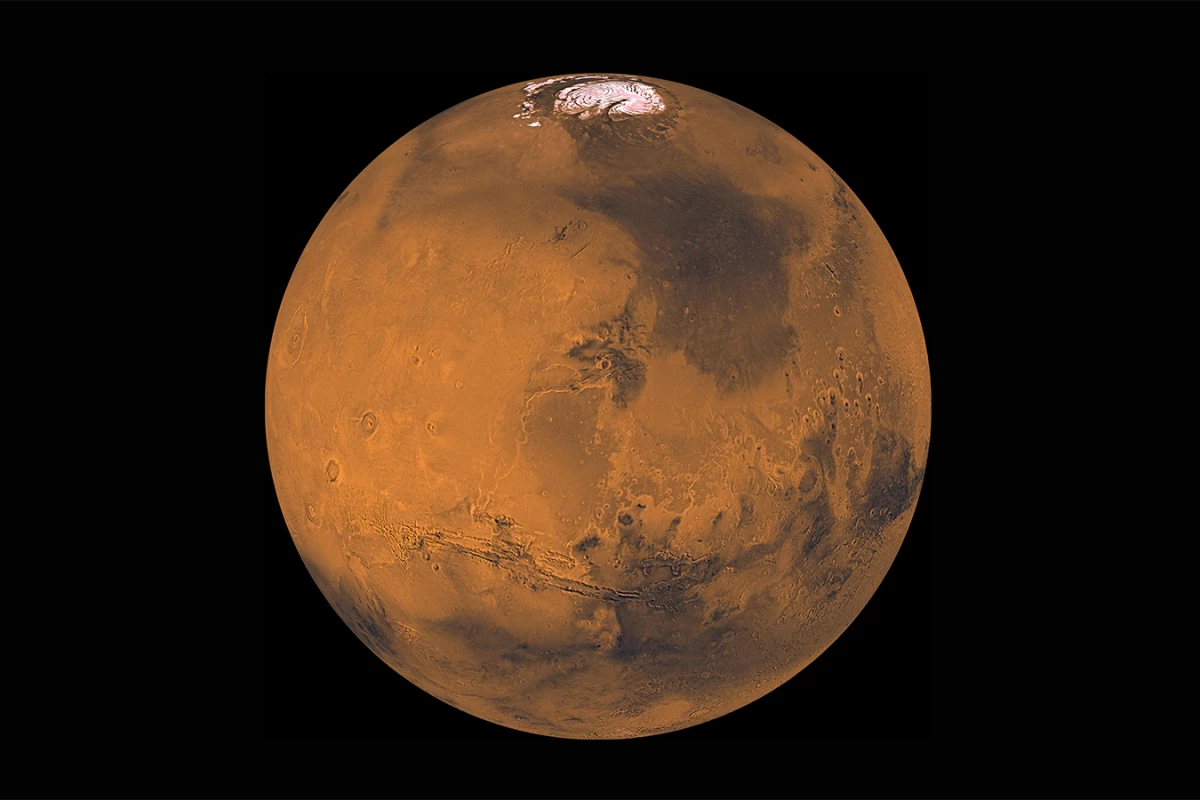
Scientists have revealed that time on Mars passes at a rate that could significantly impact future missions and potential human colonization. According to research from the National Institute of Standards and Technology (NIST), individuals on Mars would age approximately 477 microseconds faster each day compared to those on Earth, a finding rooted in Albert Einstein’s Theory of Relativity.
Understanding Time Dilation on Mars
Time dilation, a concept that has fascinated scientists and writers alike, describes how time is not a constant but is influenced by speed and gravity. On Earth, we experience time uniformly, but this changes when considering celestial bodies. In a well-known fictional example, Robert Heinlein‘s novel Time for the Stars illustrates how a twin traveling at near light speed ages slower than his sibling remaining on Earth. This phenomenon underlines the complexities of time as described by Einstein.
The effects of time dilation become particularly relevant in practical applications like GPS technology. Initially, scientists underestimated the impact of time dilation on GPS satellites, which orbit the Earth at about 28,000 km/h. Research by GPS pioneer Neil Ashby demonstrated that satellites experience time differently, running approximately 7 microseconds faster each day than clocks on Earth due to their speed, while also gaining an additional 45 microseconds daily due to reduced gravitational pull. This results in a net increase of 38 microseconds per day, necessitating corrections to avoid navigational errors.
Complex Calculations for Martian Time
The situation on Mars presents even more challenges. The research team, led by Ashby and Bijunath Patla, identified that calculating time differences on Mars is a more intricate task than for the Moon, which is primarily influenced by the gravitational effects of the Earth and the Sun. Mars, however, complicates matters because it is a factor in its own gravitational field and travels in a more elliptical orbit.
Their findings indicate that time on Mars not only runs 477 microseconds faster per day but also includes a fluctuation of 266 microseconds throughout its year. This fluctuation is due to Mars’ varying speed as it orbits the Sun, making corrections essential for any potential human presence or missions on the planet.
Correcting for time discrepancies on Mars is not as straightforward as adjusting GPS clocks. If unaddressed, calculations could be off by as much as 89 miles (143 kilometers) daily. The implications for communication systems, potentially an “internet of the Solar System,” are significant. As Ashby noted, “It’s good to know for the first time what is happening on Mars timewise. Nobody knew that before. It improves our knowledge of the theory itself, the theory of how clocks tick and relativity.”
This research not only sheds light on the implications of time dilation for future Mars missions but also contributes to a deeper understanding of the fundamental principles of relativity. As human exploration of Mars advances, understanding these time complexities will be crucial for navigation and communication.
These findings were published in The Astronomical Journal, marking an important step in our understanding of time as we venture further into space.

NASA Loses Contact with Maven Mars Spacecraft After 10 Years

Major Renovations Completed at MSP Airport’s Terminal 1

Joe Buck Receives Frick Award, Becomes First Father-Son Duo Honored

Tens of Thousands March Against Government in Bulgaria Protests

Krispy Kreme Unveils $1 Dozen Doughnuts for One Day Only

Khalid Announces 2026 Tour with Austin Concert on June 19

New York Times Defends Reporting on Trump’s Health Amid Criticism

Ohio Homeless Services Face Funding Cuts Amid Rising Demand

New Rules Require Social Media Scrutiny for Visa-Free Travelers

Ohio State Study Uncovers Brain Connectivity and Function Links

Hamas Chief Stresses Disarmament Tied to Occupation’s End

University of Hawaiʻi Joins $25.6M AI Project for Disaster Monitoring

Megan Thee Stallion Exposes Alleged Online Attack by Bots

ALMA Discovers Companion Orbiting Giant Star π 1 Gruis

Researchers Challenge 200-Year-Old Physics Principle with Atomic Engines

Paloma Elsesser Shines at LA Event with Iconic Slicked-Back Bun

FDA Unveils Plan to Cut Drug Prices and Boost Biosimilars

Motley Fool Wealth Management Reduces Medtronic Holdings by 14.7%
-
 Science1 month ago
Ohio State Study Uncovers Brain Connectivity and Function Links
-
 Politics1 month ago
Hamas Chief Stresses Disarmament Tied to Occupation’s End
-
Science1 month ago
University of Hawaiʻi Joins $25.6M AI Project for Disaster Monitoring
-
 Entertainment1 month ago
Megan Thee Stallion Exposes Alleged Online Attack by Bots
-
 Science4 weeks ago
ALMA Discovers Companion Orbiting Giant Star π 1 Gruis
-
 Science2 months ago
Researchers Challenge 200-Year-Old Physics Principle with Atomic Engines
-
 Entertainment1 month ago
Paloma Elsesser Shines at LA Event with Iconic Slicked-Back Bun
-
 World1 month ago
FDA Unveils Plan to Cut Drug Prices and Boost Biosimilars
-
 Business1 month ago
Motley Fool Wealth Management Reduces Medtronic Holdings by 14.7%
-

 Top Stories1 month ago
Federal Agents Detain Driver in Addison; Protests Erupt Immediately
-

 Entertainment1 month ago
Beloved Artist and Community Leader Gloria Rosencrants Passes Away
-

 Science2 months ago
Innovator Captures Light at 2 Billion Frames Per Second