
Science
Astronomers Decode the Mysteries of Cosmic ‘Radio Relics’

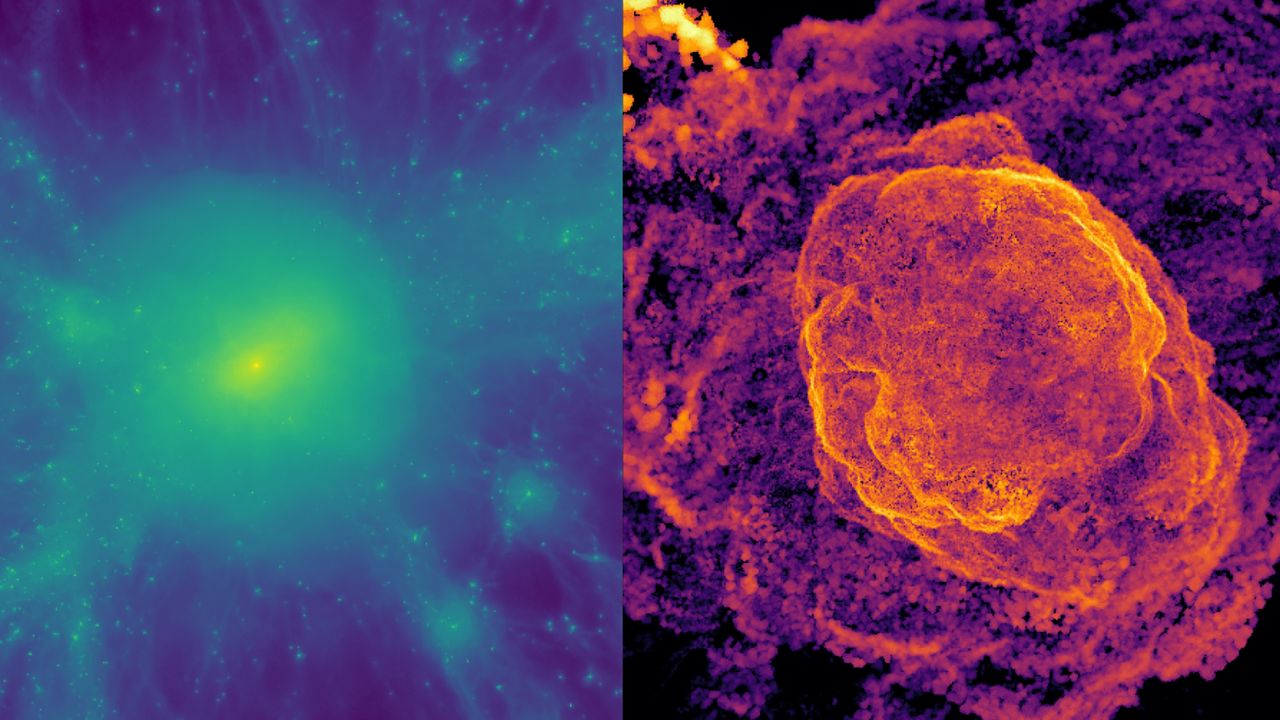
At the heart of cosmic exploration, astronomers have made significant strides in understanding the enigmatic structures known as “radio relics.” These ghostly arcs, formed from immense shock waves during the collision of galaxy clusters, stretch across millions of light-years and emit diffuse radio emissions. Despite their discovery and cataloging by researchers, their underlying mechanics have long posed a challenge to scientific understanding.
New research led by the Leibniz Institute for Astrophysics Potsdam (AIP) in Germany provides clarity on this subject. By employing high-resolution simulations, the team successfully modeled the formation and evolution of radio relics, elucidating the puzzling behaviors previously observed. Their findings promise to enhance the understanding of these cosmic phenomena.
Understanding the Formation of Radio Relics
The study’s lead author, Joseph Whittingham, a postdoctoral researcher at AIP, emphasized the importance of utilizing a multi-scale approach. The researchers conducted a series of cosmological simulations that modeled the growth and collision of galaxy clusters over billions of years. They examined a particularly powerful merger between two galaxy clusters, one approximately 2.5 times heavier than the other. This collision generated massive shock waves that extended nearly 7 million light-years across.
From these initial findings, the team created higher-resolution “shock-tube” simulations. This allowed them to isolate and track the intricate physics of a single shock wave as it interacted with the turbulent outskirts of the merging clusters. The results provided insight into how electrons are accelerated at the shock front, offering a clearer picture of the resultant radio emissions detectable by telescopes.
The simulations revealed that as shock waves propagate through galaxy clusters, they encounter other shocks created by cold gas falling from the cosmic web. This interaction leads to the compression of plasma into dense sheets, which collide with smaller gas clumps, generating turbulence. This turbulence amplifies magnetic field strengths to levels that align with observational data, addressing one of the key mysteries surrounding radio relics.
Resolving Longstanding Discrepancies
The research also clarified discrepancies observed in X-ray and radio measurements of these structures. The study noted that when shock waves sweep across dense gas clumps, certain regions of the shock front are enhanced, leading to efficient electron acceleration. These bright patches dominate the radio emissions, while X-ray telescopes measure the average strength of the shock, including its weaker regions. This explains the inconsistencies that astronomers have grappled with for years.
Moreover, the simulations indicated that only the most potent, localized areas of the shock front contribute significantly to the radio emissions. This finding reassures astronomers that the lower average strengths inferred from X-ray observations do not undermine the physics governing radio relics.
The implications of this research extend beyond mere academic interest. The successful modeling of radio relics offers a foundation for future investigations into similar cosmic structures. Christoph Pfrommer, a co-author of the study at AIP, expressed optimism about the potential to address remaining mysteries surrounding these phenomena.
The findings from this study have been accepted for publication in the journal Astronomy & Astrophysics and were made available on the preprint repository arXiv on November 18, 2023. As astronomers continue to unravel the complexities of the universe, studies like this represent important steps toward a deeper understanding of cosmic processes.

Women in HVACR and Carrier Offer $55,000 in Scholarships

Defense Tech Funding Surges to Record $7.7 Billion in 2025

49ers Dominate Browns 26-8 with Strong Air Attack in Cleveland

FDA Issues Warning on Lead-Contaminated Cookware, Urges Discarding

Riyadh to Host Global Labor Market Conference on January 26-27

Exciting New Movie Trailers: Anticipation Builds for 2024 Releases

UWS Hockey and Basketball Teams Face Tough Losses in Recent Games

Urgent Need Grows for Foster Homes as 470 Kids Await Care

Fed Chair Powell to Speak Tonight, No Policy Insights Expected

Ohio State Study Uncovers Brain Connectivity and Function Links

Hamas Chief Stresses Disarmament Tied to Occupation’s End

Megan Thee Stallion Exposes Alleged Online Attack by Bots

University of Hawaiʻi Joins $25.6M AI Project for Disaster Monitoring

Researchers Challenge 200-Year-Old Physics Principle with Atomic Engines

Paloma Elsesser Shines at LA Event with Iconic Slicked-Back Bun

FDA Unveils Plan to Cut Drug Prices and Boost Biosimilars

Federal Agents Detain Driver in Addison; Protests Erupt Immediately

Motley Fool Wealth Management Reduces Medtronic Holdings by 14.7%
-
 Science1 month ago
Ohio State Study Uncovers Brain Connectivity and Function Links
-
 Politics1 month ago
Hamas Chief Stresses Disarmament Tied to Occupation’s End
-
 Entertainment1 month ago
Megan Thee Stallion Exposes Alleged Online Attack by Bots
-
Science4 weeks ago
University of Hawaiʻi Joins $25.6M AI Project for Disaster Monitoring
-
 Science2 months ago
Researchers Challenge 200-Year-Old Physics Principle with Atomic Engines
-
 Entertainment1 month ago
Paloma Elsesser Shines at LA Event with Iconic Slicked-Back Bun
-
 World1 month ago
FDA Unveils Plan to Cut Drug Prices and Boost Biosimilars
-
 Top Stories1 month ago
Federal Agents Detain Driver in Addison; Protests Erupt Immediately
-
 Business1 month ago
Motley Fool Wealth Management Reduces Medtronic Holdings by 14.7%
-

 Entertainment1 month ago
Beloved Artist and Community Leader Gloria Rosencrants Passes Away
-

 Science2 weeks ago
ALMA Discovers Companion Orbiting Giant Star π 1 Gruis
-

 Politics1 month ago
NHP Foundation Secures Land for 158 Affordable Apartments in Denver