
Science
Ancient Pottery Reveals Advanced Math Concepts Over 8,000 Years Ago

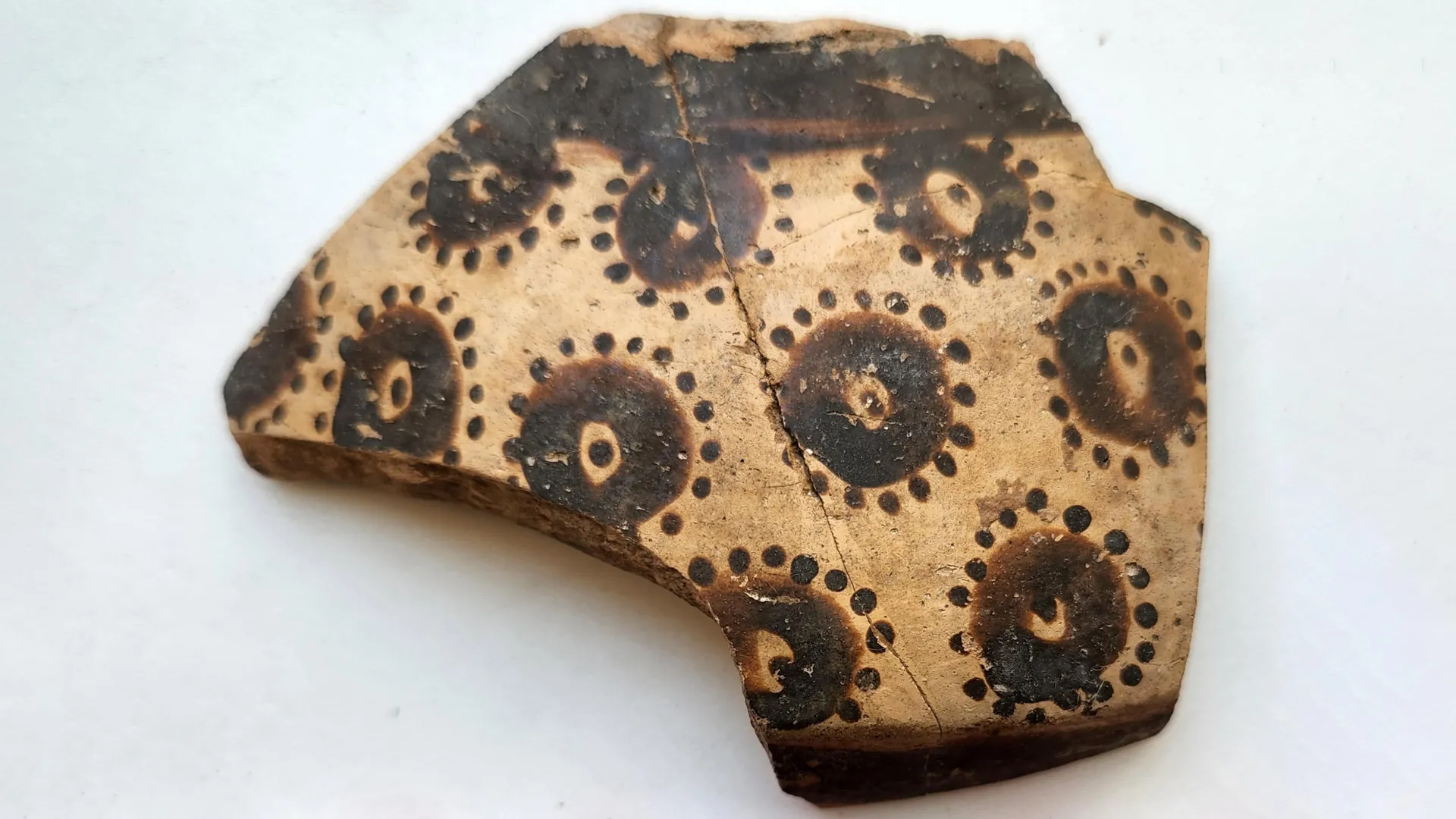
Researchers have uncovered evidence that early farming communities in northern Mesopotamia were engaging in mathematical thinking over 8,000 years ago, well before the advent of written numbers. A study conducted by experts from the Hebrew University of Jerusalem highlights intricate designs on Halafian pottery that reveal a sophisticated understanding of geometry and numerical patterns.
This research, published in the Journal of World Prehistory, indicates that some of the earliest artistic representations of plants served a dual purpose. While these designs were visually appealing, they also reflect early mathematical concepts. Prof. Yosef Garfinkel and researcher Sarah Krulwich traced the consistent use of plant imagery in human art back to the Halafian culture, which thrived between 6200 and 5500 BCE.
Significant Findings in Prehistoric Art
The study examined artifacts from 29 archaeological sites, revealing that early artists carefully arranged floral motifs with striking symmetry. Unlike earlier periods that focused predominantly on animals and human figures, Halafian pottery introduced plants as central themes in artistic expression. The researchers documented hundreds of plant designs, some realistic and others abstract, but all demonstrating intentional composition.
“The pottery represents a pivotal moment in history where people chose to portray the botanical world as worthy of artistic attention,” the authors noted. This shift in focus is linked to the development of village life and a heightened appreciation for aesthetics and symmetry.
Mathematical Precision in Floral Arrangements
One of the most intriguing aspects of the study involves the numerical patterns evident in the floral designs. Many bowls feature flowers arranged in sequences, such as 4, 8, 16, 32, and even 64 petals. The researchers argue these patterns were deliberately designed, showcasing an ability to conceptualize space and symmetry long before the establishment of written numerical systems.
Prof. Garfinkel explained, “The ability to divide space evenly, reflected in these floral motifs, likely had practical roots in daily life, such as sharing harvests or allocating communal fields.” This insight contributes to the emerging field of ethnomathematics, which examines how mathematical ideas manifest through cultural practices and artistic traditions.
The variety of plant motifs identified in the pottery is extensive, but notably, none depict edible plants. This absence suggests that the designs were not intended to document agricultural practices or rituals. Instead, the preference for flowers may indicate an association with positive emotional responses, enhancing their appeal as decorative subjects.
The findings challenge conventional understandings of the origins of mathematics. While written records of mathematical concepts appear much later in Sumer, the Halafian pottery provides evidence of an intuitive form of mathematical reasoning. This reasoning was based on visual organization, symmetry, and repetition rather than written symbols.
As Krulwich stated, “These patterns show that mathematical thinking began long before writing. People visualized divisions, sequences, and balance through their art.” By systematically documenting these plant-based designs, the research sheds light on how early societies perceived their environment and organized communal spaces, revealing complex cognitive abilities that predate formal mathematics.
The study offers a fresh perspective on the intersection of art and mathematics, emphasizing that the roots of mathematical reasoning are deeply intertwined with human creativity and cultural expression.

AP Showcases Today’s Top Photos Capturing Urgent Moments

Sarasota County Acquires 3.59-Acre WCIND Land in Urgent Move

Amazon Driver Caught Stealing Cat in Lakewood, CA – Family Devastated

Urgent Update: U.S.-China Trade Deal Stabilizes Rare Earth Supply

Trump Faces Criticism Over Response to Reiner’s Tragic Murder

Ancient Pottery Reveals Advanced Math Concepts Over 8,000 Years Ago

Celebrini Shines as Sharks Secure 6-3 Victory Over Flames

Coventry Restaurant Fined After Salmonella Outbreak in 2024

Asian Markets React as Trump Imposes Oil Tanker Blockade on Venezuela

Ohio State Study Uncovers Brain Connectivity and Function Links

University of Hawaiʻi Joins $25.6M AI Project for Disaster Monitoring

Hamas Chief Stresses Disarmament Tied to Occupation’s End

ALMA Discovers Companion Orbiting Giant Star π 1 Gruis

Megan Thee Stallion Exposes Alleged Online Attack by Bots

Researchers Challenge 200-Year-Old Physics Principle with Atomic Engines

Paloma Elsesser Shines at LA Event with Iconic Slicked-Back Bun

Innovator Captures Light at 2 Billion Frames Per Second

F-22 Raptor vs. Su-57 Felon: A 2025 Fighter Jet Comparison
-
 Science2 months ago
Ohio State Study Uncovers Brain Connectivity and Function Links
-
Science1 month ago
University of Hawaiʻi Joins $25.6M AI Project for Disaster Monitoring
-
 Politics2 months ago
Hamas Chief Stresses Disarmament Tied to Occupation’s End
-
 Science1 month ago
ALMA Discovers Companion Orbiting Giant Star π 1 Gruis
-
 Entertainment2 months ago
Megan Thee Stallion Exposes Alleged Online Attack by Bots
-
 Science2 months ago
Researchers Challenge 200-Year-Old Physics Principle with Atomic Engines
-
 Entertainment2 months ago
Paloma Elsesser Shines at LA Event with Iconic Slicked-Back Bun
-
 Science2 months ago
Innovator Captures Light at 2 Billion Frames Per Second
-
 World2 months ago
F-22 Raptor vs. Su-57 Felon: A 2025 Fighter Jet Comparison
-

 World2 months ago
FDA Unveils Plan to Cut Drug Prices and Boost Biosimilars
-

 Business2 months ago
Motley Fool Wealth Management Reduces Medtronic Holdings by 14.7%
-

 Top Stories2 months ago
Federal Agents Detain Driver in Addison; Protests Erupt Immediately