
World
James Webb Telescope May Have Discovered New Class of Star

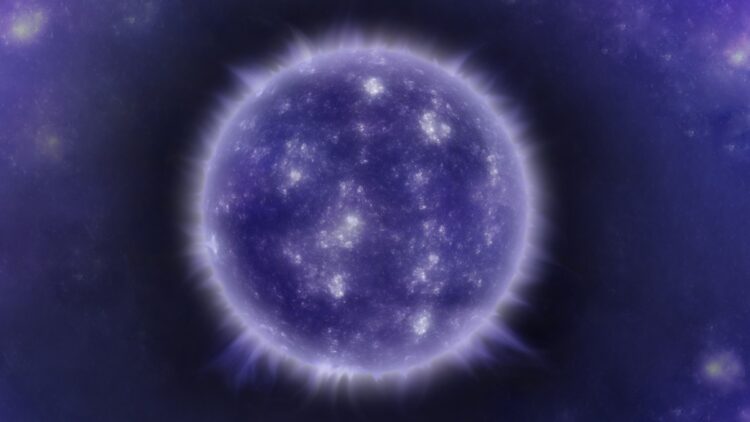
A team of researchers has potentially identified a new class of celestial object known as a supermassive dark star, using data from the James Webb Space Telescope (JWST). This breakthrough discovery, if confirmed, could significantly advance our understanding of physics and cosmology by addressing long-standing questions about the nature of the universe.
Researchers detected what they describe as the “smoking gun” evidence of a dark star, which operates with a core composed of dark matter particles that interact with one another. This finding is particularly noteworthy, as it represents the first indication of a dark star through light absorption at a wavelength of 1,640 Angstroms, a characteristic linked to dark stars and arising from ionized helium in their atmospheres. According to Cosmin Ilie, an astrophysicist at Colgate University in the United States, this marks a significant milestone in cosmic exploration.
Understanding Dark Stars
The term “dark star” can be misleading; these objects are not devoid of light. Instead, they are massive, fluffy clouds primarily made up of hydrogen and helium, functioning entirely differently from conventional stars. Unlike the Sun, which generates energy through nuclear fusion, dark stars rely on dark matter particles that self-annihilate to resist gravitational collapse. Ilie elaborated, stating, “Supermassive dark stars are extremely bright, gigantic, and fluffy clouds composed mainly of hydrogen and helium, which resist gravitational collapse thanks to the minimal amounts of dark matter that self-annihilate within them.”
Through the JWST, scientists have managed to identify four of the most distant objects recorded in the universe, all showing traits consistent with dark stars. Among these, one exhibited a distinct light absorption feature at 1,640 Angstroms, directly correlated with dark star characteristics. Ilie noted that while the signal-to-noise ratio of this feature is relatively low, it represents the first potential signal of a dark star, which is, in itself, extraordinary.
The Implications of Discovery
This research underscores the challenges faced by scientists in observing the early universe and identifying unknown cosmic entities. The JWST’s findings suggest the presence of massive objects in large galaxies that had not yet fully developed, providing a foundation for the dark star hypothesis. These stars could have masses equivalent to 1 million suns and may appear similar to galaxies. Among the four objects studied, one appears to be a concentrated light source, while the others are more diffuse, indicating they may be dark stars enveloped by clouds of ionized hydrogen and helium.
Confirming the existence of dark stars could answer pivotal questions regarding the nature of dark matter and its interactions, as well as shed light on the formation of early supermassive black holes. While further observations are necessary to verify the identities of these celestial bodies, the initial findings suggest a potential shift in our understanding of the universe and its fundamental laws. The researchers conclude that, regardless of the ultimate classification of these objects, their existence could redefine current theories in physics.

Eurozone Manufacturing PMI Dips to 49.6 in Urgent Update

Im Si Wan’s New Photos Ignite Fierce Online Debate, 42K Views

Meg Ryan’s “Empowered” Series Tackles Addiction Recovery Insights

Mastering Workplace Gift-Giving: Tips for Coworkers This Season

Public Reactions to Epstein Scandal, Political Hypocrisy, and Playwright’s Death

Supercar Sells for Record $20.6 Million at Las Vegas Auction

Broncos Secure Overtime Victory as Bonitto Shines in Clutch Moment

Hong Kong Fire Recovery Efforts Intensify as Search Nears End

Urgent Holiday Gift Guide: Win Over Coworkers with Perfect Presents

Ohio State Study Uncovers Brain Connectivity and Function Links

Hamas Chief Stresses Disarmament Tied to Occupation’s End

Megan Thee Stallion Exposes Alleged Online Attack by Bots

University of Hawaiʻi Joins $25.6M AI Project for Disaster Monitoring

Researchers Challenge 200-Year-Old Physics Principle with Atomic Engines

Paloma Elsesser Shines at LA Event with Iconic Slicked-Back Bun

FDA Unveils Plan to Cut Drug Prices and Boost Biosimilars

Federal Agents Detain Driver in Addison; Protests Erupt Immediately

Motley Fool Wealth Management Reduces Medtronic Holdings by 14.7%
-
 Science1 month ago
Ohio State Study Uncovers Brain Connectivity and Function Links
-
 Politics1 month ago
Hamas Chief Stresses Disarmament Tied to Occupation’s End
-
 Entertainment1 month ago
Megan Thee Stallion Exposes Alleged Online Attack by Bots
-
Science4 weeks ago
University of Hawaiʻi Joins $25.6M AI Project for Disaster Monitoring
-
 Science2 months ago
Researchers Challenge 200-Year-Old Physics Principle with Atomic Engines
-
 Entertainment1 month ago
Paloma Elsesser Shines at LA Event with Iconic Slicked-Back Bun
-
 World1 month ago
FDA Unveils Plan to Cut Drug Prices and Boost Biosimilars
-
 Top Stories1 month ago
Federal Agents Detain Driver in Addison; Protests Erupt Immediately
-
 Business1 month ago
Motley Fool Wealth Management Reduces Medtronic Holdings by 14.7%
-

 Entertainment1 month ago
Beloved Artist and Community Leader Gloria Rosencrants Passes Away
-

 Politics1 month ago
NHP Foundation Secures Land for 158 Affordable Apartments in Denver
-

 Science2 weeks ago
ALMA Discovers Companion Orbiting Giant Star π 1 Gruis