
Science
Webb Telescope Discovers Oldest Supernova in Cosmic History

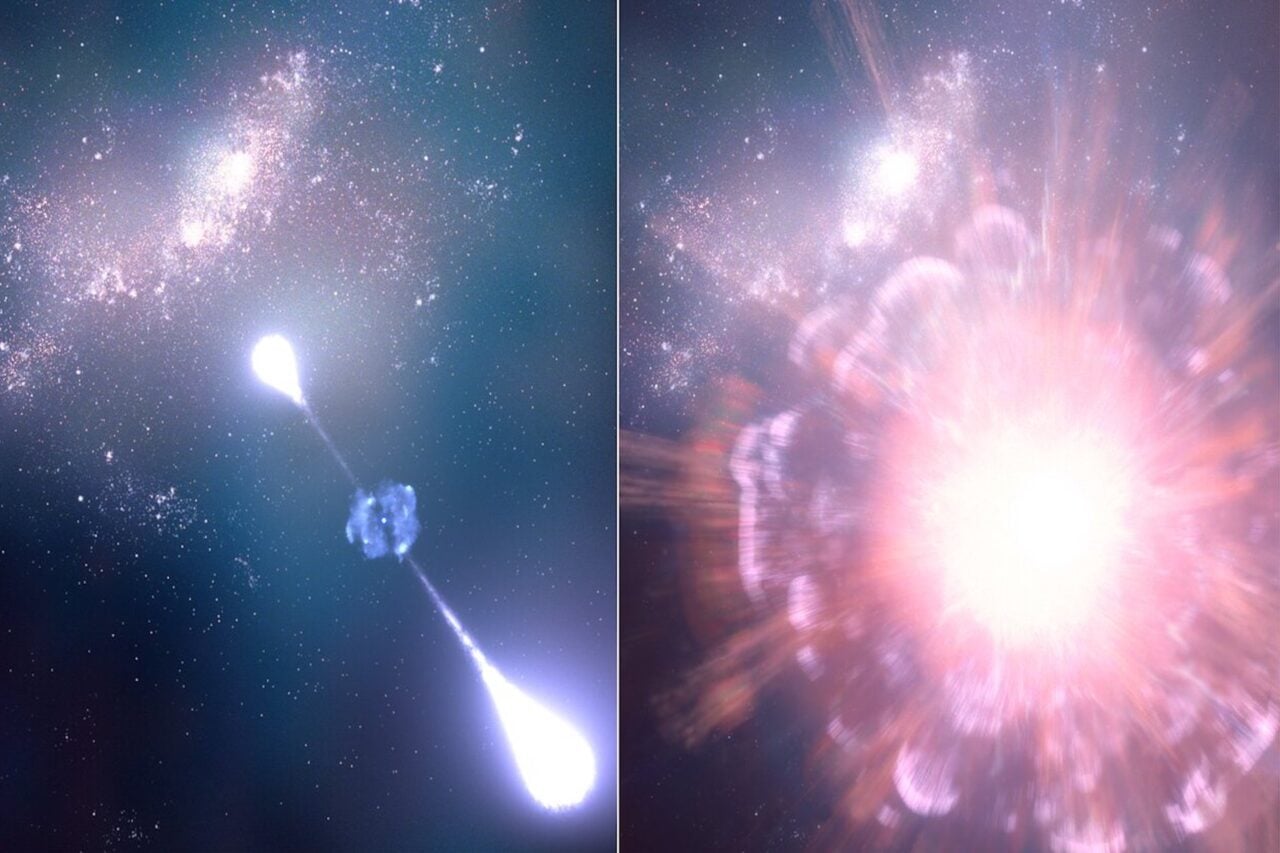
A groundbreaking discovery has emerged from the James Webb Space Telescope, which has traced a powerful gamma-ray burst back to the earliest known supernova ever observed. This stellar explosion occurred when the universe was just 730 million years old, significantly earlier than any previously recorded supernova, which occurred 1.8 billion years after the Big Bang.
The event was initially detected on March 14, 2023, by the SVOM mission, a space-based observatory designed to monitor variable astronomical objects. Almost immediately, three other telescopes were employed to pinpoint the origin of the gamma-ray burst. The findings were confirmed by the Webb telescope on July 1, 2023, marking a significant milestone in our understanding of the early universe.
Andrew Levan, a professor of astrophysics at Radboud University in the Netherlands and the lead author of a study published in Astronomy and Astrophysics Letters, highlighted the importance of this observation. “Only Webb could directly show that this light is from a supernova,” he stated. “This observation also demonstrates that we can use Webb to find individual stars when the Universe was only 5% of its current age.”
Significance of the Discovery
Gamma-ray bursts, which typically last only a few seconds, are among the most energetic events in the universe. They may result from the collision of neutron stars or between a neutron star and a black hole. The gamma-ray burst in question lasted for an extraordinary 10 seconds, indicating it was likely caused by the explosive death of a massive star.
This particular supernova is rare, with Levan noting that there have been only a handful detected from the first billion years of the universe within the last half-century. “This particular event is very rare and very exciting,” he remarked.
Observations conducted by the Webb telescope revealed that the supernova’s brightness increased over a few weeks, making it easier to identify. The light from this ancient event, however, was affected by the expansion of the universe, causing it to stretch over time. Consequently, it took longer for the light to reach Earth.
Comparative Analysis with Modern Supernovae
Upon studying the supernova, astronomers compared it to more recent explosions closer to Earth. Surprisingly, they found that this ancient supernova bears a striking resemblance to its modern counterparts. Stars in the early universe had fewer heavy elements and were generally more massive, suggesting they should exhibit different characteristics.
“We went in with open minds,” said Nial Tanvir, a professor at the University of Leicester and co-author of the study. “And lo and behold, Webb showed that this supernova looks exactly like modern supernovae.”
The research team plans to leverage the capabilities of the Webb telescope further to observe the afterglow of distant gamma-ray bursts. This data will provide insights into the evolution of galaxies and the conditions in the early universe. “That glow will help Webb see more and give us a ‘fingerprint’ of the galaxy,” noted Levan.
The findings from this unprecedented observation not only push the boundaries of our cosmic knowledge but also illustrate the evolving capabilities of space telescopes to explore the universe’s history. As research continues, the James Webb Space Telescope promises to unlock even more mysteries of the cosmos.

Mrs. Claus for a Cause Returns to Montrose: Free Event Dec. 19-21

Putin Offers Security Guarantees for Ukraine in Urgent Talks

Ukraine Proposes Peace Plan to Trump as Tensions Over Territory Persist

Unemployment Claims Rise to 236,000 as Continuing Benefits Decline

Absolute Joker Takes Over Batman’s Iconic Life in Shocking Twist

Discover the Eyelash Growth Serum Transforming Beauty Routines

Time Names “Architects of AI” as 2025 Person of the Year

Homeland Security Secretary Noem Faces Intense Scrutiny Today

Absolute Joker Claims Batman’s Manor in Shocking Twist

Ohio State Study Uncovers Brain Connectivity and Function Links

Hamas Chief Stresses Disarmament Tied to Occupation’s End

University of Hawaiʻi Joins $25.6M AI Project for Disaster Monitoring

Megan Thee Stallion Exposes Alleged Online Attack by Bots

ALMA Discovers Companion Orbiting Giant Star π 1 Gruis

Researchers Challenge 200-Year-Old Physics Principle with Atomic Engines

Paloma Elsesser Shines at LA Event with Iconic Slicked-Back Bun

FDA Unveils Plan to Cut Drug Prices and Boost Biosimilars

Federal Agents Detain Driver in Addison; Protests Erupt Immediately
-
 Science1 month ago
Ohio State Study Uncovers Brain Connectivity and Function Links
-
 Politics2 months ago
Hamas Chief Stresses Disarmament Tied to Occupation’s End
-
Science1 month ago
University of Hawaiʻi Joins $25.6M AI Project for Disaster Monitoring
-
 Entertainment1 month ago
Megan Thee Stallion Exposes Alleged Online Attack by Bots
-
 Science4 weeks ago
ALMA Discovers Companion Orbiting Giant Star π 1 Gruis
-
 Science2 months ago
Researchers Challenge 200-Year-Old Physics Principle with Atomic Engines
-
 Entertainment1 month ago
Paloma Elsesser Shines at LA Event with Iconic Slicked-Back Bun
-
 World1 month ago
FDA Unveils Plan to Cut Drug Prices and Boost Biosimilars
-
 Top Stories2 months ago
Federal Agents Detain Driver in Addison; Protests Erupt Immediately
-

 Business1 month ago
Motley Fool Wealth Management Reduces Medtronic Holdings by 14.7%
-

 Entertainment1 month ago
Beloved Artist and Community Leader Gloria Rosencrants Passes Away
-

 Science2 months ago
Innovator Captures Light at 2 Billion Frames Per Second