
Science
Researchers Uncover Prehistoric Elephant Footprints in Spain

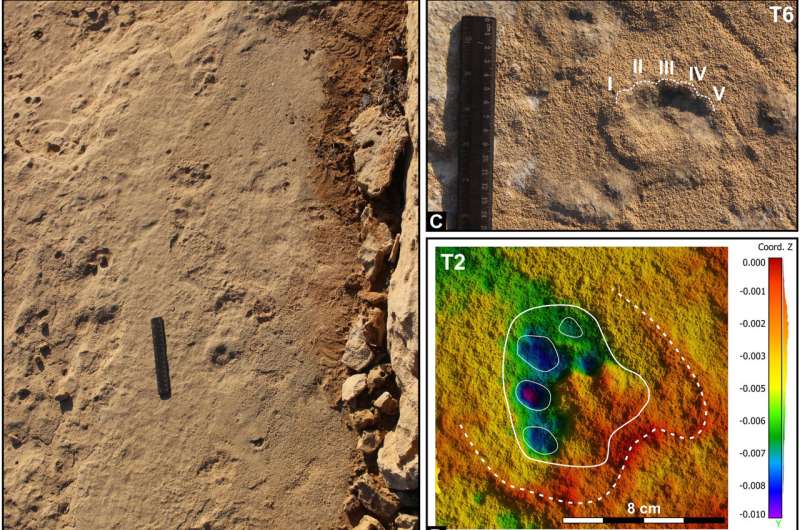
An international research team has identified the first fossilized footprints of the Quaternary period in the coastal dunes of Murcia, Spain. These footprints, attributed to the Palaeoloxodon antiquus, commonly known as the straight-tusked elephant, provide a significant glimpse into the movement of megafauna during the Last Interglacial, approximately 125,000 years ago. The findings were published on December 17, 2025, in the journal Quaternary Science Reviews.
The research, titled “New vertebrate footprint sites in the latest interglacial dune deposits on the coast of Murcia (southeast Spain). Ecological corridors for elephants in Iberia?”, highlights the ecological significance of these coastal landscapes. The study was coordinated by Carlos Neto de Carvalho from the Geology Office of Idanha-a-Nova and the University of Lisbon. Collaborating researchers included Fernando Muñiz Guinea and Miguel Cortés-Sánchez from the University of Seville, as well as Francisco J. Jiménez Espejo and Jon Camuera from the Andalusian Institute of Earth Sciences in Granada. Experts from Portugal, including Noel Moreira and João Belo, also contributed to the research.
The study confirmed four distinct areas within the coastal ecosystem that contain fossil footprints, showcasing a diverse range of mammals that thrived during the marine isotopic stage (MIS 5e). The most notable discovery occurred at Torre de Cope, where a 2.75-meter-long trackway of the proboscidean was found. This trackway features four rounded footprints, each measuring between 40-50 cm in diameter, indicative of an adult Palaeoloxodon antiquus. Researchers estimate this elephant stood around 2.3 meters tall at the hip, weighed approximately 2.6 tonnes, and was over 30 years old.
In addition to elephant tracks, the research team identified footprints from a medium-sized mustelid in Calblanque, measuring 1.5 meters in length. The arrangement of ten circular footprints hints at slow movements near water sources. Isolated footprints of a canid, measuring 10 × 8 cm and bearing claw marks, further suggest the presence of predators such as wolves (Canis lupus). Additionally, bifid footprints compatible with red deer (Cervus elaphus) were documented, indicating movement through the coastal dunes and scrubland. Notably, the trail of a young equid (Equus ferus) was also recorded, marking the most recent evidence of this species in the southeastern region of the peninsula.
This research supports the hypothesis of ecological corridors along the coast, which may have facilitated seasonal migrations between Mediterranean forests and coastal areas during a time of enhanced humidity. The findings not only shed light on the habits of ancient wildlife but also contribute to understanding the environmental landscape of the region.
The coastal corridors identified in Murcia prompt a reevaluation of the Iberian Peninsula’s role during the Pleistocene. The area may have served as a climate refuge for various species while acting as a migration route for large mammals, including elephants. The study connects these coastal corridors to paleoanthropology, suggesting a geographical link between the movement of elephants in southeastern Iberia and known Neanderthal sites, indicating these areas were rich in resources vital for both humans and megafauna.
This groundbreaking research underscores the importance of fossil records in reconstructing past ecosystems and enhances our understanding of the interactions between ancient species and their environments. The findings provide a valuable context for future studies aimed at exploring the evolutionary history of both fauna and early human populations in the region.

Urgent Rescue: Great Dane Mix Saved from Euthanasia Today

Urgent Discovery: 20,000 Dinosaur Footprints Found Near 2026 Olympics

Rev. Jesse Jackson Launches Operation PUSH: A Historic Announcement

Gradient Investments Acquires 477,013 Shares in Kinder Morgan

James Cameron’s New Avatar Film Set to Capture Box Office Glory

Study Reveals Genetic Links Between Roommates and Gut Microbes

Twinkly Awards 2025: Celebrating Central Florida’s Best Holiday Displays

FBI’s Dan Bongino Announces Departure; Oscars Move to YouTube

Research Reveals 74% of Western US Faces Wildfire Risks

Ohio State Study Uncovers Brain Connectivity and Function Links

University of Hawaiʻi Joins $25.6M AI Project for Disaster Monitoring

ALMA Discovers Companion Orbiting Giant Star π 1 Gruis

Hamas Chief Stresses Disarmament Tied to Occupation’s End

Megan Thee Stallion Exposes Alleged Online Attack by Bots

F-22 Raptor vs. Su-57 Felon: A 2025 Fighter Jet Comparison

Innovator Captures Light at 2 Billion Frames Per Second

Paloma Elsesser Shines at LA Event with Iconic Slicked-Back Bun

Researchers Challenge 200-Year-Old Physics Principle with Atomic Engines
-
 Science2 months ago
Ohio State Study Uncovers Brain Connectivity and Function Links
-
Science2 months ago
University of Hawaiʻi Joins $25.6M AI Project for Disaster Monitoring
-
 Science1 month ago
ALMA Discovers Companion Orbiting Giant Star π 1 Gruis
-
 Politics2 months ago
Hamas Chief Stresses Disarmament Tied to Occupation’s End
-
 Entertainment2 months ago
Megan Thee Stallion Exposes Alleged Online Attack by Bots
-
 World2 months ago
F-22 Raptor vs. Su-57 Felon: A 2025 Fighter Jet Comparison
-
 Science2 months ago
Innovator Captures Light at 2 Billion Frames Per Second
-
 Entertainment2 months ago
Paloma Elsesser Shines at LA Event with Iconic Slicked-Back Bun
-
 Science2 months ago
Researchers Challenge 200-Year-Old Physics Principle with Atomic Engines
-

 World2 months ago
FDA Unveils Plan to Cut Drug Prices and Boost Biosimilars
-

 Business2 months ago
Motley Fool Wealth Management Reduces Medtronic Holdings by 14.7%
-

 Top Stories2 months ago
Federal Agents Detain Driver in Addison; Protests Erupt Immediately